.png)
Key Takeaways
- North Texas expansive clay can swell up to 15% in volume after heavy rain, creating unstable ground that bogs down wheeled equipment and stalls production.
- CAT compact track loaders exert roughly 4.5 PSI of ground pressure compared to 25-40 PSI from wheeled skid steers, making tracks the clear choice for saturated black gumbo.
- Caliche rock layers typically appear at 4 to 8 feet depth across Denton County and Collin County, requiring hydraulic breakers or heavy-class excavators to penetrate.
- Scheduling grading and excavation during drier months (June through September) reduces clay-related delays by an estimated 30-40% on North Texas job sites.
- Our customers working sites from Aubrey to Prosper consistently report that the CAT 320 with a straight-edge bucket handles saturated clay better than any comparable machine in its class.
Anyone who has broken ground north of Fort Worth understands that the dirt here does not behave like dirt anywhere else. The dark, sticky clay that locals call black gumbo dominates the soil profile from Denton south through Argyle and east through McKinney, Frisco, Celina, and Prosper. This expansive clay creates conditions that test operators, wear down undercarriages, and turn simple grading jobs into multi-day ordeals if you bring the wrong equipment.
At Benchmark Equipment, we have supplied excavators, compact track loaders, and attachments to hundreds of job sites across these communities. We have watched operators lose half a day winching a wheeled skid steer out of a mudhole that formed overnight after a two-inch rain. We have also watched the right machine on the right tracks move through that same soil without breaking stride. The difference comes down to understanding what black gumbo actually is and selecting equipment that works with its properties instead of fighting them.
What Makes North Texas Black Gumbo So Difficult to Work In?
Black gumbo is a high-plasticity clay classified primarily as the Houston Black series in the USDA Web Soil Survey. These soils belong to the Vertisol order, a classification reserved for clays with extreme shrink-swell behavior. The dominant mineral is montmorillonite, which absorbs water molecules between its plate-like layers and expands significantly. According to the USDA Natural Resources Conservation Service (NRCS), Vertisols cover approximately 2.4% of the Earth's ice-free land surface, and North Texas sits within one of the largest concentrations in North America.
The plasticity index (PI) measures how much water a soil can absorb before transitioning from semi-solid to liquid. Black gumbo in Denton and Collin counties typically registers a PI between 35 and 60. Any soil with a PI above 30 is considered highly expansive by the Texas Department of Transportation (TxDOT). This means the clay can swell up to 15% by volume after prolonged rainfall and then shrink back, opening surface cracks 2 to 4 inches wide and several feet deep during dry spells.
Moisture content drives every aspect of working in this soil. At roughly 15-20% moisture, black gumbo becomes workable. Above 30% moisture, the clay transforms into a heavy, adhesive mass that sticks to buckets, clogs tracks, and builds up on undercarriages. Below 10% moisture, the clay hardens to near-concrete consistency and resists bucket penetration without significant breakout force.
Which Excavators Handle Black Gumbo Best?
Excavator selection for black gumbo projects depends on the depth of cut, the moisture state of the soil, and whether you will encounter the caliche layer underneath.
The CAT 320 is the most popular excavator we rent for residential and light commercial earthwork in Denton, Aubrey, and Celina. At approximately 22 metric tons operating weight, the 320 provides enough breakout force (roughly 30,000 pounds with a standard bucket) to cut through dry, hardened clay while remaining transportable on a standard lowboy trailer. We recommend pairing the 320 with a clean-out bucket or a straight-edge ditching bucket when working saturated gumbo because the flatter profile releases clay more easily than a general-purpose tooth bucket.
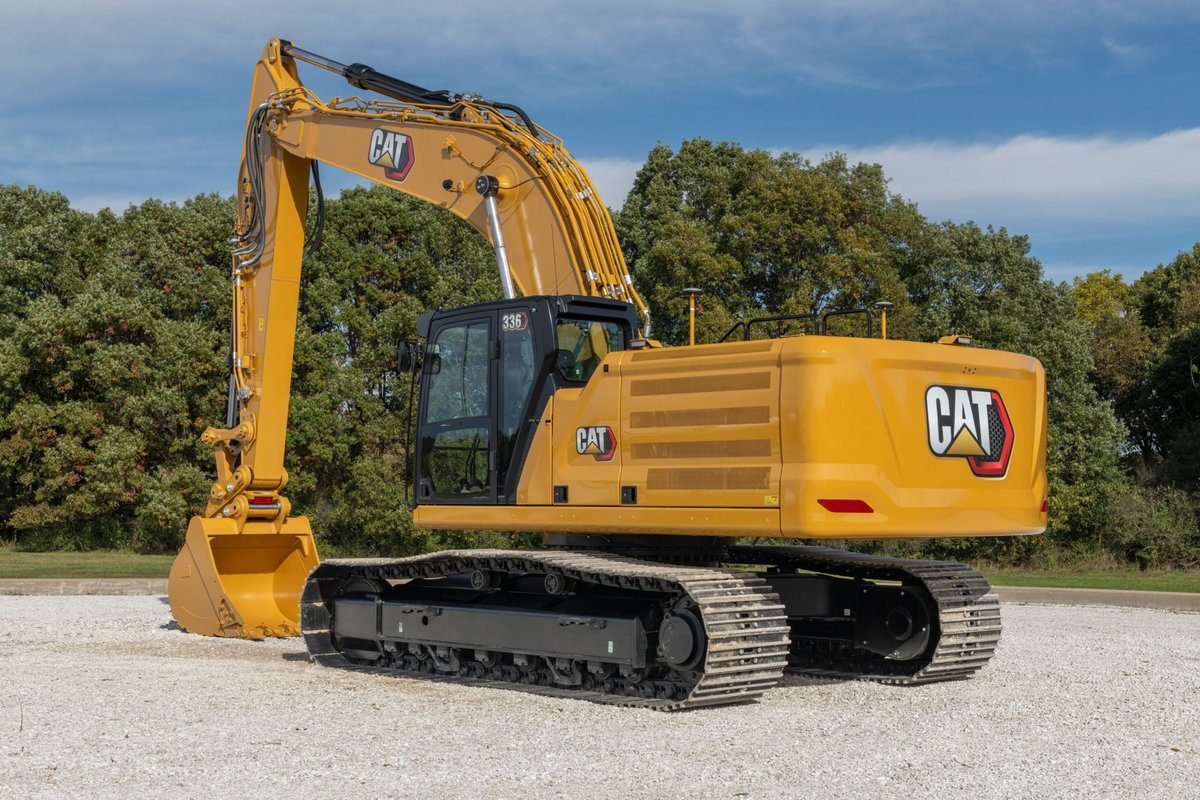
The CAT 336 steps up to approximately 36 metric tons and becomes the right choice when projects require deeper excavation into the caliche layer. Across much of Denton County and into Prosper and McKinney, contractors hit caliche rock at depths between 4 and 8 feet. Research from the Bureau of Economic Geology at The University of Texas confirms that caliche formations across the Blackland Prairie can reach several feet in thickness, requiring substantial mechanical force to remove.
The CAT 313 fills a niche for utility work and tighter residential lots where a full-size excavator cannot maneuver. At roughly 14 metric tons, the 313 offers a smaller footprint while still providing adequate breakout force for clay excavation. Contractors working infill lots in Frisco and McKinney find the 313 productive without the access complications of larger machines.
Why Do Compact Track Loaders Outperform Wheeled Machines in Clay?
Ground pressure is the single most important factor determining whether a machine stays productive or gets stuck in saturated black gumbo. A standard wheeled skid steer concentrates its full operating weight across four small tire contact patches, producing ground pressure between 25 and 40 PSI. A compact track loader distributes that same weight across the full length of its tracks, reducing ground pressure to approximately 4 to 5 PSI.
We see this play out constantly on job sites across Argyle, Aubrey, and the rapidly developing corridors between Celina and Prosper. A wheeled machine will perform adequately on a Monday morning after a dry week. By Wednesday afternoon, after an overnight thunderstorm drops an inch of rain, that same machine is spinning tires and cutting ruts 8 inches deep. Meanwhile, a CAT compact track loader working the same site maintains traction and keeps moving material. According to OSHA's excavation and trenching guidelines, unstable soil conditions require additional safety precautions, and maintaining stable equipment footing is fundamental to safe operations.
Track maintenance increases in clay conditions. Black gumbo packs into the track frame, around idlers, and between grousers. Left uncleaned, this buildup adds hundreds of pounds of parasitic weight and accelerates wear on rollers and sprockets. We advise our customers to hose down or scrape undercarriages at the end of every shift when working in gumbo. Texas A&M AgriLife Extension's soil management resources provide additional technical guidance on the behavior of expansive clay soils throughout the Blackland Prairie region.
How Does Moisture Content Affect Scheduling and Equipment Choices?
Experienced contractors in North Texas plan their earthwork calendars around soil moisture as carefully as they plan around concrete pours and steel deliveries.
During the wetter months of March through May and again in October and November, soil moisture levels frequently exceed 30%. At these levels, compaction testing becomes unreliable because the clay cannot achieve target density without first drying. Excavated material sticks to everything and will not discharge cleanly from buckets. Hauling wet gumbo adds 20-30% more weight per truck load compared to the same volume of dry material.
The drier months from June through September offer the best window for mass grading and cut-fill operations. However, extremely dry conditions (below 10% moisture) present their own challenge—hardened clay resists bucket penetration and can require pre-ripping with a dozer. The Texas Commission on Environmental Quality (TCEQ) also regulates dust control on construction sites, so bone-dry clay that generates excessive dust during disturbance requires water application.
Our recommendation: schedule rough grading for summer months, keep compact track loaders on standby for wet-condition material handling, and size your excavator one class larger than you would for sandy or loamy soil conditions.
What Should You Know About Caliche Layers Below the Clay?
Many contractors new to North Texas are surprised when their excavator bucket hits something hard at 5 or 6 feet. That layer is caliche, a naturally cemented calcium carbonate deposit that formed over thousands of years. Caliche thickness and hardness vary considerably even within a single site. On some parcels in west Denton County and around Argyle, the caliche is a loose, gravelly layer that a CAT 320 can rip through. On other parcels closer to the limestone formations east of Fort Worth, the caliche approaches the hardness of soft concrete and requires a hydraulic breaker to fracture.
Geotechnical reports for sites in this region almost always note the depth to caliche and its unconfined compressive strength. If the geotech report shows caliche at 6 feet with compressive strength above 1,500 PSI, plan on using a CAT 336 with a breaker attachment. Attempting to force a mid-size excavator through dense caliche damages bucket teeth, stresses hydraulic cylinders, and dramatically increases fuel consumption.
Caliche does have one advantage: once you excavate through it, the material below is typically more stable, less expansive clay or weathered limestone. Foundation engineers often specify excavation through the gumbo layer and into caliche for pier-and-beam foundations precisely because caliche provides better bearing capacity.
How Can You Protect Equipment and Maximize Production on Clay Sites?
Bucket selection matters. Ditch-cleaning buckets and grading buckets with flat, smooth profiles release clay more readily than toothed digging buckets.
Manage your haul roads. Laying 6 to 8 inches of crushed limestone or recycled concrete on primary haul paths prevents trucks and loaders from churning the natural clay surface into impassable mud.
Monitor weather forecasts actively. A two-day dry window is often the minimum needed to allow the top 12 inches of clay to reach workable moisture levels after a rain.
Consider soil amendment. For areas that must be compacted during wet conditions, lime stabilization can reduce the plasticity index of black gumbo by 10 to 20 points. This technique is well-documented by Texas A&M AgriLife Extension and is standard practice for road subgrade preparation across the region.
Ready to Tackle Your Next North Texas Clay Project?
Our fleet includes low-hour CAT 313, 320, and 336 excavators, compact track loaders, and the attachments you need to handle both saturated clay and hardened caliche. We deliver across Denton, Aubrey, Celina, Prosper, McKinney, Frisco, Argyle, Fort Worth, and the surrounding North Texas region.
Call us at (817) 403-4334 to discuss your site conditions and get the right machine on your job.
Frequently Asked Questions
What is the best excavator for digging in North Texas black gumbo clay?
The CAT 320 is the most versatile excavator for black gumbo clay across North Texas. Its 22-metric-ton operating weight provides roughly 30,000 pounds of bucket breakout force, enough to cut through hardened dry clay while remaining stable on saturated ground. For projects requiring breaking through caliche layers at 4 to 8 feet depth, the CAT 336 offers the hydraulic power needed.
Should I use a wheeled skid steer or a compact track loader on clay soil?
Always choose a compact track loader over a wheeled skid steer for clay soil. Track loaders produce approximately 4.5 PSI of ground pressure compared to 25-40 PSI from wheeled machines. On saturated black gumbo, wheeled skid steers frequently sink and cut deep ruts that require regrading.
What is the caliche layer and why does it matter for excavation in Denton County?
Caliche is a naturally cemented calcium carbonate layer that sits beneath the black gumbo clay across much of Denton County at depths between 4 and 8 feet. Its hardness ranges from loose gravel to near-concrete consistency. Excavation projects that extend below the clay into caliche require heavier equipment such as the CAT 336 and may need hydraulic breaker attachments.
When is the best time of year to do earthwork in North Texas expansive clay?
June through September offers the best window for major earthwork in North Texas black gumbo clay. Scheduling earthwork during the drier summer months can reduce clay-related delays by 30-40% compared to the wet spring or fall seasons.