.png)
We've rented excavators and trench boxes to hundreds of utility contractors, plumbers, and civil crews across Denton, McKinney, Prosper, Celina, and the broader North Texas region. In that time, we've seen one consistent pattern: the crews who take OSHA trenching requirements seriously finish jobs on schedule with zero incidents. The ones who cut corners on protective systems don't always get a second chance to learn from it. Trenching is the most dangerous routine operation in construction—and it's also one of the most preventable sources of fatality when the rules are followed.
Key Takeaways
- Any trench 5 feet or deeper legally requires a protective system under OSHA 29 CFR 1926.652—no exceptions, even for short-duration work.
- North Texas expansive clay (black gumbo) and caliche rock formations significantly affect soil classification and required protection methods.
- A competent person must inspect every trench before workers enter and after any event that could affect trench stability, including rain.
- Trench collapses kill an average of 23 workers per year in the U.S.—a cubic yard of soil weighs approximately 2,700 to 3,000 pounds, equivalent to a full-size car.
- The right excavator size and bucket configuration directly impacts trench wall integrity; oversized machines cause unnecessary vibration and side-wall stress in DFW clay soils.
What Does OSHA Require for Trenching and Excavation Safety?
OSHA 29 CFR 1926 Subpart P is the governing standard for all trenching and excavation work in the United States, and it's more specific than many contractors realize. The regulation requires protective systems for trenches 5 feet or deeper in most soil types, and for any trench in unstable soil regardless of depth. There are three compliant protective system options: sloping the trench walls to a safe angle, installing a shoring system, or using a trench shield (commonly called a trench box).
Beyond the protective system itself, OSHA mandates that a designated competent person inspect the trench before each work shift, after any event that could increase hazard (rain, freezing temperatures, nearby heavy equipment operation), and as conditions change throughout the day. A competent person under OSHA's definition isn't just someone with experience—it's someone who has been formally trained to identify hazardous conditions and has the authority to stop work immediately. That distinction matters enormously on a job site where a foreman might have 20 years of experience but no formal training in soil classification.
Access and egress requirements are frequently overlooked. OSHA requires a ladder, stairway, or ramp within 25 feet of any worker in a trench 4 feet or deeper. We've watched inspectors write citations specifically for missing or inadequate egress on otherwise well-protected trench operations. The fine structure is tiered: serious violations run up to $15,625 per citation, while willful or repeat violations can reach $156,259 per violation.
How Does Soil Classification Affect Trench Protection Requirements?
Soil classification under OSHA's system—Type A, Type B, or Type C—determines the maximum allowable slope angle and directly impacts which protective methods are practical for a given job. Type A soil (the most stable, like cohesive clay with no fissures) allows a 3/4:1 slope ratio (53 degrees from horizontal). Type B allows 1:1, and Type C, the least stable, requires a 1.5:1 slope ratio. In practice, that means a 6-foot-deep trench in Type C soil needs walls sloped back 9 feet on each side—which makes sloping alone impractical for most urban utility work where right-of-way is tight.
Here in North Texas, soil classification is genuinely complex and often misread by crews accustomed to other regions. The expansive black clay—what locals call black gumbo—that dominates the DFW Metroplex and extends through Denton, Frisco, Little Elm, and Waxahachie is deceptive. In dry summer conditions, it can appear firm and cohesive, which might suggest Type A or Type B classification. But this same soil has extreme shrink-swell characteristics; the USDA Natural Resources Conservation Service classifies much of Dallas and Denton County soils in the highest shrink-swell risk categories. That means previous wet-dry cycles create tension cracks and fissuring that disqualify soil from Type A classification, pushing protection requirements to Type B or C standards even when the surface looks solid.
Then there's the caliche layer. Throughout the DFW area—and particularly in communities like Weatherford, Decatur, Gainesville, and the western portions of our service area—crews typically hit caliche rock formations at 4 to 8 feet of depth. Caliche is a calcite-cemented hardpan that registers significantly on a CAT 320 or 323 excavator's breakout force. This is actually a stabilizing factor for trench walls once you're into a solid caliche layer, but the transition zone between expansive clay above and caliche below can be particularly unstable. We advise customers working in that transition zone to default to trench box protection rather than relying on slope calculations alone.
What Are the Three Types of Trench Protective Systems and When Should You Use Each?
Sloping and benching works best in open areas where the project has adequate horizontal space and the soil classification supports it. For North Texas utility contractors working in new residential developments around Celina, Prosper, and Van Alstyne—where lots are large and ground conditions are relatively open—sloping is often the most cost-effective approach for shallow sewer laterals and water service connections under 6 feet. The tradeoff is spoil pile management: OSHA requires excavated material be kept at least 2 feet from the trench edge, and on a confined residential lot, that 2-foot setback matters.
Shoring systems—hydraulic or timber—are the right choice when you need to work in a tight trench footprint and the work requires extended time in the excavation. Hydraulic aluminum shoring is faster to install and adjust than timber and holds up well in the repeated wet-dry cycles North Texas experiences. However, shoring is not a shield; if a wall collapses, shoring prevents further movement but the initial failure can still injure workers. This is why shoring is best suited to stable Type A or Type B soils where failure risk is lower to begin with.
Trench boxes (shields) are the most common solution we see rented for North Texas utility work, and for good reason. A steel trench box doesn't prevent a wall collapse—it protects workers inside the shield if one occurs. For the Type B and Type C soil conditions that characterize most of the DFW clay belt, trench boxes provide the most reliable protection across variable conditions. We stock trench boxes in our Denton yard in multiple configurations, and our customers in Wichita Falls, Sherman, Denison, and Bowie regularly pull them for deep water line replacements and storm sewer installation. One critical detail our customers sometimes miss: the trench box must be moved with workers inside it as the pipe is laid—you should never have workers ahead of or behind the box in an unprotected zone.
How Do North Texas Weather Conditions Affect Trench Safety?
Summer heat in North Texas creates two distinct trench hazards that OSHA's base regulations don't fully address but that our operational experience makes impossible to ignore. First, the direct heat hazard: working in a trench during a 105-degree July afternoon in Mesquite or Irving is not the same as working in ambient temperature. Trenches concentrate heat and limit airflow, and OSHA's Heat Illness Prevention guidelines require employers to provide water, shade, and rest breaks—but in a trench environment, the practical implementation requires deliberate planning. We strongly recommend customers schedule trench work for early morning starts, particularly for confined-space trench operations deeper than 8 feet.
Second, and more structurally significant, summer heat accelerates the desiccation cracking in North Texas clay. During extended dry spells—which are common from June through September across Denton, Collin, and Tarrant counties—the black gumbo shrinks dramatically, creating vertical tension cracks that extend several feet below grade. These cracks are invisible from the surface but radically undermine soil classification. A trench opened in August through desiccated clay that visually appears Type A should be treated as Type C. We've talked with contractors who have done the same job with the same equipment for years and then experienced a wall failure they didn't see coming because they were using last spring's soil assessment in August conditions.
Winter freeze events present the opposite problem. When North Texas gets hard freezes—as we saw with the February 2021 event that affected the entire state—the shallow soil freezes and creates a false impression of stability. Frozen soil behaves rigidly, but when temperatures rise rapidly (a pattern common in North Texas spring transitions), that same soil can lose structural cohesion quickly. Any trench opened during a thaw period should be re-inspected constantly and treated with more conservative soil classification assumptions.
What Equipment Practices Reduce Trench Wall Instability?
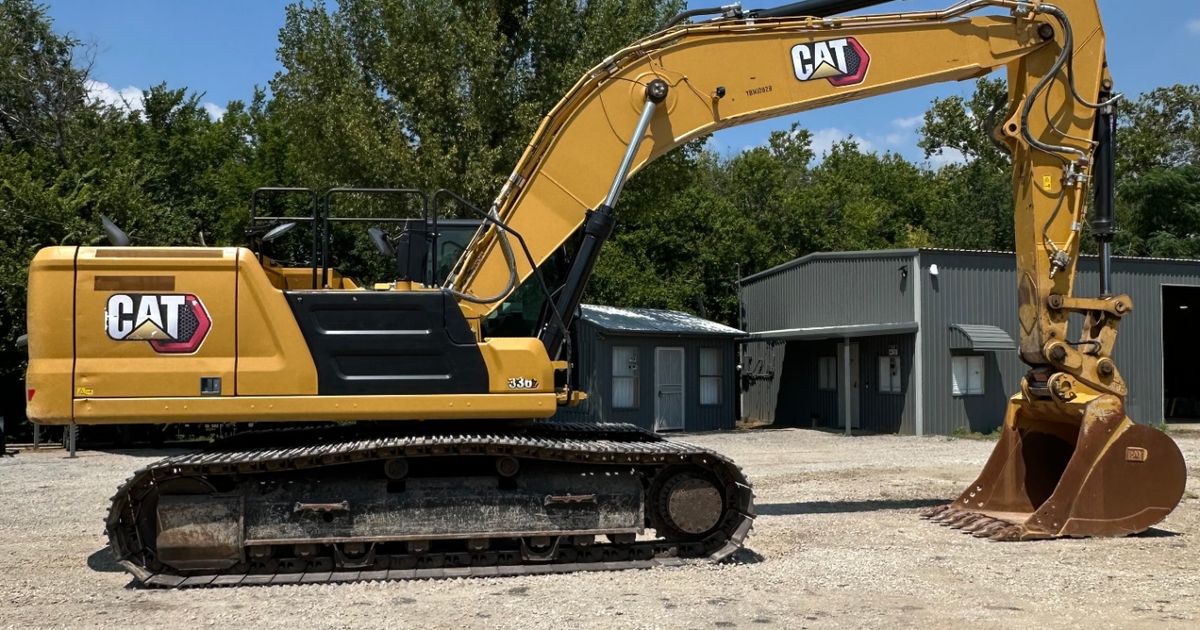
The excavator you put on a trenching job directly affects wall integrity, and this is an area where our fleet experience informs specific recommendations. Operating an oversized machine—say, putting a CAT 336 on a job that calls for a CAT 308 or 310—introduces unnecessary vibration and lateral loading on trench walls. The CAT 308 CR and CAT 310 compact excavators in our fleet are specifically suited to residential and urban utility trenching where working weight, track stance, and digging geometry minimize wall disturbance. CAT's compact excavator line provides sufficient breakout force for North Texas clay while keeping machine footprint—and trench wall stress—manageable.
Equipment positioning matters as much as equipment sizing. OSHA requires that equipment not be positioned where it could cause surcharge loading on trench walls—generally, keep equipment at least the depth of the trench away from the edge when soil conditions are variable. In DFW clay, we recommend erring on the conservative side of that guideline. We also recommend our customers avoid tracking equipment parallel to open trenches; the repetitive vibration of track pads running alongside an open cut in expansive clay accelerates micro-fracturing in the wall face.
Hydraulic performance matters in North Texas summers too. CAT excavators operating at sustained ambient temperatures above 100°F may show hydraulic response degradation if machines aren't properly serviced. Before any extended trenching project, confirm hydraulic fluid condition, check for proper cooling system function, and verify that the machine's load-sensing hydraulic system is calibrated correctly. A sluggish hydraulic response during trench box placement or shoring installation is a safety issue, not just a productivity one.
What Are the Most Commonly Cited OSHA Trenching Violations?
According to OSHA enforcement data, trenching and excavation citations consistently rank among the top construction violations nationally. The most frequently cited violations are: lack of any protective system (1926.652), failure to have a competent person on site (1926.651), inadequate egress (1926.651(c)), and excavated material or equipment positioned too close to the trench edge (1926.651(j)). What's striking about this list is that none of these violations require specialized equipment or significant cost to correct—they require planning, training, and enforcement of site protocols.
In our conversations with contractors across Denton, Frisco, Carrollton, and Fort Worth, the competent person requirement is the one that generates the most confusion. Many smaller contractors assume that their most experienced crew member qualifies automatically. OSHA is explicit that competent person status requires both training in hazard identification and the organizational authority to remove workers from danger. Formal competent person training is available through the Associated General Contractors of America and numerous regional safety organizations, and it's a one-time investment that protects both workers and the business from catastrophic liability.
If you're planning a utility installation, water line replacement, or any deep excavation project across North Texas, we're ready to help you spec the right equipment and protection system for your specific conditions. Call us at (817) 403-4334 to talk through your project—our team knows DFW soil conditions, and we stock trench boxes, compact excavators, and full-size machines ready to go from our Denton yard.
Frequently Asked Questions
At what depth does OSHA require a protective system for trenching?
OSHA 29 CFR 1926.652 requires a protective system for any trench 5 feet deep or greater in most soil conditions. For unstable soil, protection is required at any depth. Trenches 20 feet or deeper require a protective system designed by a registered professional engineer. Violations carry penalties up to $15,625 per serious citation.
What counts as a competent person for OSHA trenching inspections?
An OSHA competent person for trenching must have specific training in soil classification, identification of excavation hazards, and protective system requirements—and must have the authority to immediately stop work and remove workers from danger. Experience alone does not qualify someone as a competent person. Formal competent person training is available through organizations like the Associated General Contractors of America.
Is North Texas black clay considered Type A or Type B soil for OSHA trenching?
North Texas expansive clay (black gumbo) is frequently misclassified. While it may appear cohesive, its extreme shrink-swell characteristics cause tension cracking and fissuring that disqualify it from Type A classification under OSHA's soil classification system. Most DFW-area clay should be classified as Type B, and during dry summer conditions when desiccation cracking is present, Type C classification is appropriate. Always have a trained competent person make the on-site determination.
What is the difference between a trench box and shoring, and which should I use?
A trench box (shield) protects workers by containing a wall collapse after it occurs, while shoring systems (hydraulic or timber) physically support the trench walls to prevent collapse. Trench boxes are more commonly used in DFW-area utility work because they work in variable soil conditions and are faster to move as work progresses. Shoring is better suited to stable Type A or B soils where extended work is required. OSHA accepts both as compliant protective systems under 1926.652.
How far does excavated material need to be from the edge of a trench under OSHA rules?
OSHA 29 CFR 1926.651(j)(2) requires that excavated materials (spoil), equipment, and other surface encumbrances be kept at least 2 feet from the edge of any excavation. This setback prevents surcharge loading that can destabilize trench walls. In North Texas expansive clay, where soil can shift quickly, maintaining this setback is especially critical during temperature fluctuations and after rainfall events.