.png)
The question we get most often from residential developers calling us isn't "can you get me an excavator?" — it's "what do I actually need to move this project from raw land to pad-ready lots?" That's a fundamentally different question, and it deserves a real answer built on job site experience rather than a generic equipment checklist.
North Texas residential development is booming. From the rapid buildout in Celina and Prosper pushing north toward Gunter and Van Alstyne, to infill development across Denton, Argyle, and Aubrey, contractors are moving dirt on a scale we haven't seen in decades. And in this region specifically, the soil conditions, rock depths, and summer heat create a site prep challenge that's distinct from anywhere else in the country. What works on a Houston sand lot or an Austin limestone ridge doesn't automatically translate to a DFW black gumbo subdivision.
Key Takeaways
- A residential site prep package for North Texas developments typically includes 5-7 machines staged in sequence: dozer, excavator, motor grader, compactor, water truck, and often a skid steer for detail work
- North Texas black gumbo clay requires moisture conditioning before compaction — skipping this step causes subgrade failures that cost 3-5x more to fix than getting it right the first time
- Caliche rock formations typically hit between 4-8 feet deep across the DFW corridor, making a hydraulic hammer or rock auger attachment non-negotiable on most Denton, Celina, or Prosper subdivisions
- Summer heat above 100°F compresses productive grading hours to roughly 6 AM–1 PM for precision work, which affects how contractors schedule machine utilization and rental duration
- Sequencing your equipment properly can reduce total machine days by 20-30% compared to having all equipment on site simultaneously
What Equipment Do You Need to Start a Residential Development Site Prep?
The foundation of any residential site prep package is a tracked dozer — and in North Texas, that typically means a CAT D6 or D8 depending on acreage and tree cover. The D6T, with roughly 215 horsepower and a 6-way blade, handles most 50-200 lot subdivisions without breaking a sweat. For heavier clearing work with significant cedar, mesquite, or mature hardwood removal common on Denton County and Wise County tracts, the CAT D8T's added mass and 310-horsepower engine earns its spot on the trailer.
We've seen contractors try to stretch a smaller D5 across a 100-acre tract outside Decatur to save on rental cost. By day four, they were calling us for the D8 anyway — and they'd lost three days of production in the process. The savings rarely materialize when you're undersized for the job.
After clearing, rough grading is where the dozer shines. Modern CAT machines with integrated GPS grade control — available across our fleet — allow operators to hit design grades within 0.1 feet without a grade checker walking the site. On a 75-lot subdivision, that technology routinely saves 1-2 days of motor grader time on the back end.
What Size Excavator Do You Need for Residential Utility Trenching and Detention?
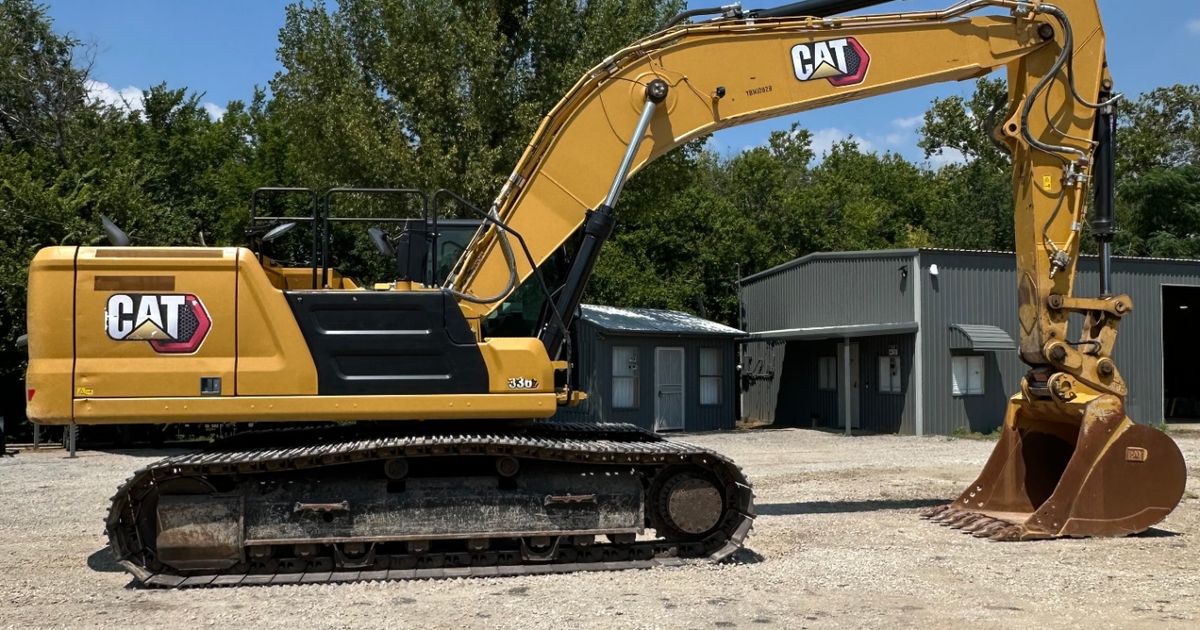
Utility trenching and detention pond excavation require a different machine entirely — and this is where North Texas soil conditions drive the spec conversation most aggressively. The CAT 320 excavator (roughly 20 metric tons, 159 horsepower) is the workhorse for residential utility work: water, sewer, storm drain, and gas line installation across standard residential lot depths. For detention basin excavation on developments with regional drainage requirements, or anywhere you're moving significant cubic yardage, the CAT 336 steps up with a 36-metric-ton frame and 295 horsepower.
Here's the North Texas-specific reality: that caliche layer sitting 4-8 feet deep across much of Collin County, Denton County, and into Tarrant County isn't going to yield to a standard bucket. When your utility trenches are hitting 8-12 feet for sewer grade, you're working through caliche with a rock bucket or hydraulic hammer for a meaningful portion of that trench. USGS geological surveys of the Cretaceous formations underlying much of the DFW Metroplex confirm this calcrete horizon is pervasive — it's not a site-specific anomaly, it's a regional condition you plan for, not around.
The CAT 320 with a hydraulic hammer attachment can fracture caliche effectively for most residential trench work. We recommend contractors budget for the hammer on any trench deeper than 5 feet across most of our service area from McKinney south through Frisco and west through Trophy Club and Weatherford.
How Does North Texas Clay Soil Affect Your Compaction Equipment Selection?
This is the question that separates contractors who build lasting subdivisions from those who get warranty calls two years after certificate of occupancy. North Texas black gumbo clay — the expansive Vertisol soils that dominate Denton, Dallas, Collin, and Tarrant counties — has a plasticity index that can exceed 50 in some formations. That means it shrinks dramatically when dry and swells significantly when wet, and standard compaction methods that work fine in other soil types produce unstable subgrades here.
The Texas Department of Transportation and most North Texas municipalities require lime stabilization for expansive clay subgrades, which means your equipment package needs to include a pulimixer or reclaimer, a water truck for lime slurry application, and a padfoot compactor for the lift after treatment. A CAT CS56B or similar smooth drum compactor handles finish rolling, but the padfoot drum is essential for the clay lifts themselves — the feet work into the cohesive material in a way smooth drums physically cannot.
Practically speaking, a residential development's compaction equipment package in our area typically runs: one padfoot vibratory compactor (CAT CP56B or equivalent), one smooth drum compactor for finish work, and a plate compactor or jumping jack for trench backfill. The water truck does double duty — moisture conditioning for compaction and dust suppression on hot days when the site dries out faster than you can work it. On DFW job sites in July and August, surface moisture can drop from acceptable to inadequate in under two hours. That's not an exaggeration; it's a job site condition our customers manage every summer.
What Role Does a Motor Grader Play in Residential Site Development?
The motor grader is the finish carpenter of your site prep package — it doesn't do the heavy lifting, but you can't finish without it. A CAT 140 or 160 motor grader with GPS machine control is the standard specification for residential subdivision pad preparation in North Texas. The 140 handles most work up to 200 lots efficiently; the 160's longer wheelbase and added horsepower earn their cost on larger tracts or when you're running extended straight grades on collector roads through the development.
What motor graders do that dozers simply cannot is maintain consistent cross-slope across lot pads and roadways. The American Society of Civil Engineers drainage requirements for residential pad grading typically specify 2% minimum cross-slope for positive drainage — tolerances that require the precision blade control only a motor grader delivers. On a subdivision with 80 lots, each requiring correct pad elevation and cross-slope before a builder can pour a foundation, the motor grader is the machine that determines whether your project passes inspection on the first walk or requires rework.
Do You Need a Skid Steer on a Residential Development Site?
In most other parts of the country, a skid steer is optional on a residential development. In North Texas, treat it as standard equipment. The CAT 262D3 or 272D3 skid steer with a rock auger attachment handles the caliche that stops hand digging completely — mailbox post holes, sign foundations, light pole bases, and landscaping excavation all hit rock before you're done. Without a machine to bore through it, those last-mile tasks turn into day-long ordeals.
Beyond rock work, skid steers with bucket and fork attachments are invaluable for materials handling across finished lots where you can't take a full-size machine without damaging pad grades. Spreading topsoil for final seeding, positioning concrete washout containment, moving pipe bundles to staging areas within the subdivision — a skid steer pays for its rental cost before the end of the first week on most of our customers' projects.
We've equipped customers in Mansfield, Crowley, and south Fort Worth with skid steers running a cold planer attachment for removing deteriorated asphalt on infill development sites. That same machine then switched to a grading bucket for lot preparation — the attachment versatility is a real multiplier on tight sites where you can't park five single-purpose machines.
How Should You Sequence Site Prep Equipment to Minimize Costs?
Sequencing is where contractors leave money on the table most consistently. Based on our experience outfitting residential development projects across the DFW metroplex, an equipment sequence that minimizes idle machine days looks roughly like this:
Phase 1 — Clearing (Weeks 1-2): Dozer, brush grinder or forestry mulcher, and a debris-handling machine. The goal is bare ground before any other machine mobilizes. Grading on partially cleared ground costs twice as long and half as well.
Phase 2 — Rough Grading (Weeks 2-4): Dozer and scraper if there's significant cut-fill movement; dozer alone if the site is relatively flat. Water truck runs concurrently for dust control. The CAT 637 scraper is worth speccing on any project moving more than 50,000 cubic yards — it cuts earthmoving cycle times by 30-40% compared to push-loaded dozer work alone.
Phase 3 — Utility Installation (Weeks 3-6, overlapping rough grade): Excavator with appropriate bucket and hammer attachments, backhoe for secondary trenching, and plate compactors for trench backfill. This phase can begin in completed sections while rough grading continues elsewhere on larger projects.
Phase 4 — Subgrade Prep (Weeks 5-7): Padfoot compactor, water truck, motor grader for initial shaping. Lime stabilization, if required by geotechnical report, happens here. Skid steer supports materials handling throughout.
Phase 5 — Finish Grade (Weeks 7-8): Motor grader with GPS control, smooth drum compactor, water truck. This phase delivers the project to the builder's homebuilder package specifications.
Industry data from the Associated General Contractors of America suggests that proper equipment sequencing on residential developments reduces total project equipment costs by 15-25% compared to mobilizing all machines simultaneously at project start. We see that range validated in our own rental fleet data — projects that call us with a phased rental plan consistently close out with lower total equipment spend than those that try to rent everything at once and then manage idle machines on site.
What Are the Hidden Equipment Needs on North Texas Residential Sites?
Three pieces of equipment routinely get underspecified on residential development budgets in our region, and all three create production losses that dwarf their rental cost.
First, the water truck. In North Texas summers — and we're talking sustained 100°F-plus heat from June through September across Wichita Falls, Sherman, Denison, and the entire northern tier of our service area — a single water truck is often inadequate for a mid-size subdivision. Moisture conditioning clay subgrades for compaction, suppressing dust on active grading areas, and supporting concrete operations simultaneously requires two water trucks or a significantly larger-capacity machine than contractors typically budget. A 4,000-gallon truck servicing a 75-acre active site in August will run dry before it finishes a single pass.
Second, the hydraulic hammer. We've already addressed caliche, but the rental line item for a hammer attachment gets cut from budgets more often than any other piece of equipment. The OSHA 1926 Subpart P trenching and excavation standards don't change because your rock layer was harder than expected — and production doesn't wait while you arrange hammer rental mid-project. Having it in the package from day one costs a fraction of the delay it prevents.
Third, a light tower package for schedule-recovery situations. When permit delays or weather push your schedule, extended working hours become necessary. Having a generator and light tower package available keeps production going into evening hours without improvising solutions that compromise safety.
If you're planning a residential development in Denton, Argyle, Prosper, Celina, or anywhere across our North Texas service area and want to talk through an equipment package specific to your acreage, soil conditions, and timeline, give us a call at (817) 403-4334. We'll review your site plan and give you a realistic assessment of what machines you need, when you need them, and in what sequence — based on what we've seen work on projects like yours, not a generic rental catalog.
Frequently Asked Questions
What is the minimum equipment package needed to prep a residential subdivision in North Texas?
At minimum, a North Texas residential subdivision site prep requires a tracked dozer (CAT D6T or larger), an excavator with rock hammer attachment (CAT 320 or 336), a padfoot vibratory compactor, a motor grader for finish work, and a water truck for moisture conditioning and dust control. Most projects in the DFW area also require a skid steer with rock auger attachment due to caliche formations that typically begin 4-8 feet below grade across Denton, Collin, and Tarrant counties. That puts the practical minimum at 5-6 machines for a project of 50 lots or more.
How does North Texas clay soil affect site prep and what equipment does it require?
North Texas expansive black clay (Vertisol) has a plasticity index that can exceed 50, meaning it shrinks dramatically when dry and swells significantly when wet — making standard compaction methods inadequate without moisture conditioning or lime stabilization. This soil type requires a padfoot drum compactor rather than a smooth drum for clay lifts, a water truck for continuous moisture management, and often a pulimixer or reclaimer if lime treatment is specified by the project geotechnical report. Skipping proper moisture conditioning before compaction causes subgrade failures that typically cost 3-5 times more to remediate than doing it correctly on the first pass.
How long does site prep take for a 50-100 lot residential subdivision?
A properly staffed and equipped 50-100 lot residential subdivision in North Texas typically requires 6-10 weeks for full site prep from clearing through finish grade, assuming no significant permit delays or weather interruptions. Clearing and rough grading generally run 2-4 weeks depending on tree cover and cut-fill volume; utility installation overlaps at weeks 3-6; and subgrade prep through finish grade runs weeks 5-9. Phased equipment sequencing — bringing machines on site in waves rather than all at once — can reduce total equipment rental costs by 15-25% on projects of this size.
Do I need a hydraulic hammer or rock auger for residential development in the DFW area?
Yes — virtually every residential development project across Denton, Collin, Tarrant, and surrounding counties will encounter caliche rock formations at some point during utility trenching or deep excavation work. Caliche in the DFW region typically begins 4-8 feet below grade and can be 2-6 feet thick in some formations. A hydraulic hammer attachment on a CAT 320 excavator is the standard approach for trench work through caliche, while a rock auger on a skid steer or excavator handles boring applications like pier holes, sign foundations, and utility poles. Budgeting for these attachments from project start prevents costly mid-project delays when rock is inevitably encountered.
What is the best dozer size for clearing a residential subdivision in Texas?
For most residential subdivisions in North Texas ranging from 30 to 150 acres, a CAT D6T (215 horsepower, 6-way blade) is the standard workhorse for clearing and rough grading. For tracts with heavy cedar, mesquite, or mature hardwood cover — common on rural land in Wise County, Denton County, and areas west toward Weatherford and Decatur — the CAT D8T (310 horsepower) provides the added mass and blade capacity to clear timber efficiently without excessive machine strain. Projects involving significant cut-fill earthmoving over 50,000 cubic yards should also consider pairing the dozer with a CAT 637 scraper, which can reduce earthmoving cycle times by 30-40% compared to dozer push alone.