.png)
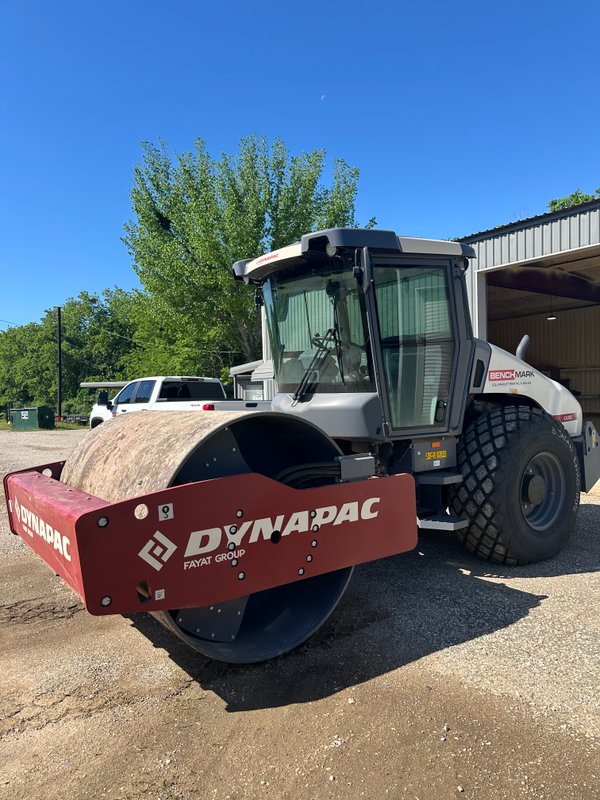
Roller selection is one of those decisions that looks simple until you're standing on a failed density test wondering what went wrong. The reality is that compaction equipment isn't one-size-fits-all, and the soil conditions across North Texas make the selection even more critical. A roller that performs perfectly on a sandy loam site in West Texas will struggle to achieve density in the high-plasticity clay that dominates the DFW construction corridor. We keep multiple roller types in our Benchmark fleet specifically because North Texas soil demands the right machine for each compaction layer.
Key Takeaways
- Padfoot (sheepsfoot) rollers are essential for clay subgrade compaction — smooth drums alone won't achieve density in North Texas expansive soils
- Vibratory smooth drum rollers in the 10-14 ton class handle 90% of road base compaction needs in the DFW area
- Moisture content is the single biggest variable — North Texas clay requires moisture within 2% of optimum for effective compaction
- Combination rollers (padfoot/smooth drum convertible) offer versatility for multi-phase projects but sacrifice some specialization
- Proper roller pattern and pass count documentation is required on all TxDOT and most municipal projects in North Texas
What Types of Rollers Are Used for Construction Compaction?
There are four primary roller types used on North Texas job sites, each designed for specific soil types and compaction layers:
Padfoot (sheepsfoot) rollers feature protruding feet welded to the drum surface. These feet concentrate compaction energy into small contact areas, creating high ground pressure (typically 250-400 psi per foot) that penetrates and kneads cohesive soils. This is your primary weapon for North Texas black gumbo clay compaction. The feet interlock soil particles and reduce air voids from the bottom up — the drum "walks out" of the soil as density increases, which gives operators a visual indicator of compaction progress.
Smooth drum vibratory rollers deliver compaction through a combination of static weight and dynamic vibration. The smooth surface provides uniform contact pressure across the full drum width, making these ideal for granular materials, flexible base courses, and surface finishing. Vibration frequencies typically range from 25-35 Hz, with centrifugal force ratings from 20,000 to 60,000 pounds depending on machine size. For North Texas road base work, a 12-ton vibratory roller operating at 30 Hz is the standard configuration.
Pneumatic (rubber tire) rollers use multiple rubber tires to deliver kneading compaction and surface sealing. These are primarily used for asphalt compaction and chip seal work rather than earthwork. Their ability to flex and conform makes them effective at sealing the surface of flexible base layers, which is valuable on North Texas road projects where the TxDOT specification calls for a sealed, tight surface before prime coat application.
Combination (convertible) rollers allow operators to switch between padfoot and smooth drum configurations by adding or removing shell kits. CAT and other manufacturers offer these as a versatility option for contractors who need both capabilities but don't want to rent two separate machines. The trade-off is that combination rollers are typically heavier and more expensive than dedicated single-purpose machines.
Which Roller Should I Use for North Texas Clay Subgrade?
For the expansive clay that dominates sites from Denton to Fort Worth and McKinney to Weatherford, a padfoot roller is not optional — it's required. The black gumbo clay in this region has a liquid limit typically ranging from 50-70 and a plasticity index of 35-55 according to USDA NRCS soil survey data. These are classified as CH (fat clay) soils under the Unified Soil Classification System, and they resist compaction by smooth drum rollers because the smooth surface can't penetrate and rearrange the plate-like clay particles.
We recommend a minimum 12-ton padfoot roller for subgrade work in North Texas clay. Operating specifications should include a vibration frequency of 28-33 Hz with an amplitude setting appropriate for lift thickness — high amplitude (1.8-2.0mm) for lifts exceeding 8 inches, low amplitude (0.8-1.0mm) for thinner lifts and when approaching target density. Expect 8-12 passes to achieve 95% Standard Proctor density in typical DFW clay conditions, compared to 4-6 passes in granular soils.
Moisture control is absolutely critical. North Texas clay must be within 2% of optimum moisture content for effective compaction. Too dry, and the soil resists densification regardless of roller energy. Too wet, and the clay pumps under the roller — you'll see the ground wave ahead of the drum, which means you're displacing material rather than compacting it. Water truck coordination with your roller operation is essential, and we often recommend renting both as a package for pad prep projects.
What Roller Specs Matter Most for Road Base Compaction?
Road base compaction in North Texas follows TxDOT Item 247 (Flexible Base) on most public projects and similar specifications on private work. The critical roller specifications for this work include:
Operating weight: Minimum 10 tons for most TxDOT specifications. We recommend 12-14 tons for production efficiency — the heavier machine achieves density in fewer passes, which translates directly to lower cost per cubic yard of compacted material.
Drum width: Standard widths range from 66 to 84 inches. A wider drum covers more area per pass, improving production rates on long road sections. For parking lot pads and smaller areas in subdivisions around Prosper, Celina, and Aubrey, a 66-inch drum provides better maneuverability.
Centrifugal force: This is the dynamic force the vibrating drum generates, measured in pounds. For North Texas road base (typically limestone or recycled concrete), a centrifugal force of 35,000-50,000 pounds delivers effective compaction without over-stressing the base material. Too much force fractures aggregate particles, which actually reduces density and structural value.
Vibration frequency and amplitude: Higher frequency (30-35 Hz) with lower amplitude works best for thin lifts of 4-6 inches. Lower frequency (25-28 Hz) with higher amplitude suits thicker lifts of 8-12 inches. Most modern CAT and Dynapac rollers allow the operator to adjust both settings from the cab — a critical feature for operators who need to optimize compaction as material conditions change across a project.
How Do I Compact Building Pads in North Texas Expansive Soil?
Building pad compaction in the DFW area presents a unique challenge because you're trying to create a stable platform on soil that wants to move. The expansive clay will swell when it absorbs moisture and shrink when it dries — this is why foundation issues are so common in North Texas residential and commercial construction. Proper pad compaction reduces but doesn't eliminate this movement; it establishes a uniform density that distributes the swelling forces more evenly.
The standard approach for pad prep in cities like Trophy Club, Little Elm, and Frisco involves: scarifying the native subgrade to 12-18 inches deep, moisture conditioning to within optimum range, compacting with a padfoot roller in 6-8 inch lifts, and achieving a minimum 95% Standard Proctor density across the entire pad. Many geotechnical engineers in the DFW area specify 98% density for commercial building pads, which requires additional passes and tighter moisture control.
The American Society of Civil Engineers (ASCE) recommends proof rolling as a final quality check for building pads. This involves driving a loaded dump truck or heavy roller across the finished pad surface while a geotechnical observer watches for deflection. Areas that deflect more than 1 inch under proof load indicate insufficient compaction or trapped moisture and need rework.
What Common Compaction Mistakes Should Contractors Avoid?
After years of supporting compaction projects across North Texas, we see the same mistakes repeatedly:
Lifts that are too thick. Contractors try to save time by compacting 12-inch lifts with a machine designed for 8-inch maximum effective depth. The surface tests fine, but the bottom half of the lift remains loose. Density tests at depth reveal the problem, and now you're ripping and recompacting — which costs more time than doing proper lifts from the start.
Ignoring moisture content. Compacting North Texas clay at the wrong moisture content is like trying to mold dry sand — no amount of roller energy will achieve density if the soil isn't at or near optimum moisture. Every load of fill placed should be tested for moisture content, and water truck support should be on site whenever compaction is in progress.
Wrong roller for the material. Using a smooth drum on clay subgrade or a padfoot on finished base course. Each roller type exists for specific materials and layers. Match the machine to the material, not the other way around.
Insufficient overlap between passes. Industry best practice calls for 6-12 inches of overlap between adjacent roller passes. Gaps in coverage create density variations that show up during testing and can cause differential settlement under structures.
Get the Right Roller for Your North Texas Project
Compaction is the foundation — literally — of every road, pad, and structure built in North Texas. The right roller matched to your soil conditions and project specifications is the difference between passing density tests on the first round and spending days reworking material. Benchmark Equipment in Denton, TX stocks padfoot, smooth drum, and combination rollers sized for every project from residential driveways in Argyle to TxDOT highway construction on I-35. Call us at (817) 403-4334 to discuss your compaction requirements and get the right machine delivered to your site.