.png)
Road construction is one of the most equipment-intensive disciplines in civil contracting — and one where the wrong machine at the wrong phase creates compounding problems that show up months or years after the ribbon cutting. We've supported road projects across a wide swath of North Texas, from municipal street work in Denton and Frisco to county road expansions in Gainesville and Decatur, and the pattern is consistent: crews that plan their equipment lineup from subgrade through final surface finish faster, spend less on rework, and pass inspection the first time.
This guide walks through each construction phase in sequence, the CAT equipment that handles it best, and the specific North Texas field conditions that affect machine selection. Whether you're bidding a new residential subdivision road in Celina or resurfacing a county road near Wichita Falls, this is the operational framework we use with our own rental customers.
Key Takeaways
- Road construction requires at least 5 distinct equipment phases — skipping or under-equipping any single phase creates compaction failures and surface defects that cost 3-5x more to fix than to prevent
- North Texas caliche rock at 4-8 feet depth frequently requires a CAT D6 or D8 dozer with ripping attachment before motor grading can begin on subgrade
- CAT AP1055F and AP655F pavers maintain mat temperatures within ±5°F across the screed width — critical in Texas summers when ambient temps exceed 100°F and asphalt cools faster at the edges
- Proper lift compaction with a CAT CS56B or CB10 roller achieves 95%+ Proctor density — the TXDOT standard for base course acceptance on public road projects
- Milling machines like the CAT PM620 remove 0-12 inches per pass, making them essential for overlay projects on existing North Texas roads with aged asphalt
What Equipment Do You Need for Subgrade Preparation on a Road Project?
Subgrade preparation is the foundation of every road that gets built, and it's also the phase where North Texas throws the most curveballs. The black gumbo clay that underlies most of the DFW corridor — stretching from Fort Worth through Denton and east toward Sherman and Denison — is some of the most reactive soil in the country. TxDOT geotechnical guidelines classify significant portions of North Texas as having Plasticity Index values above 30, which means the soil expands dramatically when wet and contracts when dry. Building a road on unprepared black gumbo is a recipe for reflective cracking within two to three years.
The primary machines for this phase are motor graders, dozers, and compactors. Our customers typically start with a CAT D6 or D8 dozer to clear and rough grade, but in areas around Prosper, McKinney, and the western Denton County line, the caliche rock layer — typically sitting 4-8 feet below grade — requires a ripper shank on the dozer before any grading can happen. We've had crews pull out CAT D8T dozers with single-shank rippers to break through caliche before the motor grader ever touched the site. Trying to motor grade over unbroken caliche is how you destroy a blade and lose a day.
Once the rough cut is done, the CAT 140 or 160 motor grader takes over for precision subgrade shaping. Motor graders establish the cross-slope, crown, and longitudinal grade that determines how water drains off the finished road — get this wrong and you're fighting ponding water and edge deterioration for the life of the pavement. The Federal Highway Administration's pavement design guidance consistently identifies subgrade drainage as one of the top three factors in pavement longevity. On a two-lane rural road in Gainesville or Bowie, we recommend a CAT 140 GC with blade float control; on wider urban arterials in Frisco or Carrollton, step up to the CAT 160 for the added blade length and horsepower.
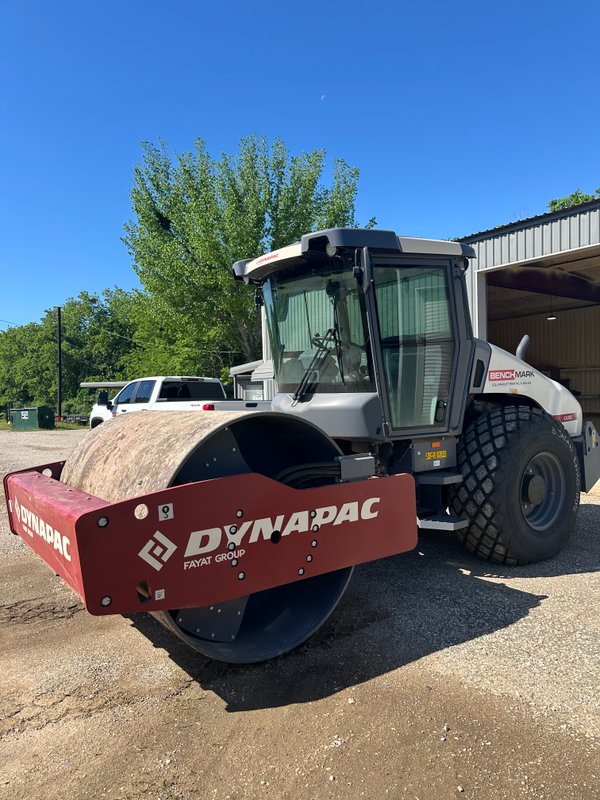
Subgrade compaction comes next, and this is non-negotiable. A CAT CS56B vibratory smooth drum roller working in 6-8 inch lifts on moisture-conditioned soil achieves the 95% Standard Proctor density that TxDOT Item 216 requires for stabilized subgrade. In summer conditions above 100°F — which is a standard July reality across our service area — moisture retention in clay soils drops fast, and we advise contractors to wet subgrade lifts the evening before compaction to stay within the 2% of optimum moisture window.
What Machines Handle Base Course and Flexible Base Installation?
Flexible base — the crushed limestone layer that sits between subgrade and asphalt — is the structural backbone of most Texas roads, and the equipment lineup shifts significantly at this phase. Motor graders remain essential, but the compaction equipment changes and the material handling equipment enters the picture.
Crushed limestone flexible base, the TxDOT Type A Grade 1 material used across most North Texas projects, typically arrives by tri-axle dump truck and gets spread by either a motor grader or a dedicated windrow machine. The CAT 140 motor grader with an attached spreader attachment can place and rough-spread material in a single pass, but on higher-volume projects in Frisco, Little Elm, or Irving, we see contractors use a CAT AP300F asphalt paver in material-spreading mode for consistent layer thickness — a technique that cuts finishing time by roughly 30% on longer straightaways.
Compaction of flexible base requires a padfoot or combination roller for the lower lifts and a smooth drum for the finish. A CAT CP56B padfoot roller breaks down material interlock in the lower 6 inches, while the CS56B smooth drum finishes the top. Industry research from the National Center for Asphalt Technology shows that base course density uniformity within ±2% across the lane width significantly reduces reflective cracking in the asphalt layer above — which is why we push customers away from using a single roller type for both passes.
One scenario we see repeatedly in the Aubrey and Celina growth corridor: contractors under-compact flexible base on subdivision roads because they're under schedule pressure from developers. The base looks solid at punch-out, but after the first heavy rain and traffic loading cycle, you get rutting and pumping that requires full-depth reclamation. Doing it right with the correct roller takes an extra half-day per lane mile. Fixing it takes two weeks and a materials bill that nobody wants to sign.
What Paving Equipment Do You Need for Asphalt Road Construction?
Asphalt paving is where the most visible work happens, and it's the phase with the tightest temperature and timing tolerances. Hot mix asphalt must be placed at 275-325°F and compacted before it cools below 185°F — the temperature at which aggregate interlock stops responding to roller passes. In North Texas summers, ambient temperatures above 100°F actually help mat temperatures stay elevated longer, but the trade-off is that crews must maintain a steady truck rotation to keep the paver moving without stopping, since cold joints from paver stops are the most common cause of early lane edge cracking.
The CAT AP655F and AP1055F tracked pavers are the workhorses for most North Texas road paving. The AP655F handles lane widths from 8 to 18 feet, making it the right tool for two-lane roads in Van Alstyne, Gunter, or rural Denton County. The AP1055F extends to 24 feet with extendable screeds, making it appropriate for urban arterials in McKinney, Mansfield, or Mesquite. Both pavers use CAT's GRADE Control System, which integrates with a ski or stringline reference to maintain grade automatically — critical on roads where TxDOT smoothness requirements specify International Roughness Index (IRI) values below 95 inches per mile for acceptance.
Breakdown rolling begins immediately behind the paver with a CAT CB10 or CB13 double drum roller, typically in static mode on the first pass to seat the mat, then vibratory for density, then static for finish. The target is 92-96% Marshall density on dense-graded surface mixes. A nuclear density gauge or PaveTracker device verifies each lot — TxDOT requires density testing per Tex-207-F on all Type D and Type C surface mixes. We always recommend that customers renting paving equipment also secure a CB10 or CB13 roller from our fleet simultaneously — the pavement won't wait for a roller that's running late from another site.
When Do You Need a Milling Machine for Road Construction?
Milling machines aren't just for repaving projects — they're essential whenever existing road geometry needs to be corrected before overlay, when drainage profiles have drifted over years of patching, or when adding a friction course to an existing structure. The CAT PM620 half-lane cold planer removes between 0 and 12 inches of asphalt per pass, and the PM820 full-lane version handles arterial and highway work where half-lane milling would create too many cold joints.
For overlay projects on older roads throughout Weatherford, Waco, and eastern Tarrant County — areas where original pavements were laid in the 1980s and 1990s and have accumulated edge-to-center cross-slope drift from multiple chip seal applications — milling is the only way to restore the original crown before a Type D overlay goes down. Paving over a road with compromised crown geometry just locks in the drainage problem under fresh asphalt.
According to the Asphalt Pavement Alliance, pavement milling and resurfacing extends road service life by 15-20 years at roughly 40-60% of the cost of full-depth reconstruction — making it one of the best return-on-investment decisions in municipal road maintenance budgets. We've seen this math play out on Denton County road projects where milling and overlay extended roads that were borderline candidates for full reconstruction, saving the county significant capital budget for higher-priority projects.
What Support Equipment Is Required Across All Road Construction Phases?
The primary paving and grading machines get most of the attention, but several supporting machines keep the whole lineup moving efficiently. Water trucks — typically a 2,000-4,000 gallon capacity unit — handle dust suppression on subgrade and flexible base operations, moisture conditioning of clay lifts, and cooling of equipment radiators during peak summer heat. In our experience running equipment through July and August across North Texas, operators in 100°F+ ambient temperatures need to check coolant temps on motor graders and pavers every two hours, and water trucks that are tied up on dust suppression sometimes can't support the moisture conditioning schedule simultaneously. Plan to have two water trucks on any road project exceeding a quarter-mile section.
Excavators — typically a CAT 320 or CAT 323 — handle utility crossing protection, inlet box excavation, and any areas where the road corridor crosses drainage features that need to be reconstructed before grading begins. On many of the residential subdivision road projects we support in Celina, Prosper, and Trophy Club, storm drainage infrastructure runs ahead of road grading by 30-60 days, and an excavator stays on site throughout that entire sequence before the first grader ever arrives.
Compaction control technology has become a standard expectation on public road work in Texas. FHWA's Intelligent Compaction initiative recommends GPS-mapped compaction passes on all federal-aid road projects, and many TxDOT district offices now request IC data on new construction projects. CAT rollers equipped with Compaction Control (CC) and Machine Drive Power (MDP) technology deliver this data automatically, which is one reason we've invested in CAT CS56B and CB10 units with the full IC package in our Denton fleet.
If you're lining up equipment for a road project anywhere from Sherman to Crowley, or from Wichita Falls to Waco, our team at Benchmark Equipment can walk through your project phasing and put together a coordinated rental package — not just individual machines. Call us at (817) 403-4334 and ask for a project consultation. We've supported enough North Texas road projects to know where the surprises hide, and we'd rather talk through your subgrade conditions before you're in a hole than after.
Frequently Asked Questions
What equipment do I need for a complete road construction project from start to finish?
A complete road construction project requires equipment across five phases: subgrade preparation (dozer with ripper, motor grader, vibratory roller), flexible base installation (motor grader, padfoot roller, smooth drum roller), paving (asphalt paver, breakdown roller, finish roller), optional milling for overlays (cold planer), and support equipment (water truck, excavator for utilities). The exact machine sizes depend on road width, daily production targets, and local soil conditions — in North Texas, caliche rock and expansive clay typically add a dozer ripping phase and moisture conditioning step that many out-of-state contractors don't anticipate.
What CAT motor grader size do I need for road grading work?
A CAT 140 GC or 140 motor grader handles most two-lane road projects and subdivision street work up to 24-foot lane widths. Step up to a CAT 160 for wider urban arterials, airport taxiways, or projects requiring more blade pressure for tough caliche and hardpan soils. The CAT 140 works at 14-foot blade length and roughly 170 net horsepower, while the CAT 160 extends to 16 feet and 215+ horsepower — meaningful differences when you're shaping a 44-foot arterial section or fighting North Texas rocky subgrade in a single pass.
How much does it cost to rent road construction equipment in North Texas?
Road construction equipment rental rates in North Texas vary by machine category: motor graders typically run $1,800–$2,800 per week, asphalt pavers $4,500–$7,500 per week, vibratory rollers $1,200–$2,200 per week, and cold planers $6,000–$10,000 per week depending on size. Full road project equipment packages covering all phases from subgrade to paving are often more cost-effective than renting individual machines from multiple suppliers — and coordinating delivery and pickup from a single source like Benchmark Equipment in Denton saves significant logistics time on compressed project schedules.
How do you compact road subgrade in North Texas black clay soil?
Compacting North Texas black gumbo clay subgrade requires moisture conditioning within 2% of optimum moisture content before rolling begins — the clay must be neither too wet (it'll pump under the roller) nor too dry (it won't achieve density). A CAT CS56B or CP56B vibratory roller working in 6-8 inch lifts with 4-6 passes per lift achieves the 95% Standard Proctor density required by TxDOT. In summer heat above 100°F, crews should pre-wet subgrade lifts the evening before compaction to prevent moisture loss before rolling begins. Nuclear density testing per ASTM D1557 verifies each lift before the next layer is placed.
When should I use a milling machine instead of just paving over an existing road?
Mill before overlaying whenever the existing road surface has cross-slope drift greater than 0.3% from design grade, when edge-to-crown height difference exceeds 2 inches, when delaminated or oxidized surface layers are present, or when the overlay thickness budget is less than 1.5 inches and you need a sound bonding surface. In North Texas, roads that have received multiple chip seal treatments over original asphalt — common on county roads from Bowie to Waxahachie — almost always require milling before a structural HMA overlay to restore drainage geometry. Paving over geometry problems just buries them under expensive new asphalt.