.png)
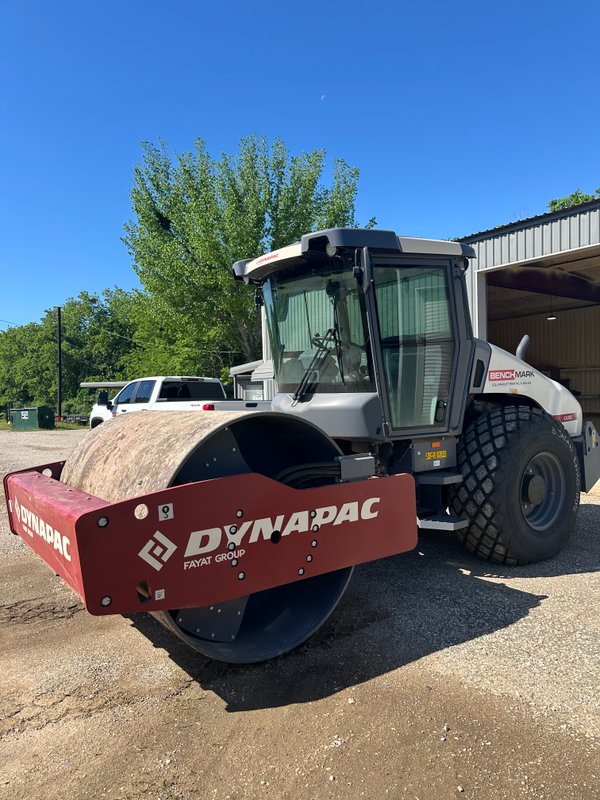
We talk to contractors every week who rent a smooth drum roller for a site and then wonder why their density tests keep failing. Nine times out of ten, the problem isn't operator error or lift thickness — it's the wrong drum type for North Texas black clay. The compactor selection conversation matters just as much as the machine's horsepower or drum width, and it's a conversation we've been having with earthwork crews across Denton, McKinney, Frisco, and Waco for years. Here's how to make the right call every time.
Key Takeaways
- Padfoot rollers generate 4–6 times more contact pressure per square inch than smooth drums, making them the correct choice for cohesive clay soils common throughout Denton, Celina, and Prosper job sites.
- Smooth drum rollers should be used for final-pass compaction of granular base material and asphalt — not for raw clay subgrade, where they can trap air and create a sealed crust over uncompacted material below.
- CAT CS and CP series rollers (smooth and padfoot respectively) support Compaction Control technology that logs real-time pass counts and density data, reducing over-compaction risk on tight-spec commercial projects.
- North Texas caliche layers encountered at 4–8 feet require ripping before any compactor is effective — neither drum type can compact through intact caliche without prior mechanical fracturing.
- Matching drum type to soil and project phase is not a preference — it is a compaction specification issue that directly affects structural performance, TXDOT acceptance, and post-construction settlement claims.
What Is the Difference Between a Padfoot and Smooth Drum Roller?
The physical difference is straightforward: a padfoot drum is covered with rows of truncated, tapered steel projections — the "feet" — that penetrate the soil surface during each pass. A smooth drum presents a continuous, uninterrupted steel cylinder to the ground. But the operational difference goes much deeper than what the drum looks like.
Padfoot drums work through kneading action. Each foot punches into the lift, displacing soil laterally and forcing particles to re-interlock under pressure. This process works from the bottom of the lift upward, which is exactly what cohesive soils need. Clay particles bond through interparticle friction and moisture, and they need mechanical manipulation — not just surface loading — to achieve target density. According to the Federal Highway Administration's earthwork compaction guidelines, cohesive soils typically require kneading-type compactors to achieve 95% Standard Proctor density at standard lift thicknesses.
Smooth drums apply load across their full contact width simultaneously. On granular materials — crushed limestone base, concrete aggregate, or hot mix asphalt — this broad pressure realigns particles efficiently without the penetration that would destabilize a well-graded aggregate. The smooth drum also "walks out" of soil naturally as density increases, which gives operators a useful field indicator: when a padfoot drum stops sinking and rides on top of the material, you're approaching target density on that lift.
Which Soil Types Require a Padfoot Roller?
Any cohesive soil — meaning any material with meaningful clay content — should be compacted with a padfoot drum during primary earthwork. In our service area, that covers the majority of native subgrade. The USDA Web Soil Survey identifies the Houston Black clay series and associated Vertisols as dominant across Denton, Collin, and surrounding counties. These are Expansive soils with shrink-swell potential ratings of "high" to "very high" — the same black gumbo that makes summer site work unpredictable and winter freeze-thaw cycles genuinely damaging to poorly compacted subgrade.
We've had customers in Argyle and Aubrey pull smooth drum rollers off our lot for residential pad construction, make a dozen passes on their clay subgrade, pass a visual inspection, and then watch their density gauge readings come back at 88–90% when the spec calls for 95%. The smooth drum created a hard crust on the surface while the material below stayed loose. A padfoot drum on the same lift, same moisture content, typically hits spec in four to six passes.
Silty soils and mixed clay-silt profiles also respond better to padfoot compaction. If your geotech report shows plasticity index (PI) values above 15, plan on padfoot drums for your subgrade work. ASTM D1557 (Modified Proctor) is the standard test method that governs target density specs on most commercial projects in Texas, and cohesive soils tested under D1557 are virtually always compacted in the field with sheepsfoot or padfoot equipment.
When Should You Use a Smooth Drum Roller Instead?
Smooth drum rollers earn their place on every job — just at a different phase. Once subgrade compaction is complete and you're placing granular base material (crushed limestone, flex base, or recycled concrete), the smooth drum becomes the correct tool. The aggregate interlock mechanism in granular materials is disrupted, not helped, by padfoot penetration. You want uniform surface pressure to seat the particles, not puncture the lift.
Asphalt compaction is exclusively smooth drum territory. Vibratory smooth drum rollers — like the CAT CS series — are the industry standard for hot mix breakdown rolling and intermediate rolling. The smooth contact area distributes load without creating aggregate fracture points, and vibratory frequency can be tuned to mat temperature and thickness. The National Asphalt Pavement Association recommends breakdown rolling begin when mat temperature is between 280°F and 300°F — a window that tightens considerably in North Texas summer heat when ambient temperatures above 100°F slow mat cooling and require roller pattern adjustments.
There's also a transitional application worth mentioning: finishing passes on clay subgrade before placing base material. Once padfoot compaction brings clay to density spec, a single static pass with a smooth drum can seal the surface and provide a stable platform for base course delivery. This is common practice on TxDOT right-of-way work in our area, and it's one reason larger projects often run both machine types simultaneously.
How Do North Texas Soil Conditions Affect Compactor Selection?
North Texas presents two distinct compaction challenges that aren't common everywhere: expansive black clay near the surface and caliche rock formations at depth. Both affect machine selection and site strategy in ways that trip up crews importing practices from other regions.
The black gumbo clay across Denton, Wichita Falls, Sherman, and the Collin County growth corridor is notoriously moisture-sensitive. Compaction window — the range of soil moisture content where density targets are achievable — can be as narrow as two to three percentage points above and below optimum. Padfoot rollers are more forgiving at the wet end of that range because the kneading action helps expel excess water, while smooth drums on wet clay simply push the material laterally without achieving density. During rainy periods, we advise customers on projects from Trophy Club to Van Alstyne to hold off on compaction entirely or strip and re-dry the lift surface before running any roller.
Caliche is a different problem entirely. This calcium carbonate hardpan, common at four to eight feet below grade across much of DFW and extending into Weatherford and Decatur, is not compactable with any drum roller in its natural state. It requires a ripper or hydraulic hammer attachment on an excavator to fracture first. Once broken, caliche material actually compacts well with vibratory padfoot equipment — the fractured nodules interlock effectively — but crews that encounter intact caliche and simply run more roller passes over it are wasting time and fuel. We frequently cross-rent ripper attachments alongside our roller fleet for deep cut commercial grading projects in the region.
Summer heat above 100°F also affects roller performance. Hydraulic fluid viscosity drops under sustained heat loading, and vibratory system efficiency can decrease if the machine runs hot. CAT's integrated cooling systems on the CP and CS series handle North Texas summers well, but we recommend checking hydraulic temps every two to three hours during July and August work and giving machines a cool-down cycle during midday shutdowns when possible.
What CAT Roller Models Are Best for Each Application?
Our rental fleet gives us direct operational perspective on how different machines perform across North Texas project types. The CAT CP Series (padfoot) and CAT CS Series (smooth drum) are the workhorses we see on most commercial and residential grading projects, and both lines now support CAT's Compaction Control with Compaction Meter Value (CMV) monitoring — a feature that has measurably reduced rework on density-spec-sensitive projects.
The CAT CP56B and CP74B padfoot rollers, with operating weights of 11,500 to 15,400 pounds and vibratory frequencies of 28–33 Hz, cover the range from residential lot preparation in Prosper and Gunter to large commercial earthwork in Mesquite and Irving. Their padfoot shell kits are interchangeable with smooth drum shells on some configurations, giving contractors flexibility when a project transitions phases. Centrifugal force ratings on these machines — typically 35,000 to 55,000 pounds — mean they're not just mechanically pressing clay; they're using dynamic impact to achieve density through the full lift depth, not just the top two inches.
The CAT CS Series smooth drum rollers — CS56B and CS74B — are the machines we stage near asphalt paving operations and aggregate base compaction work. The CS74B delivers a 66-inch drum width and up to 55,000 pounds of centrifugal force in high-amplitude mode, making it effective on thicker aggregate lifts typical of highway base course work on TxDOT projects around Gainesville and Crowley. CAT's full compaction equipment line and spec sheets are available for project planning comparisons.
According to Caterpillar's product performance data, the CP-series padfoot rollers using integrated Compaction Control technology demonstrate a 10–15% reduction in required passes to achieve target density compared to operating without real-time feedback — a direct fuel and time saving on large-scale earthwork operations.
Can You Use a Padfoot Roller on Asphalt or Base Course?
No — and this is one of the more consequential mistakes we see on sites where contractors are trying to minimize equipment costs by running one roller for every phase. Running a padfoot drum on hot mix asphalt will permanently damage the mat surface, creating voids and point-load fractures in the aggregate structure that cause premature pavement failure. The same issue applies to finished aggregate base: padfoot feet punch through the surface and disrupt the interlock you've already achieved in prior passes.
The only exception is when a padfoot drum is used with its shell kit removed and replaced with a smooth drum — a configuration some CAT models support. But that requires proper swap-out between phases, not mid-project improvisation. If your project involves both clay subgrade compaction and aggregate base finishing, budget for both machine types. The cost of a density test failure or pavement rework far exceeds one week's rental on a second roller.
How to Talk to Your Equipment Rental Yard About Compactor Selection
When you call us at Benchmark Equipment, the three questions we ask every compaction rental inquiry are: What's your soil type? What phase of the project are you in? And what's your density spec? Those three data points — combined with your lift thickness and any geotech report findings — let us put the right machine on your trailer the first time.
For projects across our service area from Waco north to Denison and from Bowie east to Sherman, soil variability is real. A site in Little Elm near the lake corridor may have significantly different native material than a site in Mansfield or Crowley, and assumptions based on prior projects in a different submarket have led crews to make the wrong rental call. We'd rather spend five minutes on the phone getting your project details right than have you make four extra passes with the wrong drum type and still miss your density spec.
Give our Denton team a call at (817) 403-4334 and tell us what you're working on. We'll match you to the right machine from our fleet — padfoot, smooth drum, or both — and make sure you're not leaving compaction performance on the table because of drum type mismatch. The Associated General Contractors of America and American Society of Civil Engineers both publish earthwork compaction guidance that aligns with what our experienced rental team recommends daily — good specs, right equipment, right soil conditions, every time.
Frequently Asked Questions
What is the difference between a padfoot and smooth drum roller?
A padfoot roller has rows of tapered steel projections on the drum that penetrate cohesive soils and compact through kneading action, working from the bottom of the lift upward. A smooth drum roller applies uniform pressure across its full contact width, which is ideal for granular materials like gravel, crushed limestone, and asphalt. Padfoot drums generate 4–6 times more contact pressure per square inch than smooth drums, making them far more effective on clay soils.
Can I use a smooth drum roller on clay soil?
Using a smooth drum roller on clay soil is a common mistake that leads to density test failures. The smooth drum can create a hard surface crust while leaving the material below loose and uncompacted — a condition that passes visual inspection but fails nuclear density gauge testing. Cohesive soils with a plasticity index above 15, which includes most native soils in the DFW and Denton areas, require padfoot or sheepsfoot compaction equipment to achieve 95% Standard Proctor density per ASTM D1557.
How many passes does a padfoot roller need to compact clay?
The number of passes required depends on lift thickness, soil moisture content, and machine specifications, but most padfoot rollers achieve target density on cohesive clay in four to eight passes at eight-inch lift depths near optimum moisture content. CAT CP-series rollers with integrated Compaction Control technology show a 10–15% reduction in required passes compared to operating without real-time density feedback, according to Caterpillar performance data. Lift thickness above 12 inches significantly increases required pass count and should be avoided on high-spec projects.
What compactor should I use for caliche rock in North Texas?
Intact caliche hardpan, typically found at 4–8 feet below grade across much of the DFW region, cannot be effectively compacted by any drum roller — padfoot or smooth — without prior fracturing. A ripper attachment on a dozer or hydraulic hammer on an excavator must break the caliche first. Once fractured, the resulting material compacts well with a vibratory padfoot roller because the broken nodules interlock under dynamic loading. Attempting to compact intact caliche with additional roller passes wastes time and fuel without improving density.
Can a padfoot drum roller be used for asphalt compaction?
No — running a padfoot drum on hot mix asphalt will permanently damage the mat by creating voids and point-load fractures in the aggregate structure that lead to premature pavement failure. Asphalt compaction requires smooth drum vibratory rollers, such as the CAT CS series, for breakdown and intermediate rolling. Some CAT padfoot drum models support interchangeable shell kits that allow swapping to a smooth drum configuration, but this requires a proper mechanical changeover between project phases, not mid-operation adjustment.