.png)
If you've driven north on the Dallas North Tollway or US-380 recently, you already understand the scale of what's happening in Collin County. Prosper and McKinney are no longer fast-growing — they're historically fast-growing, regularly appearing on national lists of the most active residential construction markets in the entire country. Cornfields become cul-de-sacs in what feels like a matter of weeks. For contractors working these subdivisions, that pace creates both tremendous opportunity and real operational pressure to have the right equipment on site at the right time.
We've been supplying equipment to this growth corridor from our Denton location for years, and the questions we hear most often from developers and GCs are remarkably consistent: What do I actually need to move dirt efficiently on a 500-lot subdivision? How do I handle the clay? What happens when my excavator hits caliche at six feet? This post answers those questions directly, based on what we see working — and not working — on North Texas job sites every season.
Key Takeaways
- McKinney and Prosper rank among the top 5 fastest-growing cities in the U.S., with Collin County issuing over 18,000 residential permits in 2023 alone — creating sustained equipment demand across the full construction cycle.
- North Texas expansive clay soils require pad-foot compactors and soil stabilization passes before any concrete flatwork; skipping this step causes slab movement that costs developers significantly more to remediate.
- Caliche rock formations at 4-8 feet depth are common across Prosper and northern McKinney, meaning excavation crews often need hydraulic hammers or rippers staged alongside their primary excavators.
- Summer heat above 100°F in the DFW metroplex requires contractors to monitor hydraulic fluid temperatures closely — CAT's advanced cooling systems on newer models help, but jobsite scheduling and fluid maintenance matter just as much.
- A properly sequenced equipment fleet — dozers first, scrapers second, graders third, compactors last — reduces cycle times by 20-30% on large subdivision pads compared to uncoordinated equipment deployment.
Why Is Equipment Demand So High in the McKinney-Prosper Growth Corridor?
The numbers tell the story. According to U.S. Census Bureau data, McKinney has grown from roughly 55,000 residents in 2000 to over 220,000 today, making it one of the fastest-growing large cities in the nation over that period. Prosper's growth rate has been even more dramatic on a percentage basis, exploding from a small community of 2,100 to a city approaching 45,000 residents — and still accelerating.
What that translates to on the ground is a near-constant pipeline of subdivision phases moving through every stage simultaneously. You'll have mass grading happening on one section while utility trenching runs in another, concrete flatwork following close behind, and infrastructure crews pulling storm sewer and water lines ahead of all of it. The equipment needs don't stack — they run in parallel, which means contractors in this market can't afford to be under-equipped or to wait on machine availability.
Collin County issued over 18,000 residential building permits in 2023, representing one of the highest concentrations of single-family permit activity in any U.S. county. Behind each of those permits is a graded pad, utility connections, and a web of subdivision infrastructure — every square foot of it requiring earthmoving equipment.
What Equipment Do You Need for Mass Grading a North Texas Subdivision?
Mass grading is where the money is made or lost on a large subdivision, and the Collin County terrain demands a specific approach. The topography across McKinney and Prosper is relatively gentle compared to, say, the Hill Country, but the soil composition is what separates North Texas earthmoving from work almost anywhere else in the country.
The black gumbo clay that dominates this region is some of the most expansive soil in North America. The Federal Highway Administration recognizes expansive soils as a major engineering challenge, and North Texas clay with plasticity indices routinely above 40 represents the high end of that challenge. In practical terms for grading contractors, this means the soil behaves completely differently wet versus dry — it swells when it absorbs moisture and shrinks and cracks when it dries out. A pad that grades beautifully on Tuesday can look like a different job after a rain event on Thursday.
For mass grading, our customers working large Prosper and McKinney subdivisions typically run a combination of CAT D6 or D8 dozers for initial clearing and rough cut work, paired with self-loading scrapers for material movement across long haul distances. A CAT 637 or 657 scraper is genuinely hard to beat for moving large volumes of material efficiently across the relatively flat Collin County terrain — the economics per yard moved simply work in the scraper's favor when you're grading 50 or 100 lots at a stretch.
On the compaction side, pad-foot rollers are non-negotiable with black clay. A smooth drum roller on North Texas clay simply won't achieve the density required to satisfy geotechnical reports. We typically see contractors running CAT CS or CP series compactors, with the pad-foot shell kit being standard equipment for clay lifts. The ASTM D1557 Modified Proctor compaction standard is what engineers spec for these pads, and hitting 95% or better of that standard in expansive clay requires both the right equipment and properly moisture-conditioned lifts.
What Size Excavator Do You Need for Utility Trenching in McKinney and Prosper?
Utility trenching is where the caliche issue becomes mission-critical. Across northern McKinney, Prosper, and neighboring Celina, we consistently see caliche rock formations beginning at four to six feet of depth — sometimes shallower depending on the specific tract. Caliche is a calcium carbonate hardpan that forms a near-concrete layer that's nearly impossible to trench with conventional bucket force alone.
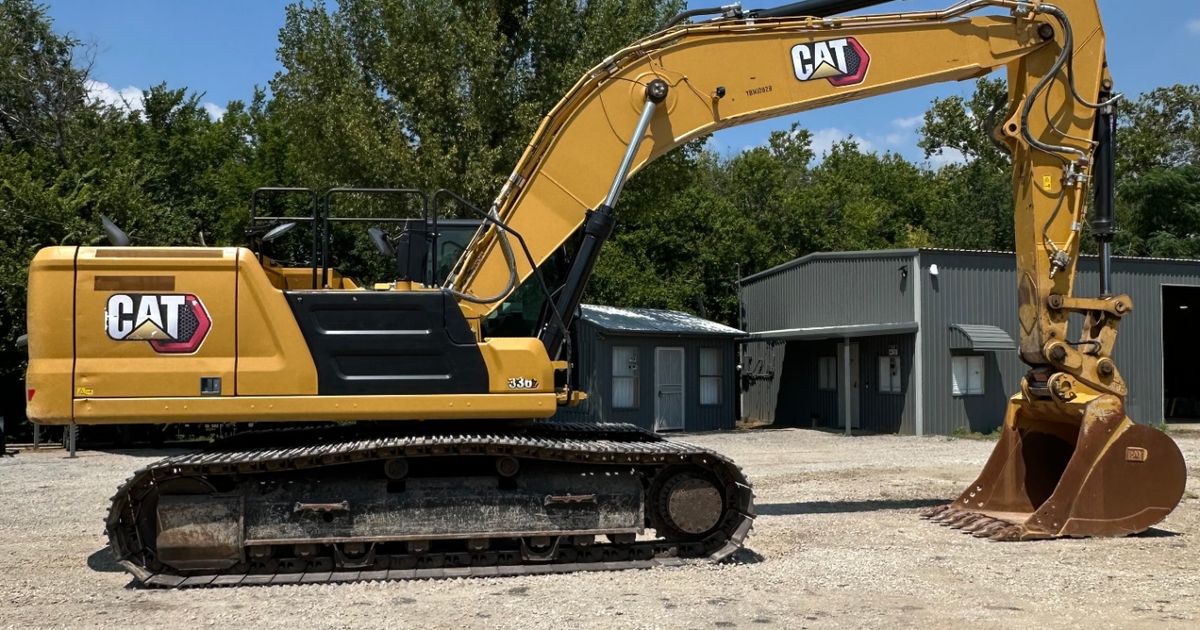
Our recommendation for utility work in this corridor is a CAT 323 or CAT 326 excavator as your primary machine, staged with a hydraulic hammer attachment available for the inevitable caliche encounters. A 20-ton class excavator has enough hydraulic power to effectively run a medium-to-large hydraulic hammer without the flow limitations you'd encounter on smaller machines, and the arm reach handles typical sewer and water depths without repositioning constantly.
We had a utility contractor working a large residential development off Coit Road in Prosper who came to us after losing significant time on a project — they'd brought in a CAT 315 thinking the trenching would be straightforward, hit caliche at five feet across an entire block of storm sewer, and had no hammer staged. Switching to a 323 with a CAT H130s hammer on standby turned that project around. The lesson wasn't that smaller machines can't work in Prosper — it's that you need contingency equipment planned for caliche before you start, not after you're stuck.
For storm sewer installations, which routinely run deeper in subdivision infrastructure, a CAT 336 provides the reach and lifting capacity that larger-diameter RCP pipe requires. At maximum digging depth, a 336 handles 18 to 24-inch storm pipe with confidence that a smaller machine simply can't match safely.
How Do You Handle North Texas Clay When Building Subdivision Pads?
The single most common mistake we see on McKinney and Prosper subdivisions is treating clay stabilization as optional or as something to be managed later. It isn't optional, and later is too expensive. TxDOT's own soil treatment specifications reflect what geotechnical engineers in North Texas have known for decades: lime stabilization of expansive clay is the foundation of everything that comes after.
The practical equipment sequence for pad preparation in black gumbo soil runs like this. After initial grading, a lime spreader and water truck prepare the soil for treatment. Then a rotary mixer — typically a CAT RM series or equivalent — works the lime into the clay to the specified depth, usually 8 to 12 inches. This is followed by initial compaction passes, a curing period, and then final compaction with a pad-foot roller before any concrete work begins. Skip or shortcut any step in that sequence and you're setting up the homebuilders and the homeowners for foundation problems that become your liability conversation.
We rent rotary mixers specifically for this application to soil stabilization subcontractors working throughout the DFW area. The demand for these machines in the McKinney-Prosper market is consistent year-round, which tells you how seriously the geotechnical community takes lime stabilization in this soil type.
What Equipment Challenges Come with North Texas Summer Heat?
Operating heavy equipment in Collin County during July and August means working in conditions that regularly reach and exceed 100°F. That heat affects both operators and machines in ways that require active management rather than hope.
On the machine side, hydraulic fluid viscosity changes significantly at extreme temperatures. CAT's newer equipment lines feature enhanced cooling systems that handle North Texas summers better than older iron, but fluid maintenance schedules still need to be tightened during peak summer months. We tell every customer renting from us during summer that hydraulic oil analysis intervals should be reduced and that keeping machines in the shade during midday breaks isn't just operator comfort — it's machine longevity.
The OSHA heat illness prevention guidelines are particularly relevant for North Texas construction sites where heat index values routinely exceed 105°F. Savvy contractors in McKinney and Prosper schedule their most physically demanding work in early morning hours and use machine air conditioning as a legitimate productivity and safety tool, not a luxury.
There's also a practical scheduling advantage to early starts: North Texas clay actually cuts and compacts better in cooler morning temperatures before the surface dries and case-hardens under direct sun. Experienced grading contractors in this market often accomplish more in the first four hours of the day than in the entire afternoon combined.
What Motor Grader Do You Need for Subdivision Street Subgrade in Collin County?
Street subgrade work is where the motor grader earns its place in the fleet, and in a market like McKinney or Prosper where city inspectors are meticulous about subgrade tolerances before they'll approve concrete paving, precision matters enormously. A CAT 140 motor grader is the workhorse we see most often on subdivision street work in this size of development — it has the blade length and horsepower to work efficiently on collector streets while being maneuverable enough for cul-de-sacs and residential lots.
For larger boulevard sections and arterial street subgrade that accompany major subdivisions, a CAT 160 provides additional blade capacity and stability that pays off in fewer passes and tighter tolerances. Many of the larger developments in Prosper and McKinney include significant entry boulevard and collector street construction that justifies the larger machine.
GPS-integrated grading systems on newer CAT motor graders are increasingly standard on North Texas subdivision contracts, where city engineers require subgrade tolerances of plus or minus 0.05 feet across long street runs. The Associated General Contractors of America has documented productivity improvements of 15-25% with GPS-guided grading compared to conventional staking, and our customers in this market consistently confirm those numbers in real-world subdivision applications.
How Should You Sequence Equipment for Maximum Efficiency on a Large Subdivision?
Coordinating equipment across a large subdivision is genuinely a logistics challenge, and we've watched contractors succeed and struggle based almost entirely on sequencing decisions made before the first machine rolls on site.
The sequencing that works in McKinney and Prosper follows this general order: clearing and grubbing first (typically a D6 dozer with brush rake), rough grading and cut/fill with scrapers and push-dozers, utility corridor preparation with excavators, storm sewer installation, water and sewer rough-in, then fine grading with motor graders, compaction testing, lime stabilization if specified, and finally concrete flatwork. Running these phases in tight coordination — not waiting for one to fully complete before starting the next — is where experienced subdivision contractors find their competitive advantage.
We work with project managers across the Denton, McKinney, Celina, and Frisco markets to help them plan equipment availability around their phase schedules. A contractor who can tell us they need a 323 excavator for three weeks starting on a specific date, followed by a 140 grader for two weeks, gets better pricing and guaranteed availability than one who calls the morning they need something. In a market this active, planning ahead isn't just smart — it's often the difference between keeping your schedule and losing it.
If you're working subdivision development in McKinney, Prosper, or anywhere across our North Texas service area, call us at (817) 403-4334. We're based in Denton and our fleet is built for exactly this work — the clay, the caliche, the heat, and the pace of one of the busiest residential construction markets in the country.
Frequently Asked Questions
What size excavator do I need for utility trenching in McKinney or Prosper, Texas?
A CAT 323 or CAT 326 in the 20-23 ton class is the right starting point for utility trenching in McKinney and Prosper, where caliche rock formations commonly appear at 4-6 feet of depth. You should also plan to have a hydraulic hammer attachment staged on site — caliche is too hard for conventional bucket excavation and planning for the hammer before you hit rock saves significant time and cost. For deeper storm sewer work with larger diameter pipe, step up to a CAT 336 for the additional reach and lifting capacity.
How do you compact clay soil on North Texas subdivision pads?
Compacting expansive black clay in North Texas requires a pad-foot roller — smooth drum compactors won't achieve the density specified by geotechnical engineers in this soil type. Contractors must also moisture-condition clay lifts to near-optimum moisture content before compaction passes, as dry North Texas clay resists compaction and wet clay pumps under equipment weight. Most subdivision pad specifications in the McKinney-Prosper market require 95% of Modified Proctor density per ASTM D1557, and achieving that consistently requires proper lift thickness, moisture content, and multiple compaction passes with a properly equipped machine.
Do I need lime stabilization for subdivision pads in Collin County, Texas?
Yes — lime stabilization of expansive clay is standard practice and typically required by geotechnical specifications on subdivision pads in Collin County, including McKinney, Prosper, and Celina. The expansive black gumbo clay in this region has plasticity indices frequently above 40, making untreated clay pads a foundation failure risk. The process requires a lime spreader, water truck, and rotary mixer to blend lime into the top 8-12 inches of soil, followed by compaction and a curing period. Skipping this step creates liability exposure for developers and contractors when foundation movement occurs.
What is the best motor grader for subdivision street subgrade work in North Texas?
A CAT 140 motor grader is the most widely used machine for residential subdivision street subgrade in the McKinney and Prosper market, offering the right balance of blade length, horsepower, and maneuverability for cul-de-sacs and collector streets. For larger boulevard and arterial sections included in major developments, a CAT 160 provides additional capacity. GPS-integrated grading systems are increasingly standard on Collin County subdivision contracts, where city engineers require subgrade tolerances of plus or minus 0.05 feet — GPS guidance delivers 15-25% productivity improvement over conventional stake-and-string grading methods.
How does the summer heat in North Texas affect construction equipment performance?
Temperatures regularly exceeding 100°F in the DFW metroplex during July and August directly impact hydraulic system performance by changing fluid viscosity and stressing cooling systems. Contractors should tighten hydraulic oil analysis intervals during summer months and ensure machines receive adequate cooldown time during peak heat hours. OSHA's heat illness prevention guidelines apply directly to North Texas job sites where heat index values frequently exceed 105°F. Many experienced contractors in the McKinney-Prosper market schedule their most demanding earthmoving operations in early morning hours, both for operator safety and because North Texas clay cuts and compacts more efficiently before surface case-hardening occurs under direct afternoon sun.