.png)
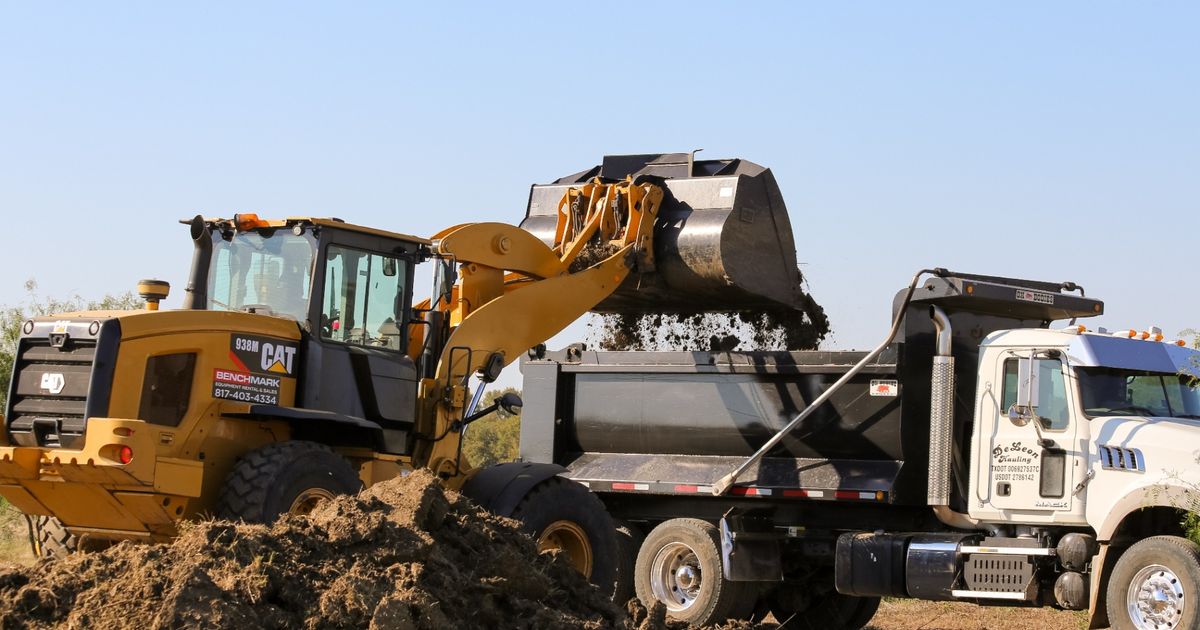
Few pieces of equipment earn their rental cost faster than a properly spec'd wheel loader. We watch our customers put these machines through their paces across Denton County, Collin County, and the entire North Texas corridor — loading aggregate at Celina subdivisions, stockpiling topsoil in Prosper, and shuttling fill across sprawling commercial pads in Frisco. When the wheel loader is matched right to the job, productivity numbers are hard to argue with. When it's not, you're burning fuel, wearing tires, and slowing down every haul truck on site.
This guide covers what we've learned running a rental fleet in North Texas — the operational decisions that actually move the needle on material handling efficiency.
Key Takeaways
- CAT 950GC and 962 wheel loaders deliver 8-12% better fuel efficiency than older generation models, making them the preferred choice for extended stockpiling operations in North Texas heat.
- North Texas expansive clay (black gumbo) increases bucket resistance by 20-30% compared to sandy loam, requiring operators to adjust crowd pressure and entry angles to protect drivetrain components.
- Caliche rock formations at 4-8 feet deep across the DFW area frequently require rock-rated bucket edges and reinforced bucket floors — standard utility buckets fail prematurely in these conditions.
- Proper V-pattern loading technique reduces cycle times by up to 25% compared to straight-push approaches, directly impacting haul truck productivity and overall project cost.
- Operating wheel loaders in 100°F+ North Texas summers requires coolant system checks every 4 hours and hydraulic fluid temperature monitoring to prevent efficiency losses exceeding 15%.
What Size Wheel Loader Do I Need for My North Texas Job Site?
The right wheel loader size is determined by three converging factors: the material you're handling, the volume you need to move per hour, and the equipment you're loading into. We tell customers to start with the haul truck, not the loader. If you're filling 14-ton articulated dump trucks or tandem-axle semis, you want a machine that loads in 3-4 passes — fewer passes mean less time the truck sits idle, and that's where the real money is made or lost.
For most residential and light commercial work in Denton, Argyle, or Trophy Club — moving topsoil, aggregate base, and sandy fill — a CAT 930 or CAT 938 is a capable, economical choice. These machines run a 2.5 to 3.0 cubic yard general purpose bucket and handle standard material efficiently without the operating cost of a larger unit.
Step up to large commercial pads in McKinney, Prosper, or the Frisco growth corridor, and the CAT 950GC becomes the workhorse answer. With a 3.0 to 4.5 cubic yard bucket capacity and 217 net horsepower, it moves material fast enough to keep multiple trucks turning. Our customers on larger infrastructure projects — utility corridors, road base work, drainage channels — frequently step to the CAT 962 for its higher payload ratings and advanced powertrain efficiency. CAT's medium wheel loader lineup gives you a clear progression from light-duty to heavy-cycle operations.
The one size-selection mistake we see most often: contractors running too small a machine to save on rental cost, then watching their trucks sit idle waiting for the next load. That math almost never works in their favor.
How Does North Texas Soil Affect Wheel Loader Performance and Bucket Selection?
North Texas soil is genuinely one of the more challenging operating environments in the country for wheel loaders, and it varies dramatically by location and depth. The expansive black clay — what locals call black gumbo — that covers much of Denton, Collin, and Tarrant counties is notorious for its behavior. In dry summer conditions, it's hard-packed and resistant. After rain, it becomes sticky and heavy, clinging to bucket floors and sidewalls and dramatically increasing effective payload weight. We've seen operators underestimate loaded bucket weight by 15-20% when working wet gumbo, which stresses drivetrain components and burns through tires faster than any other material we handle.
Below the surface clay layer — typically starting at 4 to 8 feet in most DFW-area sites — caliche rock formations are the reality for any contractor doing deep utility work, pond excavation, or large cut-and-fill operations. Caliche is soft enough that a wheel loader can attack it, but abrasive enough to destroy a standard bolt-on cutting edge in a matter of days. For customers working around Gunter, Van Alstyne, Sherman, or Decatur — areas where caliche tends to run shallower — we always recommend discussing bucket tooth configuration and rock-rated edge options before the machine hits the site. USDA Web Soil Survey data confirms North Texas's complex soil layering that makes standardized equipment specs insufficient for regional planning.
Practically speaking, material density changes everything about how an operator should approach a pile. Dense, wet clay requires a lower entry angle into the pile — attacking high causes the bucket to ride up instead of filling. Caliche fragments load better with a straight-in penetration, using the weight of the machine rather than relying on bucket cylinder force alone. These aren't manual techniques — they're the kind of adjustments experienced operators develop over seasons of North Texas work.
What Is the Most Efficient Technique for Loading Haul Trucks with a Wheel Loader?
The V-pattern loading cycle is the industry standard for a reason: it consistently outperforms straight-push or Y-pattern alternatives on sites with enough space to execute it properly. In a V-pattern, the loader approaches the pile, fills the bucket, reverses in an arc, and drives forward in the opposite arc to reach the truck — tracing a V-shape. This technique reduces the total distance traveled per cycle and keeps the machine moving efficiently rather than sitting in full-lock turning movements.
Studies from Associated General Contractors of America on earthmoving productivity consistently identify cycle time reduction as the highest-leverage variable in material handling cost control. Our field experience backs this up: when we've timed V-pattern versus straight-approach loading on comparable sites, the V-pattern produces 20-25% more loads per hour under normal conditions.
Positioning matters almost as much as technique. The haul truck should be staged at roughly a 60-degree angle to the pile, not parallel to it. This minimizes the loader's turning radius to reach the truck bed and reduces the time spent with a full, elevated bucket — which stresses the front axle and raises the machine's center of gravity. On active Prosper and Celina residential developments where we frequently support site contractors, proper truck staging is what separates a 45-minute truck cycle from a 32-minute one. That gap, compounded across a full day of operations, is often worth $1,500 to $3,000 in haul truck productivity alone.
One operational note: avoid carrying material with the bucket elevated during transport across the site. A full bucket at height significantly raises the tipping threshold, and on North Texas sites with uneven cut surfaces or unexpected drop-offs, this is a genuine safety exposure. OSHA 1926.602 sets the regulatory framework for earthmoving equipment operation, and safe carry height is addressed directly in manufacturer's operating guidelines for every CAT wheel loader in our fleet.
How Do You Build and Manage a Stockpile Efficiently with a Wheel Loader?
Stockpile management is where wheel loader operators separate themselves — and it's genuinely a skill that takes time to develop. A well-built stockpile is dense, stable, and positioned so that reclaiming material from it is as efficient as delivering to it. A poorly built stockpile wastes space, segregates material, and creates difficult, time-consuming reclaim cycles.
For aggregate stockpiles — road base, gravel, crushed limestone — the goal is to minimize segregation. Dumping repeatedly from a single point causes fines to migrate toward the center while coarser material rolls to the outside edge. The correct technique is to build the pile progressively from the base outward, adding lifts and spreading laterally. This keeps particle distribution consistent, which matters significantly on projects where base material gradation is spec'd to TxDOT material specifications.
Topsoil stockpiles are a different problem entirely. In North Texas's summer heat — and we're talking sustained 100°F-plus temperatures across June, July, and August in Denton, Weatherford, Waco, and the surrounding region — stockpiled topsoil dries and crusts rapidly. Operators working large landscape material stockpiles benefit from building them no taller than 10-12 feet to allow material turnover and minimize the hard outer crust that makes reclaiming the pile with a standard GP bucket inefficient. We've had customers on large HOA landscaping projects in Little Elm and Frisco learn this the hard way — a 16-foot topsoil stockpile after two weeks of August heat is a significantly harder reclaim than they planned for.
Reclaim efficiency from an existing stockpile is also about approach angle. Attacking the face of a stockpile straight-on is inefficient — the pile resists and the bucket fills unevenly. Working the pile in horizontal slices from the side, stepping up progressively, keeps bucket fills consistent and reduces cycle resistance.
How Does Extreme Heat Affect Wheel Loader Performance in North Texas Summers?
Operating heavy equipment in sustained 100°F-plus conditions is a real performance and maintenance variable that North Texas contractors cannot afford to ignore. Hydraulic systems are the first place heat creates measurable efficiency loss — hydraulic fluid viscosity drops as temperature rises, reducing system pressure response and slowing cycle times. On a wheel loader running continuous loading cycles through the peak of a July afternoon in Mansfield, Crowley, or Irving, hydraulic temperatures can climb to the point where the machine's onboard monitoring system begins limiting performance to protect components.
Our maintenance protocol for fleet machines during summer months includes hydraulic fluid temperature checks every 4 hours during high-cycle operations. We also strongly advise customers to run the machine's cooling system inspection as part of their daily pre-start checklist — coolant level, radiator screen condition (caliche dust is a notorious radiator clogger), and fan belt tension. A clogged radiator screen on a hot August afternoon in Wichita Falls or Gainesville can take a machine from full performance to thermal shutdown in under an hour.
Operators feel the heat too, and fatigue is a legitimate safety and productivity factor under OSHA guidance. OSHA's heat illness prevention resources outline work/rest ratios for outdoor labor that responsible contractors are incorporating into their site safety plans. CAT's enclosed cab wheel loaders with HVAC systems aren't a luxury in North Texas summers — they're a productivity tool that keeps operators sharp through a full shift.
What Attachments Expand a Wheel Loader's Material Handling Capabilities?
The standard general purpose bucket gets the most work done on most North Texas sites, but the right attachment can transform what a wheel loader is capable of. Fork attachments convert a wheel loader into a high-capacity pallet and pipe handler — valuable on sites receiving large material deliveries where a telehandler isn't on site. Grapple buckets handle demolition debris, brush, and mixed material that would fall through or spill out of a standard bucket. For customers doing large-scale aggregate handling in Bowie, Decatur, or Wichita Falls, high-capacity aggregate buckets with bolt-on cutting edges dramatically increase material moved per cycle compared to a standard GP configuration.
Hydraulic quick couplers on CAT wheel loaders make attachment changes a one-operator, sub-five-minute operation — no tools, no ground crew required. This matters on sites where the machine shifts roles across a shift: loading trucks in the morning, moving pipe in the afternoon, and clearing a lay-down area before dark. When you call us about a wheel loader rental, attachment options are part of the conversation from the start — the right configuration from day one avoids the kind of mid-project phone calls nobody wants to make.
Ready to put the right wheel loader to work on your North Texas project? Call our Denton team at (817) 403-4334 — we'll match the machine and attachment configuration to your specific material, site conditions, and production goals.
Frequently Asked Questions
How many passes should a wheel loader take to fill a haul truck?
The industry standard target is 3 to 5 passes to fill a haul truck, with 3-4 passes being optimal for productivity. Fewer passes mean less time the truck sits idle, which directly reduces haul cycle cost. To hit this target, match your wheel loader's bucket capacity to roughly 25-33% of the truck's payload capacity — a CAT 950 with a 3.5 cubic yard bucket pairs efficiently with a 14-ton articulated dump truck or standard tandem-axle haul truck.
What is the best wheel loader bucket type for North Texas caliche and clay soil?
For North Texas conditions involving expansive clay and caliche rock formations, a heavy-duty general purpose bucket with a rock-rated bolt-on cutting edge and reinforced bucket floor is the right configuration. Standard utility bucket cutting edges wear prematurely against caliche abrasiveness, often failing within a few days of continuous use. In wet clay conditions, a smooth bucket floor with side cutters helps reduce material adhesion and keeps cycle times consistent.
How far can a wheel loader transport material before it becomes inefficient?
Wheel loaders are most cost-efficient for haul distances under 300 feet. Beyond that threshold, articulated dump trucks or dozers with scrapers typically produce lower cost-per-ton figures because wheel loader tire wear and fuel consumption increase significantly with longer haul distances. For distances between 300 and 500 feet, efficiency depends heavily on site conditions and material type — it's worth calculating cycle times before committing to a wheel loader as your primary haul machine.
Can a wheel loader break up compacted caliche, or do I need an excavator?
A wheel loader can work through loosely fractured caliche and reclaim previously broken material, but it cannot effectively break through intact, in-situ caliche rock. For primary caliche breaking at depth — common at 4-8 feet on DFW-area sites — you need an excavator with a hydraulic hammer or a dozer with ripper attachment. Once the caliche is broken and fragmented, a wheel loader with a heavy-duty rock bucket is an efficient tool for loading and stockpiling the broken material.
How do I prevent wheel loader tires from wearing out too fast on construction sites?
Tire wear on wheel loaders is most heavily influenced by turning surface conditions, operator technique, and material type. Avoid spinning tires during pile entry — reduce crowd pressure and let machine momentum penetrate the pile. On sites with sharp caliche fragments or concrete rubble, L-5 rock-lug tires significantly outperform standard L-3 traction tires. Minimizing tight full-lock turning maneuvers — which is where the V-pattern loading technique provides real value — also extends tire life by 15-20% in continuous-cycle applications.