.png)
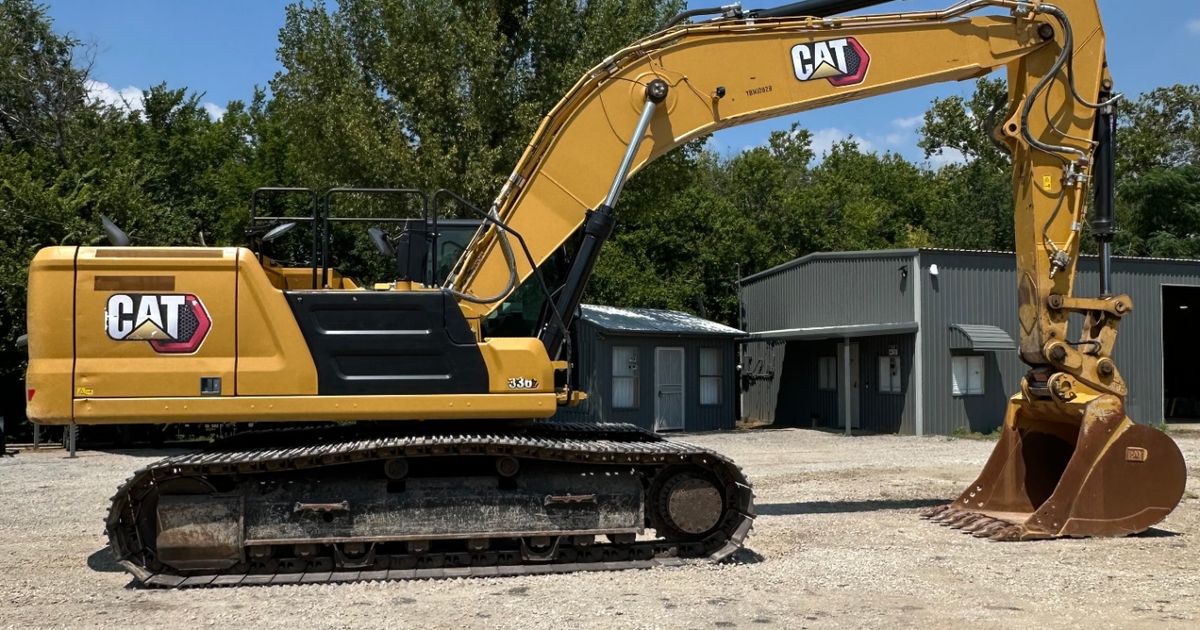
We get this call multiple times a week: a crew hits something solid 5 feet down, the bucket is spinning, and the project manager wants to know the fastest path forward. Nine times out of ten, the answer is a hydraulic breaker — but the right hydraulic breaker, properly matched to the carrier, operated the right way. Get any of those variables wrong and you'll either underperform on the material or put serious stress on a machine that costs six figures to replace. This guide covers what we've learned running breaker attachments across North Texas job sites in conditions ranging from black gumbo clay to solid limestone cap and 105°F summer heat.
Key Takeaways
- Hydraulic breakers should weigh approximately 8–12% of the excavator's operating weight — oversizing damages the carrier's boom and undercarriage over time.
- North Texas caliche formations, typically encountered at 4–8 feet deep in Denton, Celina, Prosper, and surrounding areas, require breaker impact energy of at least 700–1,200 ft-lbs for efficient penetration.
- Running a hydraulic breaker dry for more than 15–30 seconds causes blank firing that can destroy internal components in a single shift.
- CAT H-series hydraulic breakers require specific carrier hydraulic flow ranges — mismatched flow rates reduce blow frequency by up to 40% and accelerate wear.
- North Texas summer heat regularly exceeds 100°F; monitoring hydraulic fluid temperature and front-loading breaker-intensive work to morning hours extends attachment life significantly.
When Should You Use a Hydraulic Breaker Instead of a Bucket?
The decision point is straightforward: when the bucket is rocking the machine instead of breaking material, you've exceeded what a bucket can accomplish. More specifically, hydraulic breakers are the correct primary tool for reinforced concrete demolition, natural rock formations (limestone, caliche, sandstone), heavily compacted caliche hardpan, frozen ground, and existing structural demolition where controlled breaking is required by your scope of work.
One scenario we see frequently involves utility contractors working in Prosper, Celina, and Gunter — municipalities experiencing explosive growth — who underestimate what's below the topsoil. North Texas caliche forms a notoriously hard layer, often described as a calcium carbonate cemented rock, anywhere from 4 to 8 feet below grade across the DFW metroplex. A crew planning for dirt work suddenly finds themselves on material that rates between 2,000 and 8,000 PSI compressive strength depending on the formation. At that point, an excavator bucket is the wrong tool. According to the U.S. Geological Survey, caliche is one of the most common near-surface rock formations in arid and semi-arid regions, and North Texas sits squarely in that classification.
Conversely, hydraulic breakers are not the right tool for soft clay excavation, trenching in loose soil, or any application where you're tempted to use the breaker as a bucket substitute. We see operators try to scoop or drag material with the breaker — that's how you bend tool steel and damage the bracket assembly. Use each attachment for what it's engineered to do.
How Do You Match a Hydraulic Breaker to Your Excavator?
Breaker-to-carrier matching is the most important spec decision you'll make, and it comes down to three primary variables: breaker operating weight relative to excavator operating weight, hydraulic flow requirements, and operating pressure range.
The standard industry guideline, supported by Caterpillar's own attachment sizing recommendations, is that a hydraulic breaker should represent approximately 8–12% of the excavator's operating weight. For a CAT 320 excavator with an operating weight around 44,000 lbs, that puts the appropriate breaker in the 3,500–5,300 lb range. Run something significantly heavier and you're overloading the stick, boom pins, and undercarriage structure every time you absorb vibration. Run something too light and you're wasting machine hours with insufficient impact energy for the material.
Hydraulic flow matching is equally critical and more frequently botched. CAT H-series breakers — the H115, H130, H160, and H180 models we stock — each require specific gallons-per-minute flow ranges from the carrier's auxiliary hydraulic circuit. The H130 S, for example, requires 26–45 GPM at 2,100–2,500 PSI operating pressure. If your excavator's auxiliary circuit delivers outside that window, blow frequency drops dramatically — up to 40% below spec in our experience — and internal valve components wear at an accelerated rate. Before any rental, we verify carrier compatibility so our customers aren't losing productivity hours in the field trying to diagnose an attachment that was never matched correctly.
The Associated General Contractors of America recommends that contractors confirm auxiliary hydraulic specs directly from the machine's service manual — not the general spec sheet — because factory settings can differ from field configurations on older machines.
What Are the Correct Operating Techniques for Hydraulic Breakers?
Proper technique extends attachment life and maximizes penetration rate. The most important rule: keep the tool (chisel or moil point) perpendicular to the work surface and maintain steady downward crowd pressure throughout the breaking cycle. The excavator should be applying enough crowd force that the breaker isn't bouncing — you want consistent contact — but not so much that you're lifting the rear of the machine.
Blank firing is the single most destructive operational error. When the chisel punches through material and the breaker fires with no resistance, internal piston energy has nowhere to go except back into the housing components. Fifteen to thirty seconds of blank firing can cause damage that voids manufacturer warranties and puts the attachment out of service. Train every operator to release the trigger the moment material gives way.
Move the breaker frequently. Many operators find a spot, fire continuously, and wonder why penetration slows. Breaking rock creates a compaction zone around the impact point — shift the chisel 6–8 inches laterally every 30–60 seconds to exploit fracture lines and avoid that compaction wall. On caliche specifically, this technique can increase penetration rates by 25–35% compared to staying in one position.
One of our long-term customers running a utility crew out of McKinney shared this: they were averaging 45 minutes per rock crossing on a fiber conduit project until one of our field techs watched them work and pointed out they were staying on the same spot for 3–4 minutes at a time. Switching to the move-frequently technique dropped their average to 22 minutes per crossing. Same machine, same breaker, completely different result from technique alone.
How Does North Texas Heat Affect Hydraulic Breaker Performance?
North Texas summers are brutal on hydraulic systems, and breaker attachments are high-heat-generating tools even in moderate conditions. A hydraulic breaker converts hydraulic energy into mechanical impact, and that process generates significant heat in the return circuit. When ambient temperatures are sitting at 103–107°F in July and August — which is routine across Denton, Fort Worth, Waco, and Wichita Falls — your hydraulic system is already fighting to stay in the safe operating range before the breaker adds its load.
According to SAE International's hydraulic fluid standards, most construction equipment hydraulic systems are designed to operate optimally between 100–180°F fluid temperature, with degradation accelerating above 200°F. Extended breaker operation in full Texas summer sun can push system temperatures toward that upper limit faster than most operators realize.
Our standard recommendation for summer breaker work: schedule the highest-intensity breaking cycles in the early morning — 6:00 to 10:00 AM — when ambient temperature is 15–25°F lower. Check hydraulic fluid temperature on the machine's monitor every 30–45 minutes during continuous breaker operation. If you're seeing temperatures climb above 185°F, give the system a 10–15 minute cooling cycle with the engine at idle. Also, verify hydraulic fluid was changed on schedule — heat-degraded fluid loses viscosity characteristics faster, and a breaker on degraded fluid will show accelerated internal wear.
The flip side is winter. We do get freeze events in North Texas — ice storms in Denton, Sherman, and Denison are more common than people plan for. Cold hydraulic fluid is thick hydraulic fluid, and a cold-start breaker operation in sub-30°F temperatures can cavitate the pump if you don't allow proper warm-up. Run the machine at idle for 10–15 minutes before engaging any attachment hydraulics when temps are near or below freezing.
What Safety Standards Apply to Hydraulic Breaker Operations?
Hydraulic breaker operation on public or commercial job sites falls under OSHA 29 CFR 1926 Subpart Q, which covers demolition operations, and Subpart P for excavations. Beyond regulatory compliance, the practical safety requirements that matter most on North Texas job sites involve flyrock control and underground utility clearance.
Caliche and limestone fracture unpredictably. Rock fragments can travel 50–100 feet from the impact zone with enough velocity to cause serious injury. Establish a minimum 100-foot exclusion zone around active breaker operations, and brief every crew member before the first hammer stroke. We also recommend rubber deflector guards on the breaker housing when working in confined urban environments — standard practice on infill projects in Irving, Carrollton, and Mesquite where there's less buffer between the work zone and other trades or pedestrian areas.
Underground utility location is non-negotiable. Texas law requires Texas 811 notification before any ground disturbance. This is especially important in the rapidly developing areas of Frisco, Little Elm, and Trophy Club, where utility corridors are dense and not always marked consistently on older plats. A hydraulic breaker fired into an unmarked gas line or high-voltage conduit is a catastrophic event — not a near-miss.
What Maintenance Does a Hydraulic Breaker Require Between Uses?
Hydraulic breakers require more daily maintenance attention than most attachments, and skipping these steps is how a rental customer ends up with a down machine mid-project. The critical daily checklist: grease the tool bushing and retainer pins (most breakers need greasing every 2–4 hours of operation, not just daily), inspect the chisel for mushrooming at the tip and cracks along the shank, check hydraulic line connections for seepage, and verify that through-bolts are at specified torque.
Chisel condition directly affects performance. A mushroomed chisel tip transfers energy poorly — instead of concentrating force at a point, it spreads impact across a larger contact area, reducing effective breaking force. We replace or recondition chisels when tip mushrooming exceeds 10% of original diameter. In high-production caliche breaking, that can mean chisel inspection every 40–60 operating hours.
Nitrogen charge pressure in the back head (applicable to gas-charged breaker designs) should be checked monthly or any time performance seems reduced. Low nitrogen charge is a common cause of reduced blow energy that operators frequently misdiagnose as a hydraulic flow problem. This is a service item we handle between rentals, but it's worth understanding so you know what to ask about when comparing rental options.
If you're working a project in the Denton, Argyle, Aubrey, or Decatur area and need guidance on which breaker fits your carrier or your material conditions, call us at (817) 403-4334. We'll ask about your excavator model, the material you're hitting, and your daily production targets — and we'll put the right attachment on the trailer before it leaves our yard.
How Long Does It Take to Break Through Caliche or Concrete with a Hydraulic Breaker?
Production rates vary significantly based on material hardness, breaker size, operator technique, and formation thickness — but we can give you realistic field numbers from North Texas job sites. For North Texas caliche hardpan at moderate hardness (2,000–4,000 PSI), a properly matched mid-size breaker on a 20-ton excavator will typically advance 1.5–3 linear feet of trench per hour in solid formation. In fractured or layered caliche, that number improves to 3–6 feet per hour as the formation cooperates with splitting rather than requiring pure pulverization.
Reinforced concrete demolition (slabs, footings, grade beams) on a commercial demo project typically runs 15–25 cubic yards per hour for a mid-class breaker on a 20-ton carrier, with rebar still embedded. That rate drops to 10–15 cubic yards per hour on heavily reinforced structural concrete at 5,000 PSI or above, which is common in the commercial tilt-wall construction that dominates the Frisco, Prosper, and Allen corridors.
These numbers are why project managers need to plan breaker time into their schedules when working any North Texas site that hasn't been fully geotech-characterized. We've seen projects in Gainesville and Bowie where crews were budgeted for three days of excavation and spent two of those days on caliche they didn't anticipate. A preliminary soil boring report — even a basic one from a geotechnical firm — can save you from that situation. The American Society of Civil Engineers recommends subsurface investigation for all commercial and infrastructure projects as standard pre-construction due diligence.
When you're ready to put a hydraulic breaker to work on your project — whether you're clearing caliche for a utility corridor in Celina, demolishing an old foundation in Mansfield, or breaking rock for a commercial pad site in Weatherford — our team at Benchmark Equipment Rental & Sales in Denton is ready to match you with the right attachment and the right carrier. Call us at (817) 403-4334 and let's put together a solution that keeps your crew productive from the first swing.
Frequently Asked Questions
What size hydraulic breaker do I need for my excavator?
A hydraulic breaker should weigh approximately 8–12% of your excavator's operating weight for proper matching. For a 20-ton (44,000 lb) excavator like a CAT 320, the appropriate breaker falls in the 3,500–5,300 lb range. You also need to match the breaker's required hydraulic flow (GPM) and operating pressure (PSI) to your machine's auxiliary circuit specifications — mismatched flow rates can reduce blow frequency by up to 40% and cause accelerated internal wear.
How deep is caliche rock in North Texas and do I need a hydraulic breaker for it?
Caliche formations in the DFW and North Texas area typically appear 4–8 feet below grade, though depth varies by location. This calcium-carbonate cemented rock layer can reach compressive strengths of 2,000–8,000 PSI, which is far beyond what an excavator bucket can penetrate. A hydraulic breaker with impact energy of at least 700–1,200 ft-lbs is required for efficient penetration, and mid-size breakers on 20-ton carriers typically advance 1.5–3 linear feet of trench per hour through solid caliche formations.
What causes blank firing in a hydraulic breaker and how do I prevent it?
Blank firing occurs when the hydraulic breaker's chisel punches through material and the hammer fires with no resistance, sending piston energy back into the housing components rather than into the rock or concrete. Even 15–30 seconds of continuous blank firing can destroy internal components and void the manufacturer's warranty. Prevent it by training operators to immediately release the trigger the moment material fractures and the tool breaks through, and by moving the chisel frequently to exploit natural fracture lines in the material.
Can I use a hydraulic breaker in hot summer weather in Texas?
Yes, but hydraulic temperature management becomes critical in North Texas summer conditions where ambient temperatures regularly exceed 100°F. Hydraulic breakers generate significant heat in the return circuit during operation, and combined with summer ambient temperatures, fluid temps can approach 185–200°F — the upper limit where degradation accelerates. Schedule the most intensive breaking work in early morning hours (6–10 AM), monitor hydraulic fluid temperature every 30–45 minutes during continuous operation, and allow 10–15 minute cooling cycles at idle if temps climb above 185°F.
Do I need to call 811 before using a hydraulic breaker in Texas?
Yes — Texas law requires contacting Texas 811 before any ground disturbance, including hydraulic breaker operations. This is especially critical because a hydraulic breaker fired into an unmarked underground utility line creates catastrophic hazard risk. Allow the required 48-hour waiting period after notification before beginning work, and treat all utility marking as approximate — maintain safe clearance distances and hand-dig or vacuum excavate near marked utility corridors before engaging the breaker.