.png)
Key Takeaways
- Trench depth is the primary sizing factor. Water and sewer lines at 4–6 feet need a CAT 308 or CAT 310. Storm drain and force mains at 8–12 feet require a CAT 313 or CAT 320.
- North Texas soil changes everything. Expansive black-gumbo clay above 4 feet digs easily, but caliche rock starting at 4–8 feet demands higher breakout force and possibly a hydraulic breaker attachment.
- Right-of-way width limits machine size. Residential easements in Prosper and Celina subdivisions are often only 15–20 feet wide, ruling out anything larger than a CAT 313.
- Underestimating machine size increases costs by 25–40% due to slower cycle times, extra shifts, and accelerated wear on undersized buckets and teeth.
- Overestimating wastes money too. A CAT 325 on a 4-foot residential waterline trench burns 30–50% more fuel than a properly matched CAT 308 with no meaningful productivity gain.
Utility trenching is one of the most common excavation tasks across the North Texas corridor. From new water mains feeding master-planned communities in Celina and Prosper to sewer line extensions supporting commercial growth along US-380 in Denton and McKinney, contractors face the same decision on every bid: which excavator size will get the trench dug safely, on schedule, and within budget?
Our fleet at Benchmark Equipment serves utility contractors across Denton, Fort Worth, Frisco, McKinney, Prosper, and Celina every week. We see firsthand how the right machine selection separates profitable jobs from money-losing ones. This guide breaks down the factors that matter most and matches them to specific CAT excavator models so you can make a confident choice before your next project.
What Excavator Size Do I Need for Standard Utility Trenching?
The answer depends on three variables: required trench depth, trench width, and whether you need to set pipe or just open the ditch. The Occupational Safety and Health Administration (OSHA) defines an excavation as any man-made cut, cavity, or depression in the earth, and sets strict protective system requirements once the trench exceeds 5 feet in depth.
Here is a practical breakdown by utility type and depth:
Residential water service (3–4 feet): A CAT 308 (8-ton class) provides 12 feet, 9 inches of dig depth—far more than required—while staying compact enough to maneuver between curbs, driveways, and landscaping.
Sanitary sewer laterals and mains (5–8 feet): A CAT 310 (10-ton class) or CAT 313 (13-ton class) provides the extra breakout force needed for deeper cuts. The CAT 313 delivers roughly 18,800 pounds of bucket digging force, which becomes critical once you hit the dense clay and caliche layers common below 4 feet across Denton County.
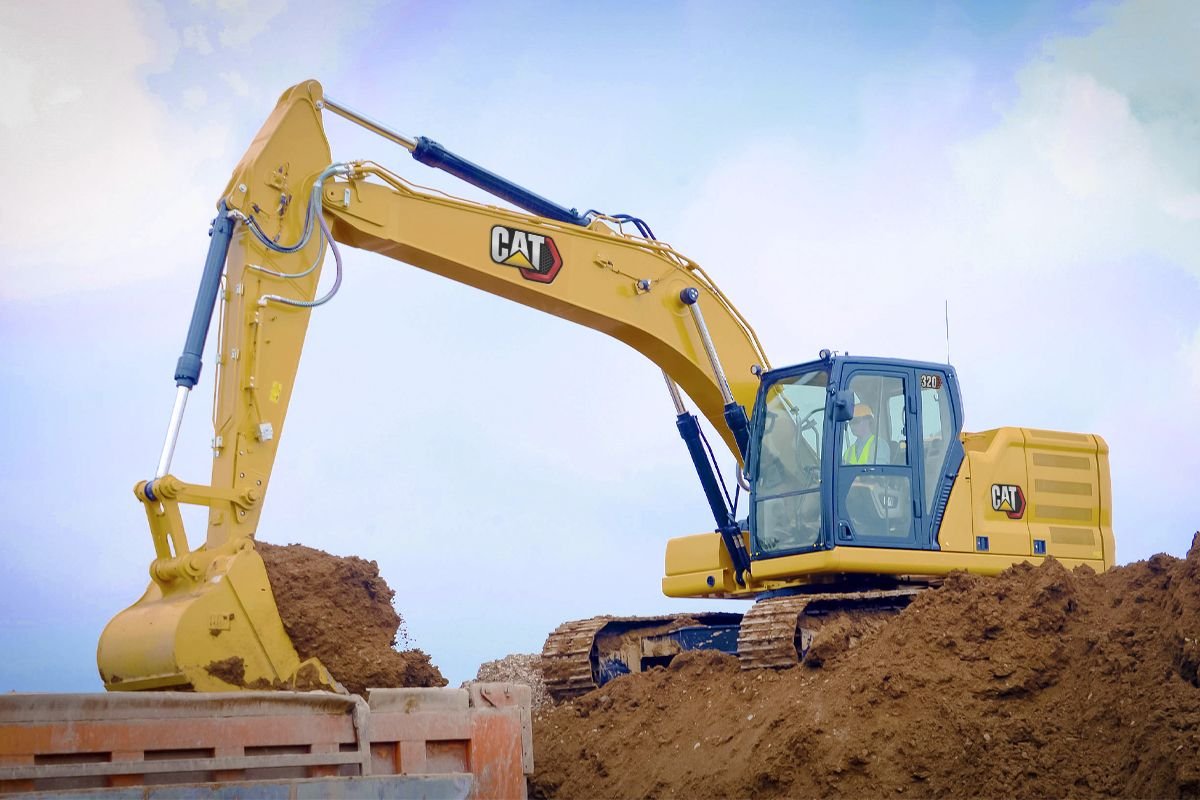
Storm drain and force mains (8–14 feet): A CAT 320 (20-ton class) is the standard workhorse for deep utility trenching. With over 20 feet of maximum dig depth and 36,200 pounds of bucket digging force, the CAT 320 handles deep trenches through mixed soil and rock profiles. For trunk sewer lines exceeding 14 feet, a CAT 325 (25-ton class) provides additional reach and lifting capacity.
How Do North Texas Soil Conditions Affect Excavator Selection?
Soil conditions across North Texas are uniquely challenging. The USDA Natural Resources Conservation Service Web Soil Survey classifies much of Denton, Collin, and Tarrant counties as Houston Black clay—what local contractors call "black gumbo."
This expansive clay presents two distinct challenges. In wet conditions, it becomes extremely sticky, adding 40–60% more weight to every bucket load. In dry conditions, the same clay hardens, requiring substantially more breakout force to penetrate.
Below the clay layer—typically starting at 4 to 8 feet—contractors across Denton, McKinney, and Prosper frequently encounter caliche rock. According to the United States Geological Survey (USGS), caliche formations in north-central Texas can reach compressive strengths exceeding 3,000 PSI. When your trench profile includes caliche, bump up at least one excavator size class.
What Size Excavator Fits Tight Right-of-Way Work in North Texas Subdivisions?
Rapid residential growth across Prosper, Celina, Frisco, and north McKinney means contractors are constantly installing utilities in active subdivisions with narrow easements. According to the Associated General Contractors of America (AGC), equipment access constraints add an average of 15–20% to utility installation costs.
Machine transport width becomes the controlling dimension:
CAT 308: Approximately 6 feet, 11 inches. Fits comfortably in most residential easements.
CAT 310: Approximately 7 feet, 3 inches. Still fits residential easements but has less clearance margin.
CAT 313: Approximately 7 feet, 9 inches. The practical upper limit for most residential utility easements.
CAT 320: Approximately 10 feet, 2 inches. Generally too wide for residential easements but suitable for commercial corridors.
CAT 325: Approximately 10 feet, 8 inches. Reserved for open-site trunk utility work and deep sewer installations.
How Does Trench Production Rate Change with Excavator Size?
Production rate is where the financial impact becomes concrete. Based on our experience renting to utility contractors across the DFW metroplex, here are representative rates for a 6-foot-deep sewer trench in typical North Texas clay:
CAT 308: 80–120 linear feet per hour in clean clay. Drops to 40–60 in caliche.
CAT 313: 120–180 linear feet per hour in clean clay. Maintains 70–100 through moderate caliche.
CAT 320: 160–220 linear feet per hour in clean clay. Maintains 100–140 through moderate caliche.
A CAT 313 produces roughly 50% more linear footage per hour than a CAT 308 in the same conditions. On a 2,000-linear-foot sewer main, that difference translates to 2–3 full working days saved—representing $8,000–$15,000 in reduced labor, fuel, and overhead costs.
What Attachments Should I Pair with My Excavator for Utility Trenching?
Hydraulic thumb: Essential for handling pipe, pulling existing utilities, and placing bedding material. On a CAT 308 or CAT 313, a properly sized hydraulic thumb can safely handle 6- to 12-inch PVC or ductile iron pipe sections.
Hydraulic breaker: Required for caliche rock. The OSHA Silica Standard (29 CFR 1926.1153) requires dust controls when breaking rock containing crystalline silica, which includes North Texas caliche.
Narrow trenching bucket: A 12- to 18-inch bucket minimizes over-excavation, reduces spoil volume, and cuts backfill costs.
What Safety Requirements Apply to Utility Trenching in North Texas?
OSHA 29 CFR 1926 Subpart P requires protective systems for any trench 5 feet or deeper, and the excavator must be positioned far enough from the trench edge to avoid contributing to a cave-in.
The heavier the excavator, the greater the surcharge load near the trench. In the expansive clay soils common across Denton and Collin counties, this setback distance is critical because the clay's shrink-swell behavior creates natural fracture planes that reduce shear strength.
Choosing a machine with good visibility is another safety consideration. The CAT 308 and CAT 313 both feature rear and side cameras as standard equipment. On deep trenches where workers must enter, this visibility can prevent struck-by incidents—which remain the second leading cause of construction fatalities according to the Bureau of Labor Statistics.
Excavator Size Selection Quick Reference for North Texas Utility Work
| Utility Type | Typical Depth | Machine (Clay) | Machine (Caliche) |
|---|---|---|---|
| Residential waterline | 3–4 ft | CAT 308 | CAT 308 or 310 |
| Sewer lateral | 4–6 ft | CAT 308 or 310 | CAT 313 |
| Sewer main | 6–8 ft | CAT 313 | CAT 320 |
| Storm drain | 8–12 ft | CAT 320 | CAT 320 or 325 |
| Trunk sewer / force main | 12–18 ft | CAT 325 | CAT 325 + breaker |
Ready to get the right excavator on your next utility trenching job?
Call us at (817) 403-4334 or browse our available equipment online.
Frequently Asked Questions
What size excavator do I need for a 6-foot utility trench in North Texas?
For a 6-foot trench in typical North Texas clay, a CAT 310 or CAT 313 is the best match. The CAT 313 provides the extra breakout force needed if you encounter caliche rock below 4 feet. Both machines fit within standard residential utility easements of 15–20 feet.
Can a mini excavator handle utility trenching in expansive clay?
Mini excavators under 6 tons can dig shallow utility trenches in soft clay, but they lack the breakout force for productive work in dense North Texas black gumbo. An 8-ton CAT 308 is the practical minimum for utility trenching in this region.
How much does it cost to rent an excavator for utility trenching near Denton, TX?
A CAT 308 typically rents for $1,500–$2,500 per week, while a CAT 320 runs $3,000–$4,500 per week. Monthly rates offer significant savings. Call Benchmark Equipment at (817) 403-4334 for current availability and pricing.
What is caliche and why does it matter for excavator selection in North Texas?
Caliche is a hardened calcium carbonate rock layer found 4–8 feet below the surface across much of Denton and Collin counties. It can reach compressive strengths above 3,000 PSI, requiring 30–50% more breakout force than clay-only trenching—which typically means stepping up one machine size class or adding a hydraulic breaker.