.png)
Finish grading is where a project either comes together or falls apart. You can do everything right in excavation and rough cut, but if the equipment selection for finish work is off, you're looking at failed inspections, drainage callbacks, and re-work that eats margin fast. We've watched that scenario play out more times than we care to count — and almost always, the root cause wasn't operator error. It was the wrong machine for the conditions.
North Texas makes precision grading harder than most regions. The black gumbo clay across Denton County and into Collin County behaves differently wet versus dry, the caliche shelf under much of the Prosper-to-Sherman corridor demands extra prep work, and summer heat affects hydraulic performance in ways that directly impact blade accuracy. Equipment selection here isn't a generic checklist — it's a site-specific decision that factors in soil profile, project tolerance requirements, and the season you're working in.
Key Takeaways
- Motor graders deliver ±0.1-foot accuracy on open grading passes, while GPS-guided blade systems can tighten tolerances to ±0.05 feet on large commercial pads
- North Texas expansive clay (black gumbo) requires moldboard pitch adjustments and often a scarifier pass before finish grading to prevent blade loading
- Compact track loaders outperform skid steers on wet DFW clay — ground pressure as low as 4.5 PSI vs. 20+ PSI prevents rutting during finish work
- Caliche rock formations at 4-8 feet depth in the Denton/Frisco corridor routinely require ripping passes before any fine grading can begin
- Equipment running in 100°F+ Texas summers needs a 10-15% longer warm-up idle before grading to stabilize hydraulic fluid viscosity for consistent blade response
What Equipment Do You Need for Precision Finish Grading?
The right equipment for finish grading breaks down by scale. For large commercial pads — think the kind of site development happening along the US-380 corridor in Celina and Prosper right now — a motor grader is the primary tool. CAT's 140M3 and 12M3 models are workhorses in our fleet for this application. The 140M3's 14-foot moldboard gives you the blade width to maintain consistent cross-slope on wide pads, and its articulated frame lets operators feather blade angle on long finish passes without fighting the machine's momentum.
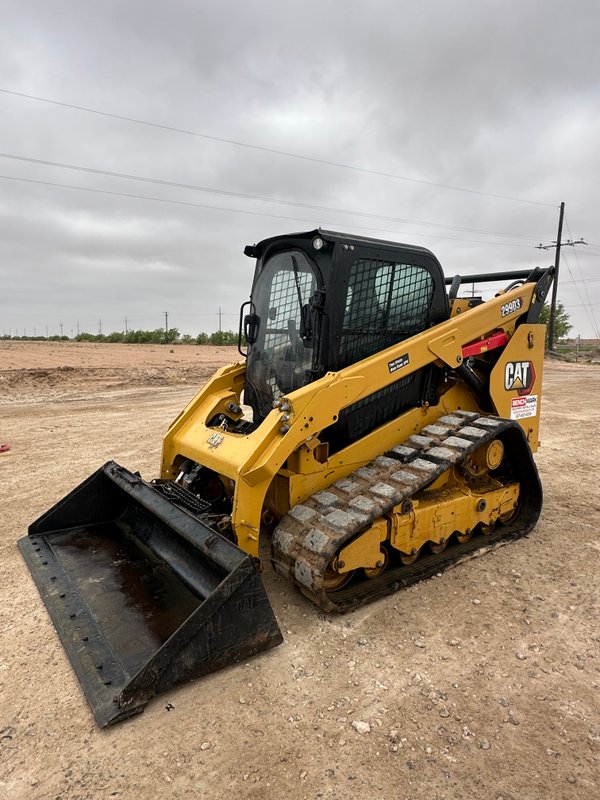
For smaller residential lots, utility corridor work, or any site where a full motor grader is physically oversized, a compact track loader with a 6-way blade or finish grading bucket is the answer. The CAT 289D3 and 299D3XE models have become go-to finish tools for residential developers in Argyle, Trophy Club, and the tighter subdivisions coming out of the ground in Van Alstyne and Gunter. Their ability to fine-tune grade in close quarters — around utility stubs, near foundation forms — is something a motor grader simply can't replicate.
According to Associated General Contractors of America, improper equipment selection for earthwork operations is a primary driver of schedule overruns on grading-intensive projects. The rule of thumb we've developed over years of watching North Texas contractors work: if your finished grade tolerance is tighter than ±0.1 foot, you need either GPS-guided grader or a second pass with a smaller precision machine.
How Does North Texas Clay Soil Affect Grading Equipment Choice?
Expansive clay — what locals call black gumbo — is the dominant soil type across most of Denton, Collin, and Tarrant counties, and it creates specific grading challenges that equipment operators in other regions don't face. When this soil is wet, it loads up on a motor grader moldboard fast, creating drag that pulls blade angle off spec and forces constant correction. When it's dry, it cuts hard and can bounce a compact machine off line on finish passes.
The practical solution for wet clay conditions: run a scarifier or ripper pass ahead of finish grading. Our customers working development sites in Little Elm and Frisco use this approach routinely — one pass with the rear-mounted scarifier on a CAT 140M3 to break the clay crust, then a finish grade pass with moldboard pitch adjusted forward to shed material rather than load it. This combination can reduce finish grading time by 20-30% compared to fighting loaded clay on a single pass.
Ground pressure is the other critical factor. On wet clay, a standard wheeled skid steer at 20+ PSI will track and rut your finish surface. A compact track loader at 4.5 PSI — like the CAT 289D3 on standard tracks — stays on top of soft clay without disturbing the surface you just graded. We've seen contractors rent a skid steer for finish work on a wet site in McKinney, cut ruts, then spend an afternoon re-grading. The track loader rental costs more per day; the overall job costs less. The USDA Natural Resources Conservation Service classifies much of DFW-area soils as Vertisols — the same shrink-swell clay classification that demands low ground pressure equipment across agricultural and construction applications.
What Grading Equipment Works Best on Caliche and Rocky North Texas Soils?
Caliche is a calcium carbonate hardpan that sits at roughly 4-8 feet depth across much of the northern DFW metro — particularly in the corridor from Denton down through Decatur, Weatherford, and west into Wise County. At grade, you're usually not dealing with caliche directly, but disturbed caliche material brought up during rough excavation creates a finish grading problem that motor grader blades alone can't solve cleanly.
When we get calls from contractors grading in Decatur, Bowie, or out near Wichita Falls, the first question we ask is whether they've hit caliche. If they have, the blade geometry changes. Caliche chunks mixed into grade material require a heavier blade angle and slower pass speed — the 14-foot moldboard on a CAT 140M3 handles this better than a smaller 12-foot blade because it can work material across a wider span before it clears the edge. Running a finishing pass at 3-4 mph over mixed caliche-clay material gives the blade time to level and shear consistently, rather than skipping over hard chunks.
For sites where caliche is at or near the finished grade surface — something we see occasionally on commercial developments in Weatherford and some areas west of Fort Worth — a hydraulic hammer or rotary cutter attachment on an excavator needs to be in the equipment plan before any fine grading starts. Trying to finish grade over intact caliche with a motor grader blade isn't grading. It's expensive frustration. The Federal Highway Administration's geotechnical engineering guidance specifically addresses caliche hardpan as a unique material requiring pre-treatment before compaction and finishing operations.
How Does Summer Heat in Texas Impact Grading Equipment Performance?
Running grading equipment in 100°F-plus Texas summers isn't just uncomfortable for operators — it has direct mechanical effects that impact precision. Hydraulic fluid viscosity drops as temperature climbs, and on a motor grader, that means the hydraulic cylinders controlling blade pitch and lift respond slightly differently than they do in cooler conditions. The difference is subtle, but on a job requiring ±0.05-foot tolerances for a concrete flatwork subgrade, subtle matters.
Our standard recommendation for summer operation: idle the machine for 10-15 minutes before starting grading passes, longer than the typical 5-minute warm-up, to let hydraulic fluid reach operating temperature and stabilize viscosity. Check hydraulic fluid level before every shift — North Texas summer heat accelerates fluid expansion and can affect reservoir readings if you're checking immediately after shutdown. CAT equipment in our fleet is spec'd with high-temp hydraulic fluid for exactly this environment, but operator habits around warm-up and monitoring make the difference on precision work.
The other summer-specific issue: dry clay. When Denton County clay dries out in July and August, it can become nearly as hard as caliche at the surface. A motor grader blade at normal cutting angle will skip and chatter rather than cut cleanly. The fix is either pre-watering the surface (which most contractors do anyway for dust control under OSHA's crystalline silica standard, 29 CFR 1926.1153) or adjusting blade pitch to a more aggressive cutting angle. Either approach works — the key is recognizing the problem before it affects your grade tolerances.
Should You Use GPS Grading Systems for Finish Work?
GPS-guided grading systems have moved from luxury to near-standard on commercial site work in North Texas over the past five years. The math is straightforward: a GPS-guided motor grader can hold ±0.05-foot accuracy consistently, compared to ±0.1-foot for a skilled operator running grade stakes. On a 10-acre commercial pad in Celina or Prosper, that accuracy difference translates to meaningfully less material waste and fewer re-grade passes before compaction testing.
According to industry data from Construction Equipment magazine, GPS machine control on motor graders reduces finish grading time by an average of 25-40% on large-scale commercial sites compared to conventional stake-and-string methods. We've seen this validated repeatedly with our customers doing pad work along the US-380 corridor — the speed advantage alone often justifies the technology cost on jobs over 5 acres.
For residential lots and smaller commercial work, GPS adds cost without proportional benefit. A skilled operator on a CAT 289D3 compact track loader with a finish bucket and good grade stakes will hit residential tolerances efficiently. The crossover point in our experience is roughly 3-5 acres: below that, conventional grading by an experienced operator is usually the right call; above that, GPS guidance starts paying for itself in time saved.
What Compaction Equipment Pairs with Finish Grading?
Finish grading without the right compaction equipment following behind is an incomplete operation. For clay subgrade work — the dominant application across most of Denton, Collin, and Tarrant counties — a vibratory smooth drum roller or a padfoot roller is standard for the compaction layer, followed by a vibratory plate compactor for surface finishing in tight areas.
The Texas Department of Transportation's standard specifications require subgrade compaction to 95% of Standard Proctor density for most roadway and commercial applications — a threshold that demands proper lift thickness control and moisture conditioning before compaction, not just roller passes. When our customers in Mansfield, Crowley, or Irving are working under TxDOT specs or municipal inspection, they typically need both a motor grader and a vibratory roller on site simultaneously to keep the operation moving.
For finish work behind the grader on residential pads, a walk-behind vibratory plate compactor handles the spots the roller can't reach — around utility stubs, along foundation edges, in narrow utility trenches. We rent these alongside CTLs and motor graders regularly for exactly this reason. The combination of a grader or CTL for surface precision and a plate compactor for confined areas covers the full scope of most residential finish operations.
How Do You Choose Between Renting and Buying Grading Equipment?
For most small to mid-size grading contractors in North Texas, renting motor graders and finish CTLs makes more financial sense than purchasing, particularly given the variability of project scale across the DFW growth corridor. A motor grader sitting unused between commercial site jobs costs ownership roughly $8,000-15,000 per month in depreciation, financing, and storage — costs that disappear when you rent by the job.
The contractors who come out ahead owning grading equipment are those with consistent, predictable workloads that keep machines moving 150+ hours per month. Below that utilization threshold, rental is almost always the better economic choice. We work with contractors from Sherman and Denison down to Waco who rent graders for 2-4 week blocks during active grading phases, then return equipment between projects. The flexibility to swap from a 12M3 to a 140M3 based on current job scale — without carrying both on the books — is something ownership simply can't offer.
If you're planning finish grading work anywhere in our North Texas service area and want to talk through equipment selection for your specific site conditions, call us at (817) 403-4334. We'll ask about your soil conditions, grade tolerances, and site size before recommending anything — because the right machine for a Prosper commercial pad and the right machine for a Gainesville residential development are often different tools entirely.
Frequently Asked Questions
What is the best equipment for finish grading a residential lot in North Texas?
A compact track loader with a 6-way finish blade or finish bucket — such as the CAT 289D3 or 299D3XE — is the best choice for residential lot grading in North Texas. These machines offer ground pressure as low as 4.5 PSI on standard tracks, which prevents rutting in the region's expansive clay soil, and they can work precisely around utility stubs and foundation forms that a full motor grader cannot access. For lots larger than 3 acres, a motor grader becomes more efficient.
How accurate can a motor grader get on finish grading passes?
A skilled operator on a conventional motor grader can consistently achieve ±0.1-foot accuracy on finish grading passes. With GPS machine control systems, accuracy improves to ±0.05 feet or better, and industry data shows GPS guidance reduces finish grading time by 25-40% on large commercial pads over 5 acres. For projects requiring concrete flatwork subgrade, GPS-guided grading is increasingly the industry standard on commercial site work in North Texas.
Do I need to scarify before finish grading North Texas clay soil?
Yes, in most cases involving wet or heavily compacted black gumbo clay — the dominant soil type across Denton, Collin, and Tarrant counties — a scarifier pass ahead of finish grading significantly improves results. Wet clay loads up on a motor grader moldboard quickly, causing blade drift and inconsistent grade. Running a rear-mounted scarifier attachment to break the clay crust first can reduce finish grading time by 20-30% and produces a more consistent finished surface for compaction.
How does caliche rock affect grading operations in the DFW area?
Caliche hardpan sits at roughly 4-8 feet depth across much of the northern DFW metro, including Denton, Decatur, Weatherford, and Wise County areas. When caliche material is brought up during rough excavation and mixed into finish grade material, it requires slower motor grader pass speeds (3-4 mph vs. 5-6 mph) and adjusted blade pitch to cut cleanly. If intact caliche is at the finished grade surface, a hydraulic hammer or rotary cutter must be used to pre-treat the material before any fine grading can produce acceptable results.
Is it worth renting a motor grader or should I just use my skid steer for grading?
For jobs over roughly 2-3 acres requiring grade tolerances tighter than ±0.2 feet, a motor grader will outperform a skid steer in both speed and accuracy. A motor grader's long wheelbase maintains consistent cross-slope over large areas where a skid steer's short wheelbase follows surface undulations rather than correcting them. On North Texas clay, a skid steer also creates rutting problems on wet sites that a motor grader or compact track loader avoids — renting the right machine typically costs less than the re-work caused by using the wrong one.