.png)
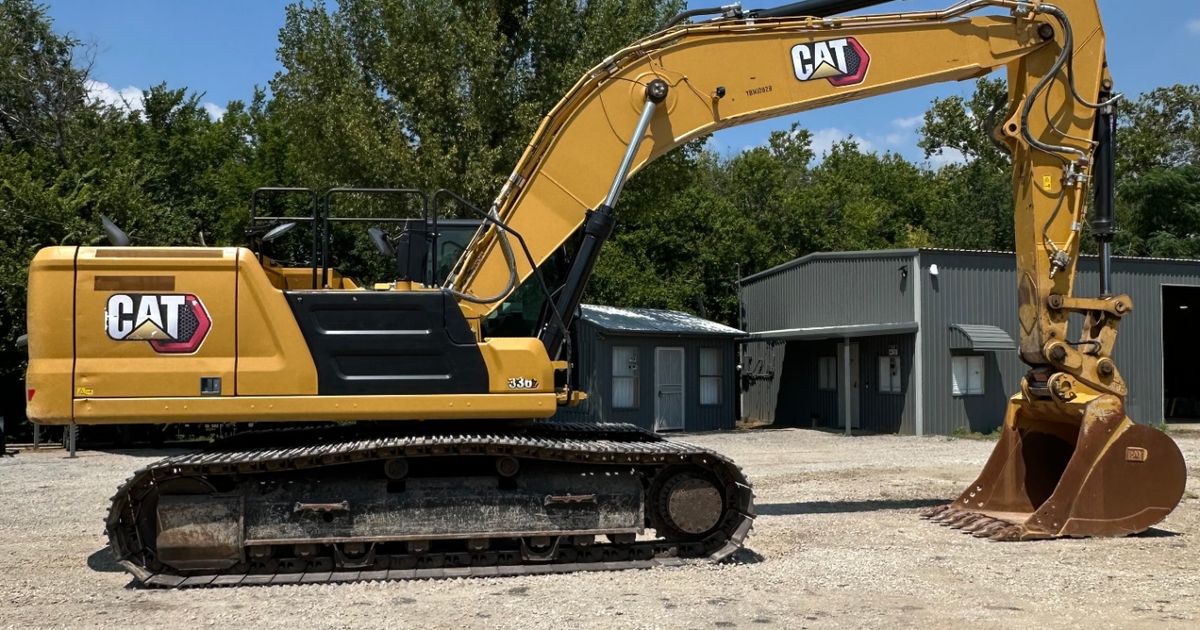
Every contractor who has lost money on a bid knows the feeling: you ran the numbers, the equipment looked right on paper, and somewhere between the estimate and the invoice, production fell short. In our experience renting equipment out of Denton to job sites stretching from Waco to Wichita Falls and from Weatherford to Sherman, undercalculating productivity is the single most common reason a project bleeds margin. This post breaks down exactly how to estimate equipment production rates for bidding — with real numbers, real conditions, and the kind of ground-level knowledge that comes from watching machines work North Texas soil every day.
Key Takeaways
- Published manufacturer production rates typically represent ideal conditions — real-world North Texas job sites run at 50-75% of theoretical maximum due to clay soils, caliche rock, and heat-related downtime
- A CAT 320 excavator in medium soil conditions produces approximately 150-200 bank cubic yards per hour; in North Texas black gumbo clay, expect 20-30% reductions without the right bucket configuration
- Fuel burn and operator efficiency together account for up to 40% variance in actual vs. estimated production — tracking both on past jobs is the single best improvement you can make to your bidding process
- Haul distance is often the most underestimated productivity killer: a scraper or dozer pushing material more than 300 feet loses disproportionate time, and that cost compounds fast on large earthwork bids
What Is Equipment Productivity Rate and Why Does It Matter for Bidding?
A productivity rate is simply the volume of work a machine completes in a given time — cubic yards moved per hour, linear feet trenched per day, square yards compacted per pass. That number becomes the backbone of your equipment cost calculation. You divide total scope by hourly production to get hours required, multiply by your all-in hourly rate (rental, fuel, operator, maintenance), and that's your equipment line item.
The trouble is that most contractors either pull rates out of memory from past jobs or use catalog numbers without correction. Neither approach survives contact with a Celina subdivision site in July, where black gumbo clay has baked to near-rock hardness in the top 18 inches and caliche sits at 5 feet. Caterpillar's performance handbooks are an excellent starting point, but they explicitly state that published rates reflect a 60-minute working hour in average conditions. Your job is to adjust from there.
How Do You Calculate Equipment Production Rates from First Principles?
The standard formula for excavator or loader production is straightforward: Production (BCY/hr) = (Bucket Capacity × Fill Factor × 3,600 seconds) ÷ (Cycle Time in seconds × Swell Factor). Every variable in that equation is adjustable based on your specific job conditions.
Take a CAT 320 excavator with a 1.2 cubic yard bucket working in North Texas clay. The fill factor for cohesive clay typically runs 0.95-1.10 because clay packs well. But cycle time stretches considerably — a typical 90-degree swing-and-dump cycle in easy digging conditions might be 20 seconds; in stiff, wet black gumbo clay, you're looking at 25-30 seconds as the machine works harder to break material loose. Running those numbers: at 20-second cycles and 0.95 fill factor, you get roughly 205 loose cubic yards per hour. At 28-second cycles, you're at 146 LCY/hr. That 60 LCY/hr difference, across a 2,000 CY foundation dig, adds nearly 14 hours to your estimate — a significant number when you're competing on a tight commercial bid in Prosper or Frisco.
We've seen this play out with customers digging detention ponds near Little Elm and Trophy Club. The upper soil profile looks manageable during site visits, but once excavation hits the transition zone between weathered clay and caliche at 4-6 feet, production slows dramatically. Customers who factored in a rock correction — or who called us about switching to a larger machine mid-job — protected their margins. Those who didn't ended up eating extra days of rental and operator wages.
What Efficiency Factors Should You Apply to Published Production Rates?
The job efficiency factor is the most powerful correction tool in your estimating toolkit. The Associated General Contractors of America and Caterpillar's Performance Handbook both recognize that a true 60-minute productive hour rarely exists on any job site. Industry standard efficiency factors run as follows: excellent conditions warrant 83% (50 productive minutes per hour); average conditions, 75% (45 minutes); poor conditions, 67% (40 minutes); and very poor conditions, 50% (30 minutes).
For North Texas operations, particularly on summer jobs in Denton, Argyle, Gainesville, or Wichita Falls where ambient temperatures regularly exceed 100°F, we recommend defaulting to the poor-condition efficiency factor as your starting point. Heat affects both equipment and operators. Hydraulic systems on excavators, dozers, and skid steers work harder in sustained 100°+ heat, and OSHA's heat illness prevention guidelines require additional rest breaks that reduce productive machine time. Our fleet data shows that during July and August heat spikes, effective productive hours per 10-hour shift drop to roughly 6.5-7 hours — a 30-35% reduction from a theoretical maximum.
Beyond heat, apply specific correction factors for these common North Texas variables:
Soil swell and load factor: North Texas clay typically swells 25-35% when disturbed. A bank cubic yard of black gumbo becomes 1.25-1.35 loose cubic yards in a truck or bucket. If you're bidding a haul-off job by the BCY but running production numbers in loose measure, you'll undercount truck trips and cycle times.
Caliche and rock corrections: Once excavation hits caliche — common at 4-8 feet across much of Denton County, Collin County, and Wise County — standard digging rates drop 40-60%. A CAT 320 that moves 150 BCY/hr in clay may produce only 60-90 BCY/hr in weathered caliche, and may require a hydraulic hammer attachment for hard caliche, at which point you're no longer estimating in cubic yards per hour but rather in hours per foot of advancement.
How Do You Estimate Dozer and Scraper Production for Earthwork Bids?
Dozer production estimates depend heavily on blade type, material, grade, and push distance. A CAT D6 dozing in average North Texas clay with a straight blade on flat ground produces roughly 150-200 BCY/hr at a 100-foot push distance. That number drops to 80-100 BCY/hr at a 300-foot push, and falls below 60 BCY/hr at 500 feet. The American Society of Civil Engineers construction estimating references confirm this exponential relationship between haul distance and dozer output — and it's why smart earthwork contractors use scrapers or loaders on spreads larger than 500 feet rather than trying to push it all with dozers.
For large residential subdivision grading projects — the kind we see constantly in Aubrey, Gunter, Van Alstyne, and Celina as the DFW metro continues expanding north — scraper production depends on load time, haul speed, dump time, and return speed. A single CAT 657 self-loading scraper in good conditions can move 500-700 BCY per hour on short hauls. Push-pull configurations add 25-40% to individual scraper production. If you're bidding a 50,000 CY rough grade in Celina and you're planning on dozers alone, run the haul distance math before you submit that number.
How Do Compaction Equipment Productivity Rates Work for Estimating?
Compaction is where we see the most underestimated estimates, particularly on utility trench restoration and subgrade prep jobs. Compaction production is calculated as: Productivity (CY/hr) = (Width × Speed × Layer Depth × Efficiency Factor) ÷ Number of Passes Required.
A CAT CS-series vibratory smooth drum roller working at 2 mph on 8-inch lifts of clay subgrade, achieving required density in 4 passes, produces roughly 200-250 compacted CY per hour on open ground. But FHWA's compaction specifications for roadway subbase typically require Proctor density testing every 500 linear feet, which introduces testing wait time into your production schedule. In wet spring conditions — which North Texas clay absorbs and holds exceptionally well — you may need to add lime stabilization, which changes your equipment lineup, material costs, and cure time entirely.
One scenario we see every spring along the I-35 corridor from Denton down toward Fort Worth and Irving: compaction crews hit specified density easily in the first few lifts, then struggle on deeper layers because the natural moisture in North Texas clay creates a soft subgrade that pumps under roller passes. Customers who didn't account for lime treatment or additional drainage time end up re-rolling sections and burning equipment hours with no forward progress. If your soil report shows plasticity index above 20 — common in Denton County black clay soils — build lime treatment into your compaction estimate as a conditional line item.
What Are the Most Common Productivity Estimation Mistakes Contractors Make on Bids?
After watching hundreds of jobs run through our rental fleet, we've identified the mistakes that consistently blow production estimates.
The first is ignoring mobilization and setup time. A machine that arrives on site at 7 a.m. is rarely producing at 7:15. Pre-shift walkarounds, attachment changes, layout verification, and morning coordination typically consume 20-30 minutes per shift. That's 4-5% of your available production time gone before the first bucket breaks ground.
The second is assuming one operator equals another. Experienced operators on a CAT 336 excavator routinely outproduce newer operators by 20-30% — not because they work faster, but because they minimize wasted motion, optimize swing angles, and keep cycle times tight. When you're staffing a job with someone who hasn't run a specific machine model before, build in a learning-curve factor for the first two to three days.
The third mistake is failing to account for weather windows in North Texas. Our freeze events — while shorter than in northern states — can shut down earthwork operations for 2-5 days when ground freezes or becomes saturated from thaw. Hydraulic systems on equipment sitting overnight in sub-20°F temperatures need extended warm-up periods, and frozen ground in Decatur or Bowie can dramatically slow production even when the air temperature climbs back above freezing. Build weather contingency into multi-week bids, especially for late fall and early spring projects.
If you're bidding a project in our service area and want to talk through equipment selection and realistic production estimates for the specific site conditions you're facing, give us a call at (817) 403-4334. We've tracked production data across a wide range of North Texas soil and seasonal conditions, and we're happy to help you build a bid that holds up.
How Should You Track and Improve Your Production Estimates Over Time?
The contractors who win work consistently and make money on it are almost always the ones who close the loop on their estimates. After each job, compare estimated production hours to actual hours by equipment type and task. A simple spreadsheet tracking machine type, task, soil conditions, operator, and actual CY or LF per hour becomes more valuable than any reference manual after two or three years of data.
Industry research cited by Construction Dive suggests that contractors who maintain job cost tracking systems improve bid accuracy by 15-25% within the first two years of consistent use. That improvement compounds directly into margin — either through more competitive bids on work you know you can execute efficiently, or through pricing appropriate contingency into jobs with higher risk conditions.
At Benchmark Equipment in Denton, we track utilization and performance data on every machine in our fleet. When customers ask us what a CAT 320 or a D6 dozer is actually producing on comparable North Texas jobs, we can give them real-world numbers — not just catalog specs. That's the kind of input that makes a bid defensible and a project profitable. Call us at (817) 403-4334 or stop by our Denton yard to talk through your next project's equipment needs before you submit your numbers.
Frequently Asked Questions
What is a realistic production rate for a CAT 320 excavator in North Texas clay soil?
A CAT 320 excavator in average North Texas clay soil produces approximately 150-200 bank cubic yards per hour under good conditions using a 1.2 CY bucket. In stiff black gumbo clay or when working near caliche formations at 4-8 feet deep, expect production to drop 20-40%, to roughly 90-150 BCY/hr. Always apply a job efficiency factor of 67-75% (poor to average conditions) for summer Texas work sites.
What efficiency factor should I use when estimating equipment production for a bid?
Standard industry efficiency factors range from 83% (excellent conditions, 50 productive minutes per hour) down to 50% (very poor conditions, 30 productive minutes per hour). For most North Texas construction projects, use 67-75% as your baseline due to summer heat exceeding 100°F, clay and caliche soil conditions, and OSHA-required heat break schedules. Adjust upward for experienced crews on simple tasks, and downward for complex sites, tight spaces, or adverse weather.
How do I estimate dozer production rates for an earthwork bid?
Dozer production depends heavily on push distance. A CAT D6 in average clay on flat ground produces roughly 150-200 BCY/hr at 100-foot push distances, dropping to 80-100 BCY/hr at 300 feet and below 60 BCY/hr at 500 feet. For any spread exceeding 300-500 feet, consider switching to scrapers or loaders to maintain productivity. Always apply a 50-83% job efficiency factor on top of the baseline production number based on site conditions.
How does soil swell factor affect my equipment production estimates for hauling?
Soil swell converts bank cubic yards (in-place volume) to loose cubic yards (material in a truck or bucket). North Texas clay typically swells 25-35%, meaning 1 BCY becomes 1.25-1.35 LCY when excavated. If you bid a haul-off job in BCY but estimate truck trips in loose measure without accounting for swell, you'll systematically undercount trips and cycle times. Always specify whether your production rates are in bank, loose, or compacted measure before running calculations.
How do I account for caliche rock when estimating excavator production in the DFW area?
Caliche formations in the DFW and North Texas area typically begin at 4-8 feet of depth across Denton, Collin, Wise, and Cooke Counties. When excavation reaches caliche, standard digging rates fall 40-60% compared to clay-soil production. A CAT 320 producing 150 BCY/hr in clay may produce only 60-90 BCY/hr in weathered caliche, and hard caliche may require a hydraulic hammer, which shifts your estimate from cubic yards per hour to hours per linear foot of advancement. Review soil borings before finalizing any deep excavation bid.