.png)
Commercial building pad work is where rental planning either makes or breaks a project schedule. Over the years, our customers across Denton, Frisco, Celina, Prosper, and McKinney have brought us into the conversation early enough to sequence the right equipment — and we've also gotten calls from GCs who are two weeks behind because they started with the wrong machine or didn't plan for what North Texas soil actually throws at you. This guide walks through every phase of commercial pad construction, the specific CAT equipment that performs best at each stage, and the regional soil factors that change the equation on nearly every DFW-area job site.
Key Takeaways
- A typical commercial pad sequence requires 4-5 distinct equipment types, each matched to a specific phase — skipping or undersizing any one machine creates downstream cost overruns.
- North Texas expansive clay (black gumbo) and caliche rock at 4-8 feet depth are the two biggest variables that determine excavation equipment selection and rental duration.
- CAT 336 excavators with rock hammer attachments break caliche at approximately 18-22 inches per hour in DFW-area conditions, compared to 4-6 inches per hour from static bucket cutting.
- Achieving 95% Proctor compaction — the standard for most commercial foundation specs — requires lift thickness control (8-12 inch lifts) and a minimum of 4-6 roller passes per lift.
- Motor graders are frequently underutilized on commercial pads; a CAT 140 grader can hold ±0.1 foot tolerance consistently, which directly reduces over-excavation and concrete waste.
What Equipment Do You Need to Build a Commercial Building Pad from Start to Finish?
The full equipment lineup for a commercial pad runs in five distinct phases, and the machines needed in Phase 1 are completely different from what you need in Phase 5. We tell our customers to think of it as a relay race — each piece of equipment hands off to the next, and a gap or bottleneck in any leg adds days to the schedule. Here's how the sequence breaks down in practice:
Phase 1 — Clearing and Stripping: A CAT D6 or D8 dozer with a push blade strips topsoil and vegetation. On a 2-acre commercial site in Aubrey or Gunter where the topsoil layer runs 12-18 inches deep, a D6T can typically strip and stockpile that material in one day. GPS-equipped dozers increasingly handle this phase with grade control active, which saves time on the back end.
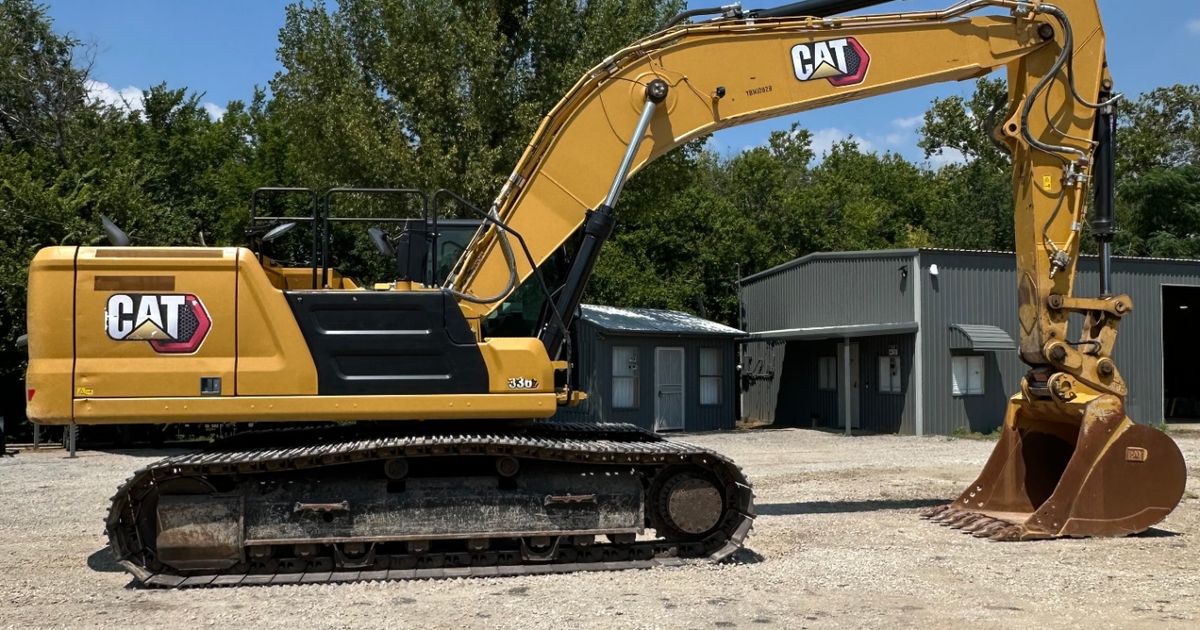
Phase 2 — Mass Excavation: A CAT 320 handles pads requiring 3-5 feet of cut. If the geotechnical report shows over-excavation depths beyond 6 feet, or if you're dealing with caliche, a CAT 336 with its 87,000-pound operating weight and 2.8-cubic-yard bucket is the right call. We've seen GCs try to push a 320 through heavy caliche in the Frisco and Little Elm corridors and lose three to four days they couldn't recover.
Phase 3 — Import Fill Spreading: Once excavation is done and approved, a dozer returns — often the same D6 or D8 — to spread imported fill in controlled lifts. This is where GPS grade control on the dozer pays significant dividends, since operators can maintain consistent 8-10 inch lift depths without pulling grade stakes every pass.
Phase 4 — Compaction: A CAT CS533E or CS56B vibratory smooth drum roller handles lift-by-lift compaction. Most commercial geotechnical specifications in Texas require 95% of Standard Proctor density per ASTM D698, and some structural pad specs push that to 98%. Lift control and pass count matter here — 4-6 passes per 8-12 inch lift is the standard operational target we relay to customers.
Phase 5 — Finish Grade: A CAT 140 or 160 motor grader with GPS machine control brings the subgrade to plan elevation within ±0.1 foot tolerance. This phase is where you recover or lose concrete budget — a grader that's off by 0.2 feet across a 10,000-square-foot pad adds meaningful volume to your concrete pour.
How Does North Texas Soil Affect Commercial Pad Excavation Equipment Selection?
North Texas soil changes the equipment calculation on almost every commercial job, and contractors coming from other regions frequently underestimate two conditions that are essentially universal across DFW: expansive black clay and caliche rock.
The black gumbo clay prevalent across Denton, Carrollton, Irving, Mansfield, and most of the Metroplex swells significantly when wet and contracts when dry. Texas Commission on Environmental Quality data and local geotechnical practice consistently flag this soil type as requiring moisture-density conditioning before compaction. In practical terms, this means your roller passes won't achieve spec if the clay is too dry — which is nearly guaranteed on a summer job in Wichita Falls or Decatur where surface temps push past 100°F and the clay desiccates between lifts. Water trucks become part of the equipment plan, not an afterthought.
Caliche is the other constant. Across the DFW and North Texas corridor, caliche limestone typically appears at 4-8 feet of depth, though we've seen it as shallow as 2.5 feet on sites in Weatherford and Crowley. A standard CAT 320 bucket will make minimal progress on dense caliche — you're looking at rock hammer deployment or a D8 with a single-shank ripper. The CAT 336 with a Caterpillar H130S hydraulic hammer breaks caliche at roughly 18-22 inches per hour in the conditions we see on local sites, versus essentially zero productive advance with bucket cutting alone. If the geotech shows caliche within your excavation depth, plan on the hammer and add it to your rental estimate upfront.
Summer heat also affects hydraulic system performance across the entire fleet. CAT excavator hydraulic systems are rated to operate in high-ambient conditions, but in sustained 105°F job site heat in Mesquite or Fort Worth, we advise customers to monitor hydraulic oil temps closely on machines running rock hammers continuously — hammer work generates heat faster than bucket digging. Our service team pre-checks hydraulic fluid levels and cooling systems on all summer rentals for exactly this reason.
What Size Excavator Do You Need for Commercial Building Pad Excavation?
The answer depends on three variables: excavation depth, soil classification, and target cycle time. For commercial pads up to 10,000 square feet with 3-4 feet of cut in native clay, a CAT 320 (47,000-pound operating weight, 1.19-1.47 cubic yard bucket) is typically the cost-efficient choice. It's maneuverable, fuel-efficient, and generates enough breakout force — approximately 33,000 pounds — to handle conditioned clay and light caliche.
When pad size exceeds one acre, excavation depths push beyond 5 feet, or caliche is confirmed in the geotech report, the CAT 336 becomes the right machine. Its 131,000-pound maximum breakout force and larger 2.1-2.8 cubic yard buckets move material significantly faster on large-scale commercial pads. On a recent project near Prosper where a GC was building a 3-acre slab foundation for a distribution facility, we set up a CAT 336 for mass excavation and a CAT 320 on cleanup and structure excavation simultaneously — the two-machine approach cut their excavation phase from a projected 9 days to 6.
For smaller commercial pads under 5,000 square feet in native soil without caliche, a CAT 308 or 311 can handle the work at lower rental cost, though the cycle time difference becomes significant if any rock work is involved.
Which Compaction Equipment Meets Commercial Pad Density Requirements?
Compaction is the phase where commercial projects most frequently run into specification failures, and the cause is almost always lift thickness or pass count rather than equipment capability. The OSHA 1926.650 subpart P standards address excavation safety, but the compaction spec itself comes from your project geotechnical report — and in North Texas commercial work, 95% Standard Proctor per ASTM D698 is the baseline minimum.
The CAT CS533E vibratory smooth drum roller (84-inch drum, 33,000 pounds operating weight) is the workhorse we recommend for most commercial pads in our service area. It delivers 33,000-66,000 pounds of dynamic force in high-amplitude mode and reaches 0-6 mph in compaction mode, allowing operators to maintain consistent pass patterns. For confined areas near footings or retaining walls, a CAT CB24B plate compactor or jumping jack handles what the drum roller can't reach.
One operational factor our customers in the Sherman, Denison, and Van Alstyne area have learned: North Texas clay requires moisture content within 2% of optimum for compaction to work efficiently. Trying to compact dry clay in August without a water truck is a guaranteed spec failure. Adding a 2,000-gallon water truck to the equipment plan isn't a luxury — it's what stands between passing and failing your density tests.
How Do You Achieve Precise Final Grade on a Commercial Building Pad?
Final grade on a commercial building pad is a precision operation, not a cleanup pass. The difference between ±0.2 feet and ±0.1 feet tolerance across a large slab directly affects concrete volume, which on a 20,000-square-foot pour represents meaningful dollars. A CAT 140 motor grader with GPS machine control is the standard tool for this phase, and in our experience, the GPS investment pays back on the first job through reduced staking labor and tighter grade control.
The CAT 140 GC (Grade Control) model works with Trimble or Leica 3D systems and maintains blade position accuracy within 0.05 feet automatically. On flat commercial pads, an experienced operator running GPS can finish-grade a 2-acre site in 6-8 hours with a single machine. Without grade control, the same work typically requires 2-3 passes with manual checking between each pass, adding a half-day or more to the schedule.
After grading, a final proof roll with a loaded tandem axle truck — standard practice per TxDOT standard specifications and most commercial geotechnical requirements — identifies any soft spots before the concrete crew mobilizes. Catching a soft spot at proof roll costs you a day of rework. Catching it after the slab is poured costs you the slab.
What Is the Right Equipment Sequence for a Phased Commercial Pad Project?
Phased pad construction — common on large commercial developments in Celina, Anna, and the rapidly growing North Texas growth corridor — requires a different rental approach than single-phase work. Rather than mobilizing a full fleet at once, phased projects benefit from a core excavation and compaction package that stays on site, with grading equipment called in as each phase approaches finish grade.
We typically help customers in this situation structure a rental plan around a CAT 336 as the continuous anchor machine (it handles both excavation and rock hammer work as phases advance), with the D6 dozer and CS533 roller cycling in during fill and compaction phases. The motor grader comes in for 2-3 days per phase at finish grade, then returns to our fleet. This approach keeps the customer's equipment costs matched to actual utilization rather than paying daily rates on machines sitting idle between phases.
The Associated General Contractors of America recommends detailed equipment utilization planning as part of commercial project scheduling, and our experience confirms that the projects that stay on schedule in North Texas are the ones where the GC treats equipment sequencing as seriously as the CPM schedule itself.
Ready to Plan Your Commercial Pad Equipment Package?
Commercial pad work in North Texas demands a sequenced, soil-aware equipment strategy — not just a list of machines. Whether you're breaking ground on a distribution facility in Prosper, a retail pad in Trophy Club, or a multiphase development in Gunter or Gainesville, we've got the CAT excavators, dozers, graders, and compaction equipment to build an efficient rental package around your schedule and geotech report.
Call us at (817) 403-4334 to talk through your project. We're in Denton and serve contractors across the full North Texas market — from Waco and Wichita Falls to Sherman and Denison. We'll look at your site conditions, your schedule, and your spec requirements and put together a rental sequence that actually fits the job.
You can also browse our CAT excavator specifications and review ASCE geotechnical standards to help scope your equipment needs before we talk.
Frequently Asked Questions
How long does it take to build a commercial building pad with the right equipment?
A 2-acre commercial building pad typically takes 5-8 working days with a properly sequenced equipment package including a CAT 336 excavator, D6 dozer, CS533 vibratory roller, and CAT 140 motor grader. North Texas conditions — specifically caliche rock at 4-8 feet depth and expansive clay requiring moisture conditioning — are the most common factors that push timelines toward the 8-10 day range. Projects that pre-plan for rock hammer deployment and water truck availability consistently stay on the shorter end of that estimate.
What compaction spec is required for a commercial building pad in Texas?
Most commercial building pad specifications in Texas require 95% of Standard Proctor density per ASTM D698, though structural slabs and heavily loaded foundations sometimes specify 98% Proctor. The project geotechnical report is the binding document — always pull that before selecting compaction equipment. North Texas black clay soil requires moisture content within approximately 2% of optimum for efficient compaction, which means water trucks are a standard part of the equipment package on hot summer jobs.
Do I need a rock hammer for commercial excavation in the DFW area?
In most of the DFW and North Texas market, yes — caliche limestone appears at 4-8 feet depth on a large percentage of commercial sites, and standard bucket cutting makes essentially no progress against dense caliche. A CAT H130S hydraulic hammer mounted on a CAT 336 excavator breaks caliche at approximately 18-22 inches per hour in typical North Texas conditions. If your geotechnical report shows caliche within your excavation depth, include a rock hammer in your rental plan from the start rather than trying to force through it with a bucket.
What is the best CAT excavator for large commercial pad excavation?
For commercial pads over one acre or with excavation depths beyond 5 feet, the CAT 336 is the strongest general-purpose choice — its 131,000-pound maximum breakout force, 2.1-2.8 cubic yard bucket capacity, and compatibility with the CAT H130S rock hammer make it the right machine for the wide range of conditions North Texas sites present. For smaller pads under 10,000 square feet with native soil only, a CAT 320 offers better fuel economy and maneuverability at a lower daily rental rate. Two-machine setups using a 336 for mass dig and a 320 for cleanup and structure work are common on larger commercial projects.
How does a motor grader improve commercial pad accuracy compared to a dozer?
A CAT 140 motor grader with GPS machine control maintains blade accuracy within 0.05 feet, compared to approximately ±0.2 feet typical of dozer finish grading. On a 20,000-square-foot commercial slab, that 0.15-foot difference in average accuracy translates to meaningful concrete volume variance — enough to affect pour budget on large projects. Motor graders also handle long, flat grade runs more efficiently than dozers, which are better suited to bulk spreading and rough shaping. Most commercial pad sequences use the dozer for spreading and shaping, then transition to the motor grader for finish grade in the final 0.3-0.5 feet.