.png)
If you've driven north on US-377 toward Aubrey, or cut across FM 428 through Gunter recently, you already know what the numbers confirm: Denton County is in the middle of one of the most sustained development runs in Texas history. Subdivisions are going vertical on land that was cotton fields three years ago. Municipal infrastructure is racing to keep pace. And contractors across our service area—from Celina and Prosper to Little Elm and Van Alstyne—are managing more simultaneous projects than most have seen in their careers.
At Benchmark Equipment Rental & Sales in Denton, we watch this growth from a unique vantage point. The equipment leaving our yard every week tells a clear story about where North Texas is building and what the ground is demanding. We've put together this breakdown specifically for contractors working the Denton County market so you can make smarter rental decisions and keep your schedules on track.
Key Takeaways
- Denton County is among the top 5 fastest-growing counties in the U.S., with master-planned communities in Celina, Aubrey, and Gunter driving multi-year construction pipelines.
- Expansive black gumbo clay soil—common across the county—requires specialized compaction equipment and moisture management, especially during North Texas summers that exceed 100°F.
- Caliche rock formations at 4–8 feet depth across the DFW region routinely require hydraulic hammers or rotary cutters as attachments on CAT 320 or CAT 336 excavators.
- CAT motor graders with automated blade control systems reduce finish grading time by up to 25% on large pad sites, a critical advantage on tight developer schedules.
- Contractors who pre-plan their equipment mix for both the dry cracked summer phase and the post-rain saturated clay phase avoid costly downtime and change orders.
How Fast Is Denton County Actually Growing, and What Does That Mean for Equipment Demand?
Denton County added more than 60,000 residents between 2021 and 2023, making it one of the fastest-growing counties in the United States according to U.S. Census Bureau data. Cities like Celina, which has approved over 50,000 future residential lots in its ETJ, and Aubrey, which is absorbing overflow from Frisco and Little Elm, are running development pipelines measured in years—not months. That sustained pace changes how contractors need to think about equipment access.
When a single master-planned community breaks ground on 800 lots simultaneously, the equipment demand isn't a one-time spike—it's a multi-phase commitment across clearing, rough grading, utility trenching, fine grading, and concrete prep. Contractors who lock in rental relationships early and plan their equipment rotations by phase are the ones finishing on schedule. We've seen crews lose two to three weeks simply because they didn't account for how long caliche breaking would take during the utility installation phase. That's an avoidable loss.
Our fleet data from the past 18 months shows that excavator and motor grader utilization rates in the Denton-Celina-Prosper corridor are running approximately 40% higher than they were in 2020. That's not a trend we expect to reverse anytime soon, given the approved plats already in the pipeline across northern Denton County.
What Equipment Do You Actually Need for North Texas Clay and Caliche Conditions?
The two soil challenges that define Denton County job sites are expansive black gumbo clay and caliche rock, and they demand fundamentally different approaches at different depths. Understanding both before you mobilize is the difference between an efficient job and an expensive one.
Black gumbo clay—the dark, expansive soil that characterizes much of the USDA-classified Blackland Prairie soils running through Denton, Collin, and surrounding counties—swells dramatically when wet and contracts into deep, hard cracks when dry. During a dry North Texas summer, this same clay becomes nearly as resistant to penetration as soft rock. We've had customers call us mid-project after their compact excavators couldn't make acceptable production rates in August conditions. A CAT 320 or larger with a narrow trenching bucket and aggressive tooth configuration is often the right tool where a smaller machine seemed adequate on paper.
At the 4–8 foot depth range common across the DFW area, caliche formations bring excavation to a standstill for crews that aren't prepared. Caliche is a calcium carbonate hardpan that can test in the 500–1,500 PSI range—soft enough that it's not technically rock, but hard enough to destroy production rates and bucket edges. A hydraulic hammer attachment on a CAT 320 or the rotary cutter option on a CAT 336 addresses caliche efficiently. We routinely set up customers in Gunter, Decatur, and the outer Denton County ring with combination packages—excavator plus hammer—because experienced contractors in those areas know the caliche is coming.
For compaction, the expansive clay dynamic means you're not just chasing density numbers—you're managing moisture. FHWA geotechnical guidelines recommend compacting expansive clays within 2–4% above optimum moisture content to control post-construction swell. A padfoot compactor—like the CAT CP series—is the right tool for cohesive clay subgrade work because the foot geometry kneads and densifies clay more effectively than a smooth drum. Smooth drum rollers are better reserved for aggregate base and asphalt phases. Using the wrong compactor for the soil type is one of the most common mistakes we see on North Texas sites, and it's an easy fix when you rent from a yard that understands local conditions.
Which Excavator Size Is the Right Choice for Denton County Development Projects?
Excavator sizing comes down to what you're doing and how deep you're going, but North Texas conditions narrow the selection pretty quickly. For residential utility trenching in new subdivisions across Celina, Prosper, and Trophy Club, a CAT 320 GC is typically the minimum effective machine—running a 24-inch bucket for water and sewer, stepping up to a 36-inch bucket for storm drain work. The CAT 320's 47,000-pound operating weight and 21-foot maximum dig depth cover the vast majority of residential utility scopes in the county.
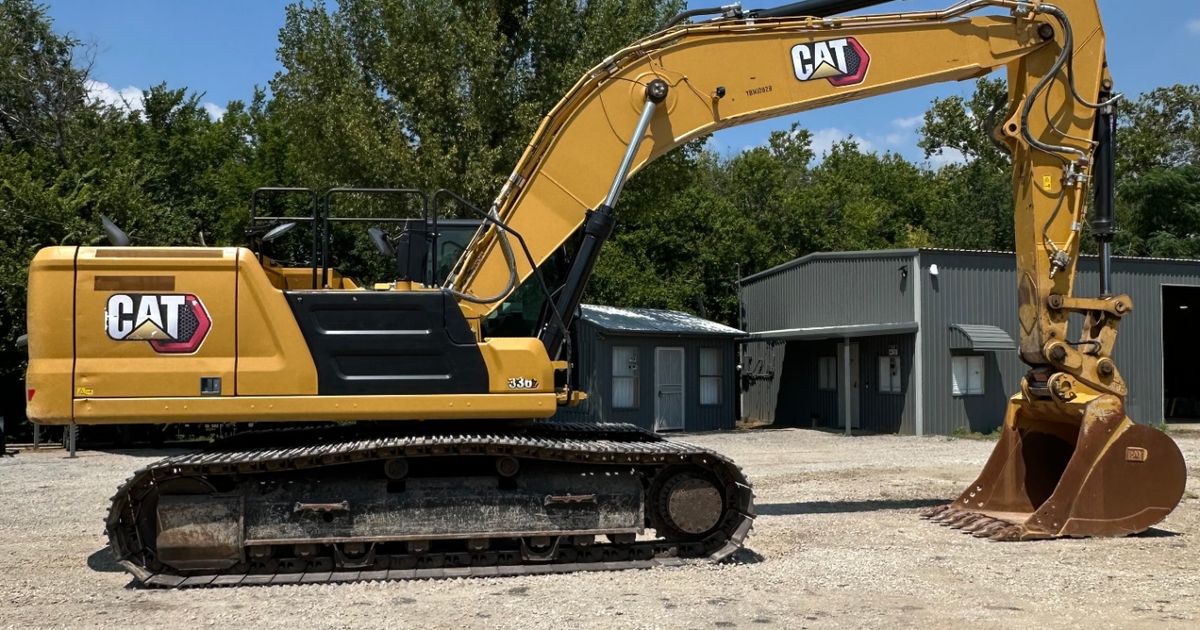
For commercial pad preparation, mass excavation, and any project where you expect to encounter caliche or need to run a hydraulic hammer, step up to the CAT 323 or CAT 336. The CAT 336, at roughly 80,000 pounds, delivers the hydraulic flow rates that power a hammer effectively—220 bar and 325 L/min—and the extra breakout force makes a real difference when you're 6 feet into a caliche layer in July heat. CAT 336 excavators achieve approximately 15–20% better fuel efficiency compared to previous-generation models in the same size class, which matters significantly on long production months.
Mini excavators—the CAT 305, 308, and 310—remain in high demand for utility reconnects, landscape and irrigation work, and confined-space residential service work throughout established neighborhoods in Trophy Club, Argyle, and Carrollton. But contractors sometimes overreach with minis on virgin ground in outer Denton County. We'll steer you toward the right size class based on your specific scope rather than just filling a request, because a mismatched machine costs you more in the end.
How Do 100-Degree North Texas Summers Affect Equipment Performance and Job Site Planning?
North Texas summer heat is not just a comfort issue—it directly affects hydraulic system performance, operator productivity, and ground conditions in ways that impact your production rates and project schedule. From late June through September, surface temperatures on job sites around Denton, McKinney, and Sherman regularly exceed 115°F. Hydraulic oil viscosity changes at high temperatures, increasing wear and reducing system efficiency if machines aren't properly configured for the climate.
CAT's factory-spec hydraulic oil for most excavator and dozer applications is suitable for North Texas summer operations, but running machines hard during peak heat hours—typically 1:00 PM to 5:00 PM—without monitoring coolant and hydraulic temperatures is how you generate unplanned downtime. We recommend scheduling your heaviest production work in the morning, maintaining a 15-minute cool-down before shutdown, and checking hydraulic fluid levels daily during summer operations. OSHA's heat illness prevention standards also require formal heat safety protocols for outdoor workers when temperatures exceed 80°F, so make sure your crew plans reflect that requirement.
The flip side of summer heat is what it does to black gumbo clay. Severely desiccated clay in August can look workable from the surface and then fracture unpredictably during excavation, creating unstable trench walls. OSHA 1926.652 excavation standards require Type C classification for previously disturbed or fissured soils—which describes desiccated gumbo exactly—meaning 1.5:1 slope requirements or trench box protection for excavations deeper than 5 feet. We keep a strong inventory of trench shields specifically because summer trenching conditions in this county require them more often than contractors sometimes expect.
What Grading Equipment Is Most Effective for Large Pad Sites Across North Texas?
Large pad site development—the kind happening continuously across the Frisco-Celina-Gunter corridor right now—demands a coordinated equipment fleet, not just a single machine. The typical sequence for a 10–20 acre commercial or multi-family pad involves a CAT D6 or D8 dozer for initial stripping and rough push work, a CAT 140 or 160 motor grader for subgrade shaping, and padfoot compactors working in parallel with the grader as lifts are established.
Motor graders with GPS grade control technology are no longer just a premium option on large commercial jobs—they're becoming standard expectation from general contractors managing tight tolerances and compressed schedules. CAT motor graders equipped with automated blade control systems reduce finish grading time by up to 25% compared to manual blade operation, and they reduce the skill dependency that can become a scheduling vulnerability when experienced operators are hard to find. We have GPS-ready graders in our fleet, and the production difference on a 15-acre pad is genuinely significant.
One operational note specific to North Texas: the black gumbo clay that grades beautifully in November becomes nearly unworkable when saturated after a significant spring rain event. We've had customers call us from job sites in Aubrey and Van Alstyne after a 3-inch rain turned their graded subgrade into a rutted mess overnight. Planning for a moisture stabilization phase—lime treatment is common in this region—and having appropriate equipment available for that scope protects your schedule when the inevitable rain arrives.
Should Denton County Contractors Buy or Rent Heavy Equipment Given Current Market Conditions?
The rent-versus-buy calculation for contractors in the current Denton County market tilts more toward renting than at any point in recent memory, for several specific reasons. First, the development boom is real but concentrated in certain project types—residential subdivision infrastructure, municipal utility expansion, and commercial pad development. When that cycle shifts, contractors who capitalized their business with purchased iron are carrying depreciation on assets that aren't generating revenue.
Second, the equipment market of 2023–2024 saw new machine prices that remain elevated from supply chain impacts and increased demand. Renting from an established local fleet like ours gives you access to late-model CAT equipment—maintained to manufacturer standards—without the capital commitment or the carrying cost between projects. The Associated General Contractors of America has consistently documented how equipment flexibility is a competitive advantage for contractors navigating market cycles.
Third, and most practically: attachment flexibility. A purchased excavator is configured. A rented excavator can come with a different bucket, a hydraulic hammer, or a compaction wheel depending on what your next phase requires. For multi-phase subdivision work in Celina or Prosper where you're moving from clearing to utilities to fine grading across a 14-month project, that flexibility is operationally valuable in ways that don't always show up in a simple cost-per-hour comparison.
If you're running two or more pieces of equipment consistently for 200+ hours per month and have a stable forward project book, ownership starts to make more economic sense. We'll have that conversation honestly with you—we also sell equipment—and we'd rather give you the right answer than just the answer that benefits us most in the short term.
Putting It Together for Your Next Denton County Project
The contractors winning in this market aren't just the ones with the most iron—they're the ones who understand the ground they're working and plan their equipment accordingly. Black gumbo clay, caliche at depth, triple-digit summer heat, and the occasional saturated mess after a spring front: these are the operating conditions that define Denton County construction, and every equipment decision should account for them.
At Benchmark Equipment Rental & Sales, we're based right here in Denton and we're running equipment on these same soils every day through our customers. When you call us at (817) 403-4334, you're not getting a call center—you're getting people who know why your excavator slowed down in the Gunter caliche and what attachment fixes it. Whether you're breaking ground on a 500-lot subdivision in Aubrey, running commercial utilities in Frisco, or doing municipal improvement work in Gainesville or Wichita Falls, we'll help you spec the right equipment mix for the specific phase you're in.
The Denton County boom has years of runway left. The contractors who build the right equipment relationships now are the ones who'll be positioned to capture it.
Frequently Asked Questions
What excavator size do I need for subdivision utility work in Denton County?
For residential utility trenching in Denton County subdivisions—including water, sewer, and storm drain work—a CAT 320 is typically the minimum effective machine, offering a 21-foot maximum dig depth and sufficient breakout force for the region's expansive clay soils. If your scope includes depths where caliche rock is likely (4–8 feet in much of the DFW area), plan on a CAT 323 or CAT 336 paired with a hydraulic hammer attachment. Undersizing your excavator in North Texas conditions is one of the most common causes of missed production targets on subdivision utility projects.
How does black gumbo clay in North Texas affect my compaction equipment choice?
Black gumbo clay—the expansive Blackland Prairie soil dominant across Denton, Collin, and Tarrant counties—requires a padfoot compactor rather than a smooth drum roller for subgrade compaction work. The padfoot geometry kneads and densifies cohesive clay more effectively, and FHWA geotechnical guidelines recommend compacting expansive clays at 2–4% above optimum moisture content to control post-construction swell. Using a smooth drum on clay subgrade is a common mistake that leads to density failures and potential structural issues down the road.
Should I rent or buy heavy equipment for a large subdivision project in Celina or Aubrey, TX?
For most contractors taking on large subdivision work in the Celina, Aubrey, or Gunter area, renting provides better financial flexibility than purchasing given the project-phased nature of the work and current elevated equipment prices. Renting allows you to swap attachments and machine sizes as you transition from rough clearing to utility installation to fine grading—phases that each demand different configurations. If you're consistently running a machine at 200+ hours per month with a stable 12-month forward project book, ownership starts to make economic sense, but the multi-phase nature of subdivision work often favors a rental-based fleet strategy.
How does summer heat over 100°F affect CAT excavator performance on North Texas job sites?
Sustained temperatures above 100°F on North Texas job sites—common from June through September—affect hydraulic oil viscosity, increasing system wear and reducing efficiency if machines aren't properly monitored. Operators should check hydraulic fluid levels daily during summer operations, schedule the heaviest production hours before 1:00 PM to avoid peak heat, and allow a 15-minute cool-down period before shutdown. Additionally, severely desiccated black gumbo clay in summer conditions can fracture unpredictably during excavation, requiring OSHA 1926.652 Type C slope or trench box protection for excavations deeper than 5 feet.
What is caliche rock and how does it affect excavation timelines in the DFW area?
Caliche is a calcium carbonate hardpan layer found across the DFW region—typically at 4–8 feet depth in Denton County—that can test in the 500–1,500 PSI range. It's soft enough to technically classify as hardpan rather than rock, but hard enough to devastate excavation production rates and rapidly wear bucket teeth on an unprepared machine. Contractors who don't account for caliche in their utility installation timelines commonly lose 2–3 weeks on projects in the Gunter, Decatur, and outer Denton County market. A hydraulic hammer attachment on a CAT 320 or CAT 336 is the standard solution for breaking through caliche efficiently.