.png)
Drive the US-380 corridor between Denton and McKinney on any given weekday and you'll count more construction cranes, grade stakes, and freshly cut subdivisions than you can track. Celina and Gunter aren't just growing — they're transforming at a pace that has contractors, developers, and municipal infrastructure teams all competing for the same equipment at the same time. We've watched this region accelerate from a steady rural-to-suburban transition into a full-scale building boom, and the equipment demand that comes with it is unlike anything we've seen in other parts of our service territory.
For contractors trying to land and execute work in this corridor, understanding what equipment you'll need, what the ground conditions will throw at you, and how tight the rental market actually is right now can mean the difference between a profitable project and a scheduling nightmare.
Key Takeaways
- Celina's population has grown over 400% in the past decade, fueling one of the most active construction corridors in North Texas along US-380 and the Preston Road corridor
- Expansive black clay soils and caliche rock formations 4-8 feet deep are standard across Celina and Gunter job sites, requiring heavier excavators with rock-rated bucket teeth and high-breakout-force configurations
- Summer temperatures regularly exceeding 100°F in Collin and Grayson counties demand equipment with enhanced cooling systems and operators who know how to manage hydraulic temps during peak heat
- Equipment availability gaps are real — contractors who don't reserve machines 2-4 weeks ahead during peak building season (March through October) frequently face delays sourcing the right iron
How Fast Are Celina and Gunter Actually Growing?
Celina's growth numbers are staggering by any measure. The city's population has surged by over 400% in the past decade, and the U.S. Census Bureau has consistently ranked it among the fastest-growing municipalities in the entire country. Gunter, just to the north in Grayson County along US-75, has followed a similar trajectory as buyers price out of Collin County and push further north along the Sherman-Denison corridor.
The practical effect on construction is a pipeline that doesn't let up. Master-planned residential communities, commercial pad sites, utility infrastructure, new school campuses, and road widening projects are all running simultaneously. The Associated General Contractors of America has flagged North Texas suburban corridors like this as among the most labor- and equipment-intensive construction environments in the Sun Belt, and from where we sit in Denton, that tracks exactly with what we see in our rental calendar every week.
According to the Texas Comptroller's Office, Collin County alone issued over $4.2 billion in construction permits in a recent 12-month period — a number that reflects the scale of what's happening across the entire US-380 and Preston Road growth corridor that includes Celina, Prosper, Frisco, and beyond.
What Ground Conditions Should Contractors Expect in Celina and Gunter?
The ground in this part of North Texas will humble contractors who aren't prepared for it. The region sits on some of the most challenging expansive clay soils in the state — the black gumbo that North Texas contractors know intimately. This material absorbs moisture and swells, then dries out and shrinks, creating significant movement that affects foundations, utilities, and compaction timelines. The Federal Highway Administration classifies Texas's expansive clay conditions as among the most severe in the nation for infrastructure durability, and the Celina-Gunter corridor sits squarely in that zone.
What makes this area particularly demanding is the caliche layer that typically starts between 4 and 8 feet below grade. We regularly hear from our customers working residential foundations and utility trenches in Celina that they hit caliche significantly harder and shallower than they expected — sometimes within 3 feet in certain micro-geological pockets. That means a machine spec'd for straight clay digging is suddenly working against near-rock material that requires serious breakout force and the right bucket teeth to keep production moving.
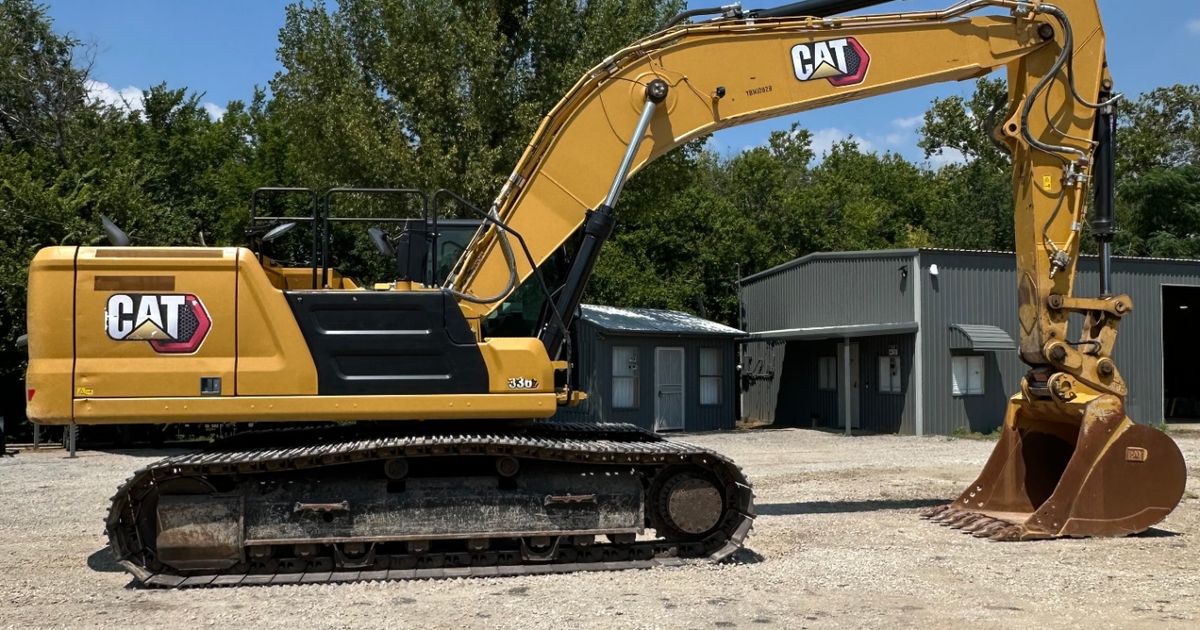
For excavator work in Celina and Gunter, we typically recommend a CAT 320 or CAT 323 for mid-depth residential utility work, stepping up to a CAT 336 for deeper utility corridors, detention pond excavation, or commercial footings where you're consistently fighting caliche. The CAT 336 delivers approximately 20% more breakout force than the 320-class machines, and on a job site where you're alternating between gumbo clay and rock-hard caliche in the same trench, that extra capability pays for itself in production time.
What Equipment Is in Highest Demand for Celina-Area Construction?
Based on our rental activity across the Celina, Prosper, and Gunter corridor, the equipment categories under the most consistent demand break down across the construction phases happening simultaneously in the region.
Excavators are the foundation of demand. Both residential and commercial projects require them for footings, utility installation, and detention grading. CAT 320-class machines are the workhorses for residential, while CAT 336s get called for larger commercial and infrastructure work. Demand for excavators with thumb attachments has also increased significantly as contractors use them for debris sorting and rock manipulation on caliche-heavy sites.
Motor graders are critical for the road widening and subdivision street work that's happening at scale. Celina's infrastructure buildout — which includes the extension of major collector roads and improvements to FM 455, FM 1385, and the US-380 frontage — keeps a consistent need for CAT 12M and 140M graders in the rental market. The Texas Department of Transportation and Collin County Precinct projects add to this demand on top of private development.
Skid steers and compact track loaders — particularly CAT 299D3 and 289D3 models — are in constant demand for lot clearing, backfill, and finish grading on the dense residential side of the market. In tight-lot subdivisions where larger equipment can't maneuver efficiently, a well-configured CTL with a brush cutter or auger attachment gets enormous work done in limited space.
Compaction equipment rounds out the picture. With expansive clay soils, meeting engineered fill compaction specs (typically 95% of Standard Proctor per ASTM D698) requires the right compactor matched to lift thickness and moisture content. We see a lot of customers underestimate how many passes it takes to hit those numbers in North Texas clay, especially after a rain event when the material's moisture content swings dramatically.
How Does North Texas Summer Heat Affect Equipment Performance on These Job Sites?
Summer heat in the Celina-Gunter corridor is not a footnote — it's a primary operational factor. Temperatures regularly hit 100°F to 108°F from June through September, and asphalt and exposed soil surfaces can exceed 140°F at ground level. Under those conditions, hydraulic systems run hotter, engine cooling systems work harder, and operators face heat stress that directly affects productivity and safety compliance under OSHA's heat illness prevention guidelines.
We counsel our customers to schedule heavy excavation and grading work in the early morning hours during peak summer months. A CAT 336 pushing hard in 105°F heat with a partially restricted air filter or low hydraulic fluid level will trigger thermal warnings and force downtime — usually at the worst possible moment. Before any summer rental deployment in Celina or Gunter, our team checks coolant levels, hydraulic fluid condition, and air filter restriction indicators specifically because we know what these machines face out there.
CAT's GRADE and payload monitoring technology built into newer excavator models actually helps operators in high-heat conditions by reducing unnecessary bucket cycles and over-digging, which translates to lower hydraulic temps and better fuel economy. On a full summer day, that efficiency difference matters more than customers sometimes expect.
Why Is Equipment Availability Tight in This Growth Corridor?
The straightforward reality is that equipment demand in the Celina-Gunter-Prosper corridor consistently outpaces regional fleet supply during the March-through-October building season. We field calls almost weekly from contractors who are a week or two out from mobilization and suddenly realize the specific machine they need isn't available locally. That's not a theoretical risk — it's a pattern we've seen repeat itself as the region's construction pace has accelerated.
The problem compounds because multiple project types compete for the same equipment simultaneously. A utility contractor running water main extensions in new Celina subdivisions, a commercial grading crew working a pad site on US-380, and a road contractor widening a collector street in Gunter might all need a CAT 320 excavator during the same two-week window. When you factor in that Prosper, Frisco, and McKinney are running similar activity levels, regional fleet availability gets stretched quickly.
Our recommendation, based on years of managing equipment logistics across Denton, Collin, and Grayson counties, is to book 2-4 weeks ahead of your mobilization date during peak season. Customers who call us the week before they need iron almost always face constraints. Those who plan ahead lock in the right machine at the right time and keep their schedules intact.
What Should Contractors Budget for Equipment Rental in the Celina-Gunter Market?
Rental rates in 2025 reflect both the tight availability and the logistics of operating modern telematics-equipped CAT equipment. A CAT 320 excavator in North Texas runs in the range of $2,800–$3,400 per week for standard rental terms, while a CAT 336 runs $4,200–$5,100 per week depending on configuration and rental duration. Compact track loaders like the CAT 299D3 typically fall in the $1,600–$2,000 per week range.
Longer-term rentals — monthly or multi-month contracts for extended infrastructure or commercial projects — generally produce better economics, and we work with contractors on fleet packages when multiple machines are needed simultaneously. For large Celina or Gunter projects where you're running excavation, compaction, and finish grading phases concurrently, coordinating a rental package with us in advance gives you both availability certainty and better overall project economics.
Fuel and transport costs are also real line items to account for. Mobilization from our Denton yard to Celina runs roughly 35-45 miles depending on the specific project site, and we offer delivery and pickup as part of our rental service. Factor transport into your project budget from the start — it's an area we see contractors occasionally underestimate on tight-margin residential work.
How Can Contractors Secure Equipment for Projects in Celina and Gunter?
The most effective approach we've seen is a simple phone conversation before you finalize your project schedule. When you tell us what you're building, where, and what your timeline looks like, we can match you to the right machine configuration for North Texas soil conditions, flag any availability constraints on our end, and get something locked in before the window closes.
We serve Celina, Gunter, Prosper, McKinney, Sherman, Denison, Van Alstyne, and the surrounding growth corridor from our Denton location daily. Our fleet includes CAT excavators, motor graders, skid steers, compact track loaders, and compaction equipment — all maintained to manufacturer specs and ready for the conditions contractors face in this market.
Call us at (817) 403-4334 to talk through your project. If you're planning work in the US-380 corridor or anywhere in Collin or Grayson County, we want to help you get the right equipment on-site on time.
Frequently Asked Questions
What size excavator do I need for residential construction in Celina, TX?
For standard residential foundation and utility work in Celina, a CAT 320 or CAT 323 handles most applications through the clay layer. However, because caliche formations commonly appear between 4 and 8 feet deep in Collin County, contractors doing deeper utility work or commercial footings should step up to a CAT 336, which delivers approximately 20% more breakout force to handle the rock transition without losing production time.
How far in advance should I reserve construction equipment for a project in the Celina-Gunter growth corridor?
Plan to book equipment 2-4 weeks ahead during the peak building season, which runs March through October in North Texas. The Celina, Gunter, and Prosper corridor has some of the tightest equipment availability in the region due to simultaneous residential, commercial, and infrastructure construction. Contractors who call within a week of mobilization regularly face limited machine choices or unavailability.
How do North Texas clay soils affect construction timelines in Celina and Gunter?
Expansive black clay soils in the Celina-Gunter corridor absorb and release moisture at rates that directly impact compaction timelines, foundation prep, and utility backfill schedules. Hitting 95% Standard Proctor compaction per ASTM D698 in North Texas clay typically requires more passes than contractors budget for, especially after rain events when material moisture swings sharply. Equipment selection — particularly choosing compactors matched to lift thickness and soil type — has a measurable effect on meeting engineered fill specifications on schedule.
Does extreme summer heat in North Texas affect heavy equipment performance on job sites?
Yes, significantly. Temperatures regularly reach 100°F to 108°F in Collin and Grayson counties from June through September, which causes hydraulic systems to run hotter and increases the risk of thermal shutdowns on machines that aren't properly maintained. Pre-shift checks on coolant levels, hydraulic fluid condition, and air filter restriction indicators are critical before deploying equipment in summer conditions, and scheduling heavy excavation work in early morning hours reduces both equipment stress and operator heat illness risk under OSHA heat exposure guidelines.
What types of construction projects are driving the most equipment demand in Celina and Gunter right now?
Master-planned residential subdivision development is the dominant driver, but Celina and Gunter are simultaneously seeing commercial pad site construction along US-380, municipal utility infrastructure extensions, new school campus construction, and road widening projects on FM 455, FM 1385, and collector streets. This overlap of residential, commercial, and public infrastructure work happening concurrently is why equipment availability in the corridor stays tight throughout the building season, with excavators, motor graders, compact track loaders, and compaction equipment all in consistent high demand.