.png)
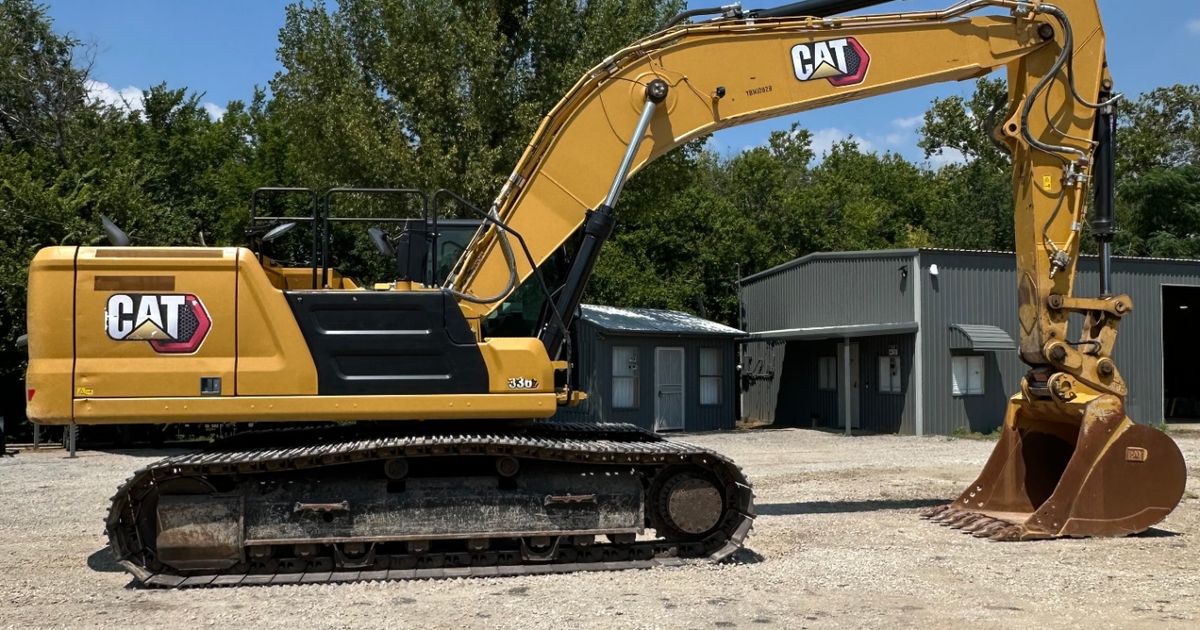
We get this question at least a few times a week at our Denton yard: "Should I go with the 308 or step up to the 310?" Both are excellent compact excavators from Caterpillar's next-generation mini lineup, and on paper, the specs look close enough that the decision feels arbitrary. In practice — especially on North Texas ground — the differences matter more than you'd expect.
We've run both machines across job sites from Weatherford to Sherman, Celina to Waco, and the feedback from our rental customers tells a consistent story. This isn't a spec-sheet comparison. It's a working contractor's guide to which machine fits which job.
Key Takeaways
- The CAT 310 delivers approximately 22% more bucket breakout force than the 308 (36,700 lbs vs. 30,000 lbs), a meaningful edge when hitting caliche at 4-6 feet in Denton or Prosper subdivisions
- The CAT 308 CR's 8-ton operating weight and compact radius design make it the go-to machine for residential backyard work and urban job sites with gate or alley access restrictions
- Both machines run Cat's Smart Mode hydraulics, but the 310's larger engine (47.6 hp vs. 40.7 hp) maintains more consistent cycle times in 100°+ Texas summer heat when hydraulic oil temps climb
- Our North Texas fleet data shows the 308 averages 5.5–6.5 gallons of diesel per day on typical utility trenching, versus the 310's 7–8 gallons — a real factor on multi-week projects
What Are the Core Differences Between the CAT 308 and CAT 310?
The CAT 308 CR (Compact Radius) and CAT 310 sit at adjacent rungs on Caterpillar's mini excavator ladder, but they're designed with different priorities. The 308 is purpose-built for confined-space efficiency — its compact tail swing radius means it can swing a full 360° with minimal clearance, making it genuinely useful in the kind of tight residential backyards and narrow utility corridors we see constantly across Frisco, McKinney, and Trophy Club neighborhoods.
The CAT 310, at roughly 10.7 metric tons operating weight versus the 308's 8.4 metric tons, crosses into a category where it can do meaningful production work. Its Caterpillar-spec'd bucket breakout force of approximately 36,700 lbs versus the 308's 30,000 lbs isn't just a number — on caliche and hardpan, that 22% difference is the margin between grinding productivity and actual production. We've watched 308s labor through the caliche layer that commonly shows up at 4 to 6 feet deep in the DFW metro, where a 310 hits the same material and keeps moving.
Digging depth tells part of the story too. The 310 offers a maximum dig depth of approximately 13 feet, compared to the 308's 11.5 feet. For most landscaping, drainage, and shallow utility work, neither limit is a constraint. But on deeper lift station excavations or subdivision storm drain tie-ins across areas like Aubrey and Gunter — where we're regularly quoting equipment for the growth corridor along Highway 377 — that extra depth matters.
Which Mini Excavator Handles North Texas Clay and Caliche Better?
North Texas soil conditions are the single biggest factor that separates these two machines in real use. The expansive black clay — what old-timers call "black gumbo" — that runs through much of Denton, Collin, and Tarrant counties is deceptively demanding. It packs into buckets, adds enormous weight to every pass, and during wet periods, the shrink-swell cycle leaves ground that fights the bucket on the way in and sticks to it on the way out.
The 308 handles black clay adequately on trenching runs up to 4 feet. Below that, or when the ground has dried and hardened through a Texas summer, the 308 starts showing its limits — you'll see slower cycle times and operators working harder to seat the bucket cleanly. The 310's additional breakout force and heavier undercarriage give it better purchase in those conditions without the operator having to ride the machine aggressively, which matters for attachment life and hydraulic system longevity.
Caliche is where the gap really opens up. The Texas Commission on Environmental Quality and geotechnical surveys across North Texas consistently document caliche formations starting at 4 to 8 feet in many DFW-area locations. When a utility crew is running gas or water service lines in Celina or Prosper and they hit that hard layer, the 308 can punch through it — but it's working. The 310 breaks caliche with noticeably less effort, and in our experience that translates to 15-20% better daily production on jobs with consistent caliche encounters.
One scenario we see regularly: irrigation contractors in Argyle and Flower Mound area spec the 308 for landscape system installs — shallow, clean cuts in turf, rarely needing more than 24 inches of depth. They're right to use it. That same contractor taking on a commercial property with deeper mainline work or a lift station connection should seriously consider stepping up to the 310.
How Does Summer Heat Affect the CAT 308 vs 310 Performance?
Anyone who's run equipment on a North Texas job site in July knows that 100°+ ambient temperatures aren't an edge case — they're a standard operating condition from June through September. Both the 308 and 310 are equipped with Cat's electronically controlled cooling systems and Smart Mode hydraulics, and both machines are engineered for these conditions. But there are real-world performance differences between them when temps climb.
The 308's 40.7 hp engine running hard in sustained heat will trigger thermal management more frequently than the 310's 47.6 hp engine doing comparable work. According to OSHA heat safety guidelines, job site productivity planning should account for reduced equipment and operator performance in extreme heat — and the machines reflect this. What we observe in our rental fleet is that 308s doing heavy-cycle trenching in peak summer heat will occasionally step down in response to elevated hydraulic temps, while the 310, with more thermal headroom in its larger cooling package, tends to maintain steadier output through a full shift.
For operators running 10-hour shifts during summer in Wichita Falls, Fort Worth, or Mansfield — where heat index values regularly exceed 110°F — the 310's thermal stability is a legitimate productivity advantage. On a 5-day rental, even moderate productivity differences compound.
What Jobs Is the CAT 308 Best Suited For?
The 308 CR excels at work where its compact footprint is a genuine operational advantage, not just a nice-to-have. In established residential neighborhoods across Carrollton, Irving, and older Denton subdivisions, yard access is often through a standard 36-inch gate, and the 308's ability to fit through those openings — sometimes with minor preparation — is what gets the job done without tearing up a client's fence.
Landscaping companies, irrigation contractors, and pool excavation crews in our area consistently return to the 308 because it's manageable with a single operator-plus-spotter, loads on a standard trailer without drama, and gives enough machine to be productive on residential-scale cuts. The fuel economy advantage is real: our customers report that a 308 doing 8 hours of residential work consumes roughly 5.5 to 6.5 gallons of diesel, versus the 310's 7 to 8 gallons on comparable work. Over a 3-week project, that's a measurable cost savings.
The Associated General Contractors of America classifies mini excavators under 10 metric tons as appropriate for confined-site work where ground bearing pressure is a concern — finished surfaces, sloped yards, and properties with underground infrastructure that can't take heavy equipment loading. The 308 fits cleanly in that category; the 310 is approaching the threshold where site conditions need evaluation.
What Jobs Justify Renting the CAT 310 Instead?
The CAT 310 earns its keep on jobs where soil resistance, dig depth, or production targets exceed what the 308 can deliver efficiently. Utility contractors running 6-inch water service lines through caliche, demo crews clearing concrete footings on light commercial teardowns, and grading contractors cutting benches in hillside sites around Decatur or Weatherford hill country are all using a machine that fits the work when they spec a 310.
We've also seen the 310 prove its value on pipeline work and erosion control projects in the Red River drainage areas near Gainesville and Denison, where crews are fighting a combination of expansive clay, unpredictable rock, and access constraints that rule out a full-size excavator. The 310 gives them a machine with genuine digging capability that still loads on a standard equipment trailer and doesn't require a CDL to haul with the right tractor-trailer combination.
One practical data point: National Ready Mixed Concrete Association production benchmarks suggest that concrete foundation prep on residential projects requires sustained breakout force that mini excavators below 36,000 lbs bucket breakout force will struggle to meet in hardened soil. The 310 clears that bar; the 308 technically does not on its best day in tough ground.
If your job involves any combination of depth beyond 10 feet, sustained demo work, significant caliche exposure, or production rates that make hourly efficiency meaningful, the 310 is almost always the right answer — and the rental rate premium is typically recovered within the first two days of a project where ground conditions limit what the smaller machine can accomplish.
How Do Attachments Work on the CAT 308 vs 310?
Both machines run Cat's pin-on and coupler-compatible attachment systems, and both accept hydraulic hammers, auger drives, tiltrotators, and specialty buckets. But the 310's higher hydraulic flow — approximately 42.8 gallons per minute versus the 308's 34.4 gpm — means high-demand attachments perform better. This matters most with hydraulic hammers and cold planers, where sustained flow directly determines how much material you move per hour.
For standard buckets, grading blades, and auger drives on typical North Texas soil conditions, both machines deliver adequate performance. When our customers are planning to run a hydraulic breaker on caliche-heavy sites — a common scenario in Van Alstyne, Gunter, or Sherman where natural rock is closer to the surface — we recommend the 310 to maintain efficient hammer operation through a full shift. The National Stone, Sand & Gravel Association standards for rock excavation work emphasize hydraulic pressure and flow consistency as primary factors in hammer productivity, and the 310 delivers both more reliably.
Which Machine Should You Rent for Your Next North Texas Project?
Our straightforward recommendation: if the job is residential, depth under 10 feet, soil is predominantly clay without significant caliche exposure, and access is tight — the 308 is your machine. If you're going deeper, hitting rock, running demo, or need consistent production rates that can't tolerate a smaller machine grinding through tough ground — step up to the 310.
When contractors call us at Benchmark Equipment in Denton unsure which way to go, we ask three questions: What's your maximum dig depth? Do you have confirmed caliche or rock in the profile? And is access a real constraint or just a preference? The answers almost always point clearly to one machine or the other. The few dollars per day in rate difference is never the right reason to underspec a job.
We stock both machines at our Denton yard and serve job sites throughout the Metroplex and surrounding regions — from Crowley and Fort Worth in the west to Denison and Sherman in the north, and down through Waco to the south. Call us at (817) 403-4334 to discuss your specific project, and we'll point you to the right machine for what you're actually dealing with in the ground — not just what looks good on a spec sheet.
Frequently Asked Questions
What is the difference between the CAT 308 and CAT 310 mini excavator?
The CAT 310 is a larger, more powerful machine at approximately 10.7 metric tons versus the 308's 8.4 metric tons. The 310 delivers about 36,700 lbs of bucket breakout force compared to the 308's 30,000 lbs — a 22% advantage — and offers a maximum dig depth of roughly 13 feet versus 11.5 feet for the 308. The 308 has a compact radius design for tight-access work, while the 310 prioritizes production capacity and harder ground performance.
Is a CAT 308 big enough to dig through caliche rock?
A CAT 308 can penetrate caliche, but it works hard doing so, especially at depths of 4 to 8 feet where caliche commonly appears in North Texas. The machine's 30,000 lb bucket breakout force is below what most geotechnical standards recommend for efficient hardpan and caliche excavation, which means slower cycle times and more wear on the machine. For consistent caliche exposure, the CAT 310 with 36,700 lbs of breakout force is the more efficient and cost-effective choice.
How much fuel does a CAT 308 mini excavator use per day?
On typical utility trenching and residential excavation work, a CAT 308 consumes approximately 5.5 to 6.5 gallons of diesel per 8-hour shift. The CAT 310 uses roughly 7 to 8 gallons per shift on comparable work. Over a multi-week rental, this difference can add up to meaningful savings — but only if the 308 has sufficient power for the job conditions. Undersizing the machine and losing production time costs more than the fuel savings.
Can a CAT 310 fit through a residential gate for backyard work?
The CAT 310 is significantly wider than the CAT 308 and typically cannot fit through a standard 36-inch residential gate without gate removal or modification. The CAT 308 CR's compact radius design and narrower transport width make it the preferred machine for backyard access in residential neighborhoods. Contractors doing residential work in established subdivisions across the DFW area almost universally specify the 308 when gate access is a constraint.
Which CAT mini excavator is better for North Texas summer heat?
The CAT 310 handles sustained work in 100°+ North Texas summer heat more consistently than the 308, due to its larger engine (47.6 hp vs. 40.7 hp) and greater thermal headroom in its cooling system. The 308 will occasionally reduce output to manage hydraulic temperatures during heavy-cycle work on hot days, while the 310 maintains steadier performance through a full shift. For summer production work — particularly in high-heat areas like Wichita Falls or Fort Worth — the 310's thermal stability is a genuine operational advantage.