.png)
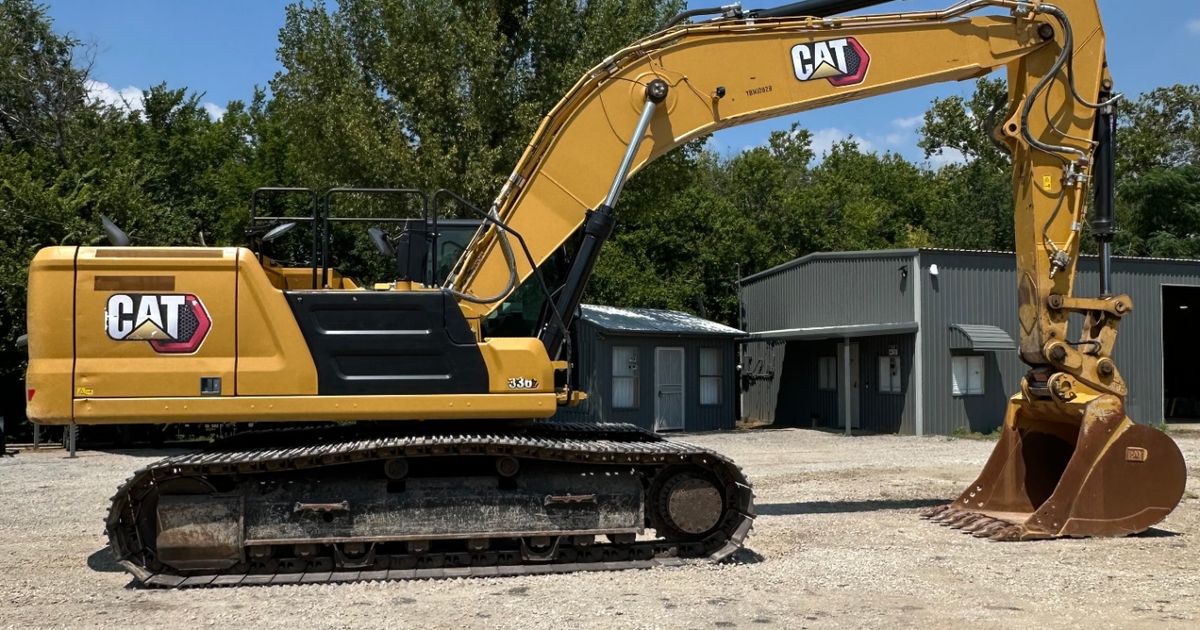
If you've run a project in Prosper, Celina, McKinney, or anywhere along the U.S. 380 corridor lately, you already know the moment. The excavator bucket drops, breaks through the topsoil and the familiar black gumbo clay, and then — nothing. The teeth skate across a pale, chalky layer that doesn't yield. That's caliche, and it stops more North Texas projects cold than any other subsurface condition we see come through our Denton yard.
We've watched contractors lose full days of production because they showed up with a standard bucket and no plan for what's underneath. We've also watched experienced crews move through the same material efficiently because they matched the right tool to the right machine before the first pass. The difference is preparation and equipment knowledge — both of which we're going to lay out here.
Key Takeaways
- Caliche in the DFW and North Texas corridor typically begins 4–8 feet below the surface and can reach compressive strengths exceeding 10,000 PSI, requiring hydraulic breakers rated at 800 ft-lbs or higher for efficient penetration.
- A CAT 320 excavator paired with a mid-class hydraulic breaker is the most common and cost-effective combination our customers use for utility trenching through caliche in cities like Prosper, Celina, and McKinney.
- Pre-soaking caliche with water 24–48 hours before breaking can reduce machine hours by 15–25% by softening the calcium carbonate cement matrix, particularly valuable on large commercial grading projects.
- Mismatching breaker size to carrier weight — running an oversized breaker on an underweight excavator — is the leading cause of premature hydraulic system damage we see returned to our Denton yard.
- North Texas summer heat above 100°F accelerates hydraulic fluid degradation during sustained breaker work; scheduling breaker operations in early morning hours can extend component life significantly.
What Exactly Is Caliche and Why Is It So Common in North Texas?
Caliche is a sedimentary rock layer formed when calcium carbonate leaches downward through soil and re-cements loose material — sand, gravel, clay — into a hardened mass. The U.S. Geological Survey identifies caliche as one of the dominant near-surface geologic features across the southern Great Plains, and North Texas sits squarely in that zone. The conditions that formed it — low annual rainfall relative to evaporation, alkaline soils, and centuries of calcium leaching — are textbook for our region.
What makes caliche particularly disruptive on modern North Texas job sites is its inconsistency. On a single residential development in Aubrey or Van Alstyne, one lot might have a 6-inch caliche layer at 5 feet that a good breaker clears in 20 minutes, while the adjacent lot has a 3-foot-thick hardpan at 4 feet that requires pre-drilling and sustained hydraulic breaking to get through. Compressive strength in local caliche ranges from roughly 1,500 PSI in soft, chalky zones to over 10,000 PSI in well-cemented layers that behave more like limestone than soil. You cannot look at the surface and predict what you'll find — that's what makes pre-project soil investigation worth every penny on larger contracts.
The USDA Natural Resources Conservation Service maintains county-level soil survey data for Denton, Collin, Tarrant, and surrounding counties that can give you a preliminary read on caliche depth and character before mobilizing equipment. It's not a substitute for a geotechnical report on large projects, but it's a free starting point that more contractors should be using.
What Equipment Works Best for Breaking Caliche in the DFW Area?
The hydraulic breaker is the workhorse of caliche demolition, and matching the breaker class to the carrier machine is where most mistakes happen. We rent breakers across three general classes from our Denton location, and the application drives the choice far more than budget.
For light caliche — soft, chalky material under 3,000 PSI — a compact excavator like the CAT 308 or CAT 315 with a small-class breaker handles utility trench work on residential lots efficiently. This combination works well in established neighborhoods in Frisco, Trophy Club, or Carrollton where lot access is tight and swing room is limited. The tradeoff is penetration rate: light breakers on soft caliche are fine, but if the material hardens with depth, you'll be swapping machines mid-project.
The CAT 320 excavator with a mid-class hydraulic breaker in the 800–1,200 ft-lb energy range is our most-rented caliche combination. It covers the widest range of North Texas subsurface conditions, handles the weight transfer needed to keep the breaker tool seated properly, and has enough hydraulic flow — typically 38–55 GPM in the CAT 320's breaker mode — to maintain consistent blow frequency without cavitating the pump. On commercial utility projects in Celina, Prosper, and McKinney where caliche depths and hardness vary lot to lot, the 320 gives operators the flexibility to adjust without switching carriers.
For severe caliche — thick layers over 18 inches with compressive strengths approaching limestone — a CAT 336 or larger carrying a heavy-class breaker rated above 2,000 ft-lb is the practical answer. We've seen highway and large commercial grading crews in the Waco and Weatherford corridors use this combination to maintain production on rock cuts that would stall smaller machines for hours. A CAT 336 operating a heavy breaker can fracture hard caliche at rates 40–60% faster than a mid-size machine struggling against the same material, according to production data tracked on comparable Texas road construction projects.
Beyond breakers, two other attachment types earn their place on North Texas caliche sites. Hydraulic rippers — single-shank attachments mounted in the excavator's coupler — are effective on medium-hardness caliche because they apply sustained downward force and prying action rather than impact energy. They're quieter, produce less vibration fatigue on the machine, and work well when you need to break material in areas sensitive to structure vibration, like residential infill projects in Denton or Sherman. Rock wheel cutters and drum cutters are increasingly popular on pipeline and drainage projects where a clean, consistent trench profile matters — they cut through caliche rather than fracturing it, leaving a more predictable trench wall that's easier to sheath and backfill.
How Should You Prepare a Caliche Site Before Breaking Starts?
Pre-soaking is the most underutilized productivity tool on North Texas caliche projects. Calcium carbonate — the cement that makes caliche hard — is weakly soluble in water. When you saturate a caliche layer 24–48 hours before breaking, you're softening the cement matrix enough to measurably reduce breaking resistance. Our customers who build pre-soaking into their project schedules consistently report 15–25% fewer machine hours per linear foot of trench compared to dry breaking on the same job site. That's a number worth building into your bid.
The practical challenge in North Texas is that our expansive black clay soils don't drain quickly, and saturation timing matters. Oversaturating on a slope creates mud that bogs equipment and creates OSHA 29 CFR 1926 Subpart P trenching hazard concerns with unstable trench walls. The goal is deep moisture penetration to the caliche layer, not surface saturation. Experienced operators use slow-drip methods or run water trucks the evening before a morning breaking shift for best results.
On large grading projects in fast-growing areas like Gunter, Anna, or Aubrey — where entire subdivisions are being rough-graded and caliche is encountered across broad areas — some contractors bring in contract drilling. A track-mounted rotary drill pre-drilling a grid of 3–4 inch relief holes through the caliche layer gives hydraulic breakers a fracture initiation point that dramatically increases production. It's an added mobilization cost, but on projects where caliche depth exceeds 18 inches and covers multiple acres, the math often favors it.
What Are the Biggest Mistakes Contractors Make Breaking Caliche in Texas Heat?
North Texas summers are brutal on hydraulic systems, and sustained breaker work in 100°F-plus ambient temperatures pushes fluid temps into ranges that accelerate seal degradation and pump wear. We see more hydraulic system damage returned on breaker rentals in July and August than any other time of year, and most of it is preventable.
The first mistake is running a breaker continuously without monitoring hydraulic fluid temperature. Most CAT excavators equipped with modern LINK technology will alert operators when fluid temps approach the 180–190°F warning threshold, but operators working under production pressure sometimes override or ignore those warnings. Sustained operation above 200°F degrades ISO VG 46 hydraulic fluid significantly faster than normal operating temps, shortening fluid life and accelerating component wear. The Society of Automotive Engineers has documented that hydraulic fluid viscosity drops by roughly 50% between 100°F and 200°F, directly impacting film strength and lubrication effectiveness.
The second mistake — and the most expensive one we see — is running an oversized breaker on an underweight carrier. A breaker generates recoil energy proportional to its blow energy. When the carrier is too light, that recoil transmits into the machine's boom, arm, and hydraulic cylinders rather than being absorbed by machine mass. We've seen CAT 308s returned with bent boom pins and cracked attachment brackets after contractors rented a mid-class breaker thinking bigger was better. Breaker manufacturers publish carrier weight ranges for a reason, and those ranges are the minimum starting point for North Texas conditions where hard caliche creates unpredictable resistance spikes.
Blank firing — running a hydraulic breaker with the tool not seated against material — is a third common error. When a breaker tool punches through a fracture point and enters open air, the machine absorbs the full unloaded impact through its hydraulic circuit. CAT recommends a maximum of 15–20 seconds of blank firing before repositioning, and most operator manuals for major breaker brands mirror that guidance. On fragmented caliche where voids open unpredictably, operators need to stay sharp about repositioning quickly after breakthrough.
How Do You Plan Caliche Disposal and Site Management?
Broken caliche has genuine value as a base material, and experienced North Texas contractors don't haul it off by default. Fractured caliche compacts well and meets TxDOT Item 247 flexible base specifications in many cases, making it usable as road base, parking lot sub-base, or driveway stabilization on the same project. On larger developments in Decatur, Gainesville, or Wichita Falls where haul distances to disposal sites are significant, reusing caliche on-site as base material can eliminate multiple dump truck loads and meaningfully reduce project cost.
For caliche that won't be reused, jaw crusher attachments on excavators are increasingly popular on larger North Texas grading and infrastructure projects. A crusher bucket or dedicated jaw crusher on a CAT 336 can process fractured caliche into sized base material in one pass, turning a disposal problem into a stockpile asset. The capital cost of crusher attachments is significant, but on a major subdivision development with tens of thousands of cubic yards of caliche to manage, the economics typically favor on-site processing over haul and disposal.
Which CAT Excavator and Breaker Combination Should I Rent for My North Texas Project?
The answer depends on three variables: caliche depth, layer thickness, and production rate requirement. For residential utility work — water, sewer, and gas service trenching at 5–8 feet in soft to medium caliche — a CAT 315 or CAT 320 with a mid-class breaker handles the work cleanly and fits on most residential lots. For commercial utility and site development in the active growth corridors from Frisco north through Celina and Gunter, the CAT 320 or CAT 323 with a mid-to-heavy breaker covers the widest range of what you'll encounter. For road construction, large drainage structures, or heavy commercial grading where caliche is thick and continuous, a CAT 336 with a heavy-class breaker is the correct starting point.
When our customers call us from active job sites in Mansfield, Crowley, or Irving because they've hit unexpected caliche, we ask three questions before recommending a swap: How thick is the layer, what's the production deadline, and what carrier is already on site? In many cases, adding the right breaker attachment to an excavator already on the job is faster and cheaper than mobilizing a larger machine — and we can often get a breaker delivered same day across our North Texas service area.
If your project is in the planning stage and you have any uncertainty about subsurface conditions, talk to a geotechnical engineer before finalizing your equipment budget. The American Society of Civil Engineers recommends subsurface investigation for all commercial and infrastructure projects as a standard practice, and in North Texas that recommendation is particularly relevant given the variability of caliche depth and hardness across short distances.
Our team at Benchmark Equipment in Denton has outfitted contractors across every corner of North Texas for caliche work — from tight residential lots in Trophy Club to wide-open commercial grading in Bowie and Wichita Falls. We know this ground, and we know which machines move through it efficiently. Call us at (817) 403-4334 before your next project hits that pale layer, and we'll make sure you're not the crew that lost a day to a material problem that the right attachment solves in hours.
Frequently Asked Questions
How deep is caliche typically found on North Texas construction sites?
Caliche in the DFW and North Texas corridor typically appears 4–8 feet below grade, though depth varies significantly by location and soil profile. In fast-developing areas along the U.S. 380 corridor — Prosper, Celina, Gunter — contractors regularly encounter caliche at 5–6 feet on residential lots. On some sites in Denton and Wise counties, caliche can begin as shallow as 3 feet or extend below 10 feet, which is why geotechnical investigation is valuable on larger commercial projects.
Can I use a standard excavator bucket to break through caliche?
A standard digging bucket will not effectively penetrate hard caliche — teeth will deflect or wear rapidly rather than fracturing the material. You need a hydraulic breaker, hydraulic ripper, or drum cutter attachment matched to the hardness of your specific caliche layer. Soft, chalky caliche under 3,000 PSI can sometimes be loosened with a heavy ripper tooth on a CAT 320 or larger machine, but medium-to-hard caliche requires a proper hydraulic breaker with blow energy matched to the carrier weight class.
How long does it take to break through a caliche layer with a hydraulic breaker?
Production rates vary significantly based on caliche hardness, layer thickness, machine size, and operator experience. As a general benchmark, a CAT 320 with a mid-class hydraulic breaker can advance through soft-to-medium caliche (under 5,000 PSI) at approximately 15–30 linear feet of trench per hour for an 18-inch-wide utility trench. Hard caliche approaching 10,000 PSI can reduce that rate to 5–10 feet per hour on the same machine. Pre-soaking the site 24–48 hours before breaking can improve production rates by 15–25% on medium-hardness caliche.
What is the compressive strength of caliche in North Texas?
North Texas caliche ranges widely in compressive strength — from approximately 1,500 PSI in soft, newly formed chalky zones to over 10,000 PSI in well-cemented, older caliche layers that behave similarly to limestone. The variability is significant even within a single project area. The USDA NRCS county soil surveys for Denton, Collin, and Tarrant counties provide baseline information on caliche character, but a geotechnical boring report gives you the specific compressive strength data needed for accurate equipment selection on large contracts.
Is broken caliche reusable as base material on Texas construction sites?
Fractured caliche is frequently reusable as road base, parking lot sub-base, or site fill material, and often meets TxDOT Item 247 flexible base specifications depending on gradation and composition. Before deciding to haul caliche off-site, contractors in North Texas should have a sample tested — reusing caliche on-site eliminates truck haul costs and landfill tipping fees that can add up quickly on large grading projects in areas like Decatur, Wichita Falls, or Gainesville. Crusher bucket attachments on large excavators can process fractured caliche into sized, usable base material in a single pass.