.png)
Key Takeaways for North Texas Earthmoving Projects
- Ground Conditions Rule: Articulated trucks perform 40% better in soft clay conditions due to lower ground pressure (8-12 PSI vs 15-20 PSI for rigid frames)
- Payload Capacity: Rigid frame trucks carry 30-50% more material per cycle, making them ideal for high-volume projects with stable haul roads
- Maneuverability Advantage: Articulated design allows 45-degree turning radius, critical for confined DFW urban construction sites
- Operating Costs: Rigid frames cost 15-20% less per ton-mile on established roads, while articulated units reduce tire replacement costs by 25% in soft conditions
- Regional Performance: Summer heat affects articulated hydraulic systems more, requiring enhanced cooling packages for Texas operations
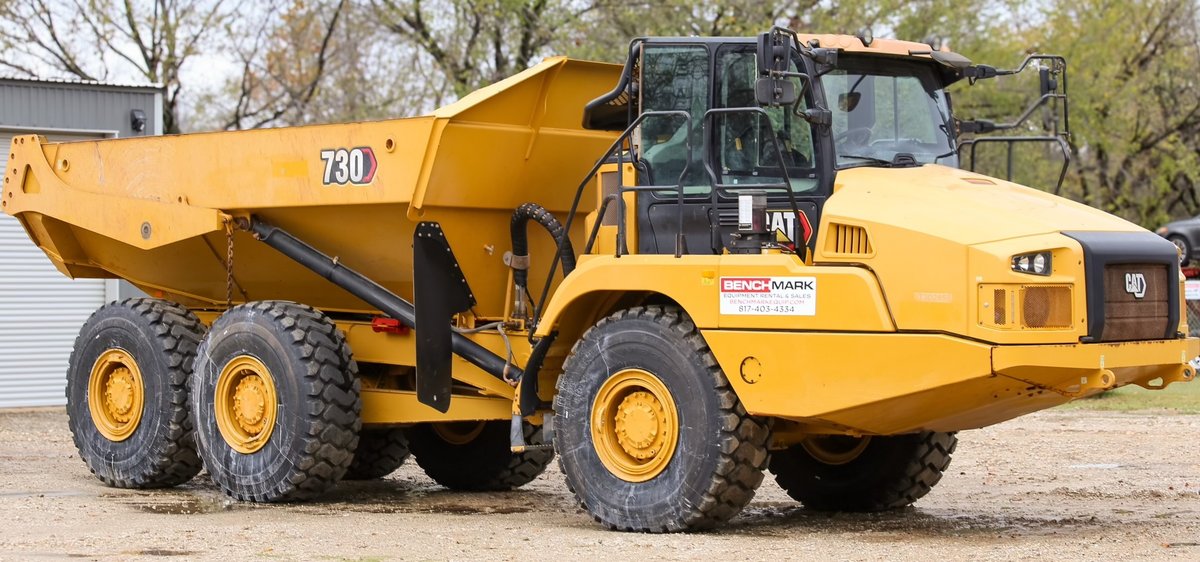
After managing hundreds of mass earthmoving projects across North Texas, we've learned that choosing between the CAT 730 off-road truck and rigid frame dump trucks isn't just about payload capacity—it's about matching equipment capabilities to specific site conditions. The expansive clay soils throughout Dallas, Fort Worth, Denton, and surrounding areas present unique challenges that significantly influence equipment selection.
Our customers frequently ask us which dump truck type will maximize their productivity while minimizing operating costs. The answer depends on multiple factors, from jobsite access and ground stability to haul distances and environmental considerations specific to Texas operations.
What Makes Ground Conditions the Primary Selection Factor?
Ground stability determines equipment selection more than any other factor in North Texas earthmoving operations. The region's notorious black gumbo clay creates conditions that can make or break project schedules, particularly during spring and fall moisture cycles.
Articulated dump trucks distribute their weight across six wheels instead of four, creating significantly lower ground pressure. In our experience operating across Collin, Denton, and Tarrant counties, this translates to continued productivity when rigid frame trucks would sink or struggle for traction. The typical ground pressure difference—8-12 PSI for articulated units versus 15-20 PSI for rigid frames—becomes critical when working in saturated clay conditions.
We've observed that articulated trucks can maintain haul speeds of 15-20 mph in soft conditions where rigid frames drop to 8-12 mph or require assistance. This performance advantage becomes particularly valuable during Texas spring seasons when unpredictable rainfall can transform jobsite conditions overnight.
The six-wheel drive system standard on most CAT articulated dump trucks provides superior traction compared to rear-wheel drive rigid frames. In caliche rock conditions common 4-8 feet below surface level throughout the DFW area, this traction advantage helps articulated units climb steep ramps and navigate uneven terrain more effectively.
When Do Rigid Frame Trucks Deliver Superior Economics?
Rigid frame dump trucks become the economical choice when jobsites feature stable ground conditions and established haul roads. Their higher payload capacity—typically 30-50% more than comparable articulated units—dramatically reduces the number of cycles required for large-volume earthmoving projects.
On major highway construction projects we've supported from McKinney to Arlington, rigid frame trucks excel when contractors can establish and maintain proper haul roads. A CAT 775G rigid frame truck carries approximately 41 tons compared to a CAT 730 off-road truck's 25-ton capacity. This payload difference translates to significant productivity gains on high-volume projects exceeding 10,000 cubic yards of material movement.
Operating costs favor rigid frames on established surfaces. Industry studies show rigid frames operate 15-20% more efficiently per ton-mile on stable haul roads. Their simpler mechanical systems typically require less maintenance, and parts costs run lower than articulated units' more complex hydraulic and drive systems.
We've tracked fuel consumption data showing rigid frames consume 10-15% less fuel per ton hauled on level, stable surfaces. However, this advantage disappears quickly in soft ground conditions where rigid frames struggle with traction and require more aggressive throttle inputs.
How Do Jobsite Constraints Influence Equipment Choice?
Urban construction throughout Dallas-Fort Worth presents unique spatial challenges that often favor articulated dump trucks despite payload disadvantages. The 45-degree turning radius typical of articulated units allows maneuvering in confined spaces where rigid frames simply cannot operate effectively.
We regularly deploy articulated trucks on residential development projects in Plano, Frisco, and similar suburban areas where narrow access roads and tight turning requirements eliminate rigid frame options. The articulated design's ability to negotiate sharp corners while maintaining stability proves essential in these applications.
Jobsite elevation changes also influence selection. Articulated trucks handle steep grades more effectively due to their weight distribution and traction advantages. On projects with sustained grades exceeding 8-10%, we typically recommend articulated units to maintain consistent cycle times and reduce wear on equipment.
Bridge weight restrictions increasingly common on Texas roads factor into equipment selection. Articulated trucks' lower axle weights often allow operation on structures where rigid frames exceed legal limits, providing access to jobsites otherwise requiring smaller, less productive equipment.
What Are the Maintenance and Operating Differences?
Maintenance requirements differ significantly between articulated and rigid frame dump trucks, with implications for long-term operating costs and equipment availability. Our service experience across North Texas reveals distinct patterns that influence total cost of ownership.
Articulated trucks' hydraulic systems require more frequent service intervals, particularly in Texas summer heat exceeding 100°F. The additional hydraulic cooling systems, steering circuits, and oscillation joints create more maintenance points compared to rigid frames' simpler mechanical systems. We typically budget 15-20% higher maintenance costs for articulated units over their service life.
However, tire costs often favor articulated trucks in soft ground applications. The even weight distribution reduces tire wear rates, and we've documented 25% longer tire life in clay soil conditions. This advantage can offset higher hydraulic system maintenance costs on projects with significant soft ground exposure.
Rigid frames excel in maintenance simplicity. Their conventional truck-based systems use readily available components, and service intervals typically extend longer than articulated units. OSHA 1926.601 standards apply equally to both types, but rigid frames' simpler systems often make compliance verification more straightforward.
How Do Environmental Factors Affect Performance in Texas?
Texas operating conditions present unique challenges for both dump truck types. Summer temperatures regularly exceeding 100°F stress cooling systems, while occasional winter freezes affect hydraulic performance and ground conditions.
Articulated trucks' additional hydraulic systems generate more heat, requiring enhanced cooling packages for reliable Texas operation. We specify transmission oil coolers and hydraulic oil coolers as standard equipment for our North Texas rental fleet. The investment in cooling capacity prevents the productivity losses we've observed during peak summer months.
Freeze-thaw cycles affect the region's clay soils dramatically. During rare freeze events, typically 2-3 times per winter, ground conditions can shift from soft clay to concrete-hard surfaces within hours. This variability favors articulated trucks' adaptability over rigid frames' optimization for specific surface types.
Dust control becomes critical during dry periods common in North Texas summers. Both truck types benefit from water spray systems, but articulated units' enclosed cab designs typically provide better operator protection from dust and debris common in earthmoving operations.
What Production Rates Can You Expect in North Texas Applications?
Production calculations must account for regional soil conditions and typical haul distances in North Texas earthmoving projects. Our operational data from projects across the DFW metroplex provides realistic productivity expectations for both equipment types.
In ideal conditions with stable haul roads and 1-mile average haul distances, rigid frame trucks typically achieve 20-25% higher daily production due to their payload advantage. A CAT 775G can move 400-500 tons per day compared to a CAT 740B's 320-400 tons in similar applications.
However, production rates converge quickly in challenging ground conditions. We've tracked projects where articulated trucks matched or exceeded rigid frame productivity when soft clay conditions reduced rigid frame operating speeds or required recovery assistance.
Construction industry data suggests articulated trucks maintain more consistent production rates across varying conditions, while rigid frames show higher peak performance but greater variability based on surface conditions.
How Do Operating Costs Compare Over Project Lifecycles?
Total operating cost analysis requires considering multiple factors beyond hourly rental rates. Our cost tracking across numerous North Texas projects reveals distinct patterns that influence equipment selection decisions.
Rigid frame trucks deliver lower per-ton hauling costs on projects with established infrastructure and stable ground conditions. The combination of higher payload capacity and lower fuel consumption per ton creates a 15-20% cost advantage in optimal applications.
Articulated trucks prove more economical when ground conditions limit rigid frame productivity. Soft soil applications where rigid frames require assistance or operate at reduced speeds quickly eliminate their per-ton cost advantages. We've documented cases where articulated trucks achieved 25-30% lower total project costs despite higher hourly rates.
Tire replacement costs significantly impact operating economics. In abrasive caliche conditions common throughout North Texas, rigid frames' higher ground pressure accelerates tire wear. Conversely, articulated trucks' weight distribution extends tire life, particularly valuable on long-duration earthmoving projects.
What Specific Applications Favor Each Truck Type?
Project-specific requirements ultimately determine optimal equipment selection. Our experience supporting diverse North Texas construction projects has identified clear application patterns for each truck type.
Choose articulated dump trucks for:
Residential development projects in areas like Allen, McKinney, and Prosper where confined spaces and soft clay subsoils require maneuverability and flotation. The ability to navigate tight corners while maintaining productivity in unstable ground conditions makes articulated units essential.
Pipeline and utility installation across rural North Texas where projects encounter varying soil conditions and limited access. The versatility to perform effectively across different terrain types reduces the need for multiple equipment types.
Landfill operations where soft waste surfaces and steep working slopes favor articulated trucks' traction and stability advantages. We've observed consistent productivity in applications where rigid frames struggle.
Select rigid frame trucks for:
Highway construction projects with established haul roads and stable base materials. Major projects like highway expansions through Dallas and Fort Worth benefit from rigid frames' high-capacity hauling capabilities.
Large-scale commercial development where volume requirements exceed 15,000-20,000 cubic yards and contractors can establish proper haul road infrastructure. The payload advantage justifies the infrastructure investment.
Quarry and aggregate operations with established internal road networks and stable operating surfaces. The higher payload capacity maximizes productivity in repetitive hauling applications.
How Should You Structure Equipment Rental Decisions?
Making optimal equipment rental decisions requires analyzing multiple project factors before committing to either articulated or rigid frame dump trucks. Our rental consultation process helps contractors avoid costly equipment mismatches.
Begin with soil condition assessment. ASTM D1586 soil sampling provides objective data on bearing capacity and moisture sensitivity. Projects with bearing capacities below 2,000 PSF typically favor articulated equipment regardless of hauling volume.
Evaluate haul road development costs against equipment productivity differences. Investing in proper haul road construction may justify rigid frame selection on high-volume projects, while smaller projects benefit from articulated trucks' ability to operate without road improvements.
Consider project duration and seasonal timing. North Texas projects spanning multiple seasons encounter varying ground conditions that may favor articulated trucks' adaptability over rigid frames' optimized performance in specific conditions.
At Benchmark Equipment, we help contractors analyze these factors during our rental consultation process. Our experience with both equipment types across diverse North Texas applications ensures you get the right equipment for your specific project requirements.
Whether you're moving 5,000 cubic yards on a tight residential site in Carrollton or handling 50,000 cubic yards on a major commercial development in Arlington, we'll help you select the dump truck type that maximizes productivity while controlling costs. Give us a call at (817) 403-4334 to discuss your specific earthmoving requirements and get expert equipment recommendations based on your project's unique conditions.
Frequently Asked Questions
What's the main difference between articulated and rigid frame dump trucks?
Articulated trucks have a flexible joint between the cab and dump body with six-wheel drive, while rigid frames are one-piece units with four-wheel drive. This gives articulated trucks better flotation in soft ground but rigid frames higher payload capacity.
Which dump truck type works better in North Texas clay soils?
Articulated dump trucks perform significantly better in North Texas black gumbo clay due to lower ground pressure (8-12 PSI vs 15-20 PSI) and superior traction from six-wheel drive systems.
Are rigid frame trucks more economical than articulated trucks?
Rigid frames cost 15-20% less per ton-mile on stable surfaces due to higher payload capacity and simpler maintenance. However, articulated trucks can be more economical in soft ground conditions where rigid frames struggle.
How do I choose between articulated and rigid frame for my project?
Consider ground conditions first, then payload requirements and jobsite constraints. Soft soils and tight spaces favor articulated trucks, while stable ground and high-volume hauling favor rigid frames.
What maintenance differences exist between the two truck types?
Articulated trucks require 15-20% higher maintenance costs due to complex hydraulic systems, but often achieve 25% longer tire life in soft conditions. Rigid frames have simpler systems but higher tire wear on unstable ground.